
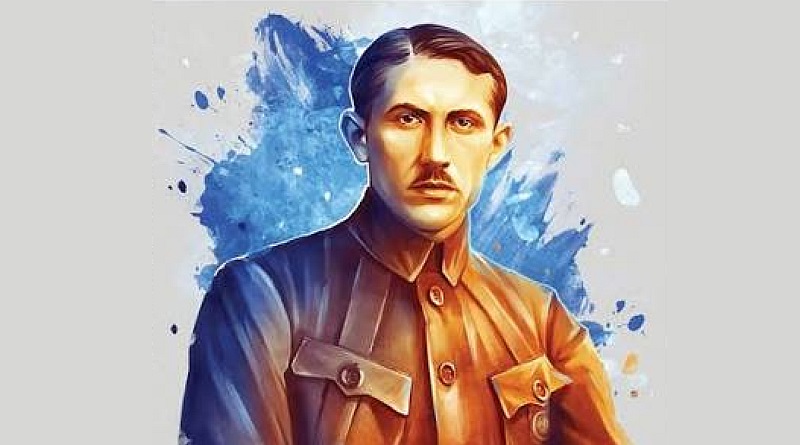

The Ukrainian liberation movement repeatedly changed its forms and methods of struggle, adapting to new circumstances. The ability to reformat without losing its main goal was largely based on the experience of Yevhen Konovalets — a man who, after the fall of the Ukrainian People’s Republic, not only preserved the movement but also gave it new meaning.
Imagining the history of 20th-century Ukraine without Yevhen Konovalets is difficult. His role in developing the liberation movement, which more than half a century after his death finally achieved its goal, was undoubtedly decisive.
A native of Lviv, he arrived in Kyiv in September 1917 after Russian captivity, which he fell into as a soldier of the Austro-Hungarian army. The Ukrainian revolution provided Konovalets with an opportunity that he fully utilized — to become one of the brightest leaders of a generation of fighters for independence.
In Kyiv, he created and led one of the most combat-ready units of the Ukrainian People’s Republic Army. Despite the prevailing beliefs at the time about the unnecessary nature of a regular army, he formed one. Despite increasing anarchy, he introduced strict discipline.
The Sich Riflemen and their 27-year-old commander played a decisive role in the most critical moments of the revolution — from suppressing the Bolshevik uprising in Kyiv in January 1918 to the Battle of Motovylivka. Yet, Konovalets did not use his gained authority in political disputes.
He was primarily a soldier — a man capable of professionally executing orders and defending independence with arms. However, neither he nor other Ukrainian military figures fully realized their potential: Ukrainian statehood fell to a large extent due to political infighting.
The defeat of 1921 was a shock for many Ukrainian politicians from which they never recovered. Many became emigrant figures, disconnected from Ukrainian realities and dependent on the support of foreign states. For Konovalets, the defeat was not the end but a catalyst for action.
At thirty, he led the underground Ukrainian Military Organization, which continued the fight under the slogan “The war is not over.” The emergence of the UVO demonstrated that the independence movement had entered a new stage of development and overcame the crisis of defeat.
Without Konovalets, the Ukrainian liberation movement could have long remained a hostage of memories of a heroic past and lost the ability to respond to contemporary challenges. The political elite that mobilized Ukrainians to fight for statehood squandered the most favorable moment for its acquisition. For the first time in several centuries, Ukrainians had a chance to realize their state ambitions and lost it, while Poles, Finns, Czechs, and the Baltic peoples seized the historical opportunity.
Gathering strength to continue the struggle, formulating new goals and creating a new format for the movement — this became the main task for the next generation. It had to be done in conditions of societal disillusionment and the absence of authoritative and untainted leaders. Konovalets coped with this challenge.
At 38, his authority and organizational talent became the foundation for creating the Organization of Ukrainian Nationalists. Founded in 1929, the OUN, which united Galicians and Dnieper Ukrainians, became, without exaggeration, the most successful political project of Ukrainians in the 20th century and radically changed the course of our history.
This is why the assassination of Yevhen Konovalets by an NKVD agent in 1938 was a painful loss. But it could no longer stop the processes he initiated.
Konovalets became a leader in the most challenging transitional moment for any movement — when it was necessary to abandon familiar but ineffective methods, seek new forms of struggle, and prepare to pass the initiative to the younger generation.
He brilliantly fulfilled his mission. The underground struggle not only preserved the liberation movement but also laid the foundation for its transformation into a large-scale insurgent competition during World War II. Roman Shukhevych, Stepan Bandera, and other young figures who went through the UVO school in the 1920s soon became leaders of the next stage of the struggle.
The principles laid down by Konovalets in the early 1920s determined the development of the Ukrainian liberation movement over the next three decades. And even when by the late 1950s the phase of armed underground struggle was exhausted, this did not mean the end of the confrontation.
The struggle acquired new forms: initially — the intellectual resistance movement of the 1950s–1980s, and later — the mass national-democratic movement of the late 1980s to early 1990s.
By that time, there was already a historical precedent for successfully reformulating the liberation movement according to new conditions.
Poster: Mykhailo Dyachenko/UINP
