
Anne Applebaum, The Atlantic / Translation by iPress
Renowned publicist and journalist Anne Applebaum, in an article for The Atlantic, convincingly refutes the prevailing narrative about Ukraine’s inevitable defeat. Thanks to a technological breakthrough – network situational awareness, interceptor drones, and long-range strike systems – Ukrainian forces have effectively frozen the frontline and disable tens of thousands of enemy soldiers every month. Meanwhile, Ukrainian long-range drones systematically destroy Russia’s oil refining and logistics infrastructure, reducing its combat potential. On the diplomatic front, Ukraine is transforming from a war victim into a desirable partner: Gulf state leaders are eager to acquire Ukrainian drone warfare technologies, as this experience is most relevant to their own threats. Applebaum suggests that even without a formal peace treaty, the frontline could gradually become a de facto border – akin to the demilitarized zone between the two Koreas, marking a strategic defeat for Putin, who sought to destroy Ukraine as a state.
“In a field outside Kyiv last weekend, a van stood inconspicuously hidden behind trees. Inside, there were no passenger seats: only a long table, two office chairs, two laptops, additional monitors. Despite its unimpressive appearance, it was a mobile drone interception point – one of hundreds of such vehicles now scattered throughout Ukraine. And it’s part of something much larger: a complex of technological achievements that have changed this war with Russia, and perhaps all future wars – forever,” Anne Applebaum writes in the article for The Atlantic.
As the author notes, on one of the laptops, a soldier showed her an aerial view of a section of Ukrainian rural terrain over 160 kilometers away. His task is to recognize objects in the air: to distinguish birds and bats from combat Russian drones. Upon spotting the latter, the soldier on the adjacent laptop directs the interceptor – a small drone resembling a miniature missile, to track and destroy enemy aerial targets before they hit their objectives.
At first glance, Anne Applebaum notes, the images on the screens seem simple – like in a video game. But this is not a primitive operation. The interceptor drones with artificial intelligence have become possible thanks to a complex network of radar systems, acoustic sensors, and other tools that hundreds of large and small Ukrainian tech companies develop and improve daily, using data directly from such soldiers.
Applebaum emphasizes that almost none of these companies existed four years ago. They emerged from a technically skilled civil society whose members changed professions or redirected efforts to help defend their country. She recounts meeting leaders of Ukrainian defense companies from the financial sector, architecture, and politics. Last weekend she met another – he had returned from the front line that very day. He shared that he finds it useful to learn how soldiers use his products and how they can be improved.
As the author notes, this constantly evolving information system is connected to other units throughout the country – and not just in vans. Last year, Applebaum visited an underground room in Ukraine, where dozens of people on a series of screens were monitoring hundreds of kilometers of the front line. Ukrainian defense analyst Andriy Zagorodnyuk calls this system of drones, monitors, AI-based navigation, battle-tested robots, and interconnected soldiers “network situational awareness” – and it is this system that explains why perceptions of this war suddenly changed.
Anne Applebaum is convinced that Ukrainian military technologies have rapidly evolved since the early years of the war. But only now are foreign observers – in Europe, the USA, the Gulf countries, and of course in Russia – beginning to understand what this evolution means. Since 2022, many public discussions about the war, even in Europe and the USA, have reproduced the narrative promoted by Russian propaganda, tacitly assuming that Ukraine, being outnumbered and outgunned, would eventually lose. Assistance to Ukraine was seen as merely postponing disaster, nothing more. When the Trump administration stopped supplying Kyiv with military and financial aid in 2025, some in Washington expected – or perhaps even hoped – that the end would come swiftly.
Instead, Applebaum points out, Europe provided money. Ukrainian society created network situational awareness. And when at the end of March, Ukrainian President Volodymyr Zelensky made a tour of the Gulf countries and signed a series of security agreements, something changed in international perception. The leaders of Qatar, the United Arab Emirates, and Saudi Arabia spoke with Ukraine not out of sympathy for a war victim, but because they wanted to acquire interceptor drones. Iranians use the same drone technologies as the Russians, and Ukrainians know best how to combat them.
And not only the Gulf leaders: suddenly, many realized that the Russian narrative was false. Ukrainians are not losing. The Russians are not winning and, more importantly, do not know how to win. Ukrainians and external analysts, Applebaum notes, describe this dynamic in three main dimensions of the war.
Ground War
If in the past two years the main storyline was Russia’s slow, exhausting advance, this year the picture is quite different. Since the beginning of spring, with the start of the annual offensive, Russia has lost more territory in Ukraine than it has gained. It is now difficult to comprehend how the Russian army can move forward, as the front line is not really a line but a wide no-man’s-land about 32 kilometers wide. Everything in this zone is visible from drones, so any Russian truck, tank, or infantryman attempting to attack new Ukrainian positions is immediately detected and easily targeted. Since Russian commanders continue to attack nevertheless, Ukrainians kill and wound thousands of enemy soldiers every month—perhaps up to 30,000. They say their goal is to disable more Russians than can be mobilized as replacements, and they seem close to achieving it.
Long-Range War
Although the Russians are unable to shift the front line, they can still use drones and missiles to kill civilians and destroy civil infrastructure in Ukrainian cities, as happened again last week. Putin’s appetite for such strikes is growing because he has no other practical way to harm Ukraine. He also knows that the Ukrainians lack air defense systems to intercept ballistic missiles, even if most drones can now be shot down. Ukraine still largely relies on air defense systems from the US, especially on munitions for Patriot batteries. A European fund has been created for the purchase of these interceptor missiles, although some analysts fear there simply might not be enough for purchase. According to Zelensky, during the first three days of the American-Iranian conflict, more Patriot missiles were used than in the entire Russian-Ukrainian war.
However, notes Anne Applebaum, Putin does not acknowledge that his side is also depleting its air defense resources. This has allowed Ukrainian long-range drones to more successfully target Russia’s oil and gas infrastructure—with spectacular explosions and a reduction in refining capacity by at least 20 percent. Almost all major refineries in central Russia have halted or reduced production, and some have been hit more than once.
With the same regularity, a new wave of Ukrainian drones with a range of 160 kilometers strikes ammunition depots, logistics centers, and supply chains deep in the rear of Russian-occupied territories. These strikes are less spectacular than those deep within Russia itself but have already caused a critical fuel shortage on the Crimean Peninsula and complicate the supply of Russian troops fighting in the East and South.
Psychological Warfare
Over the course of four years, writes Anne Applebaum, the Kremlin repeatedly assured Russian society that the war was progressing successfully, that Ukraine as a real country did not exist, and that victory was inevitable. But this is hard to reconcile with the panic that gripped Moscow last month when the annual military parade was shortened due to fears of it being interrupted by Ukrainian drones. Nor does it align with the spectacular plumes of black smoke last Wednesday morning after Ukrainian drones struck a local oil refinery on the first day of the annual St. Petersburg Economic Forum. Former military intelligence chief Kyrylo Budanov, now the head of the Office of the President of Ukraine, told Applebaum that there is much evidence that Russians are finally beginning to realize the falsehood of state propaganda: “They don’t understand why they must continue to fight and why they are now being hit, as they were told they would win and Ukraine is nothing.”
However, the author emphasizes, not everyone believes this means a quick end to the war. A young woman, a Ukrainian civil servant, told Applebaum last weekend that she and her friends have already given up the idea of ever living in a “normal” country, as the war will go on forever. She recalled a flight she and her friends took to Barcelona before the war: “That beautiful life will never return.”
Nonetheless, Anne Applebaum notes that there are signs some people in Moscow are already preparing for the end of the war. Recently, documents leaked from the office of Sergey Kiriyenko, a former Russian prime minister and now one of the highest officials in Putin’s administration. The slides describe a plan to present the end of the war to the country: declare victory, portray the Russian army as “the most capable in the world,” present minor territorial gains as a grand success, claim that Europe has suffered a devastating economic blow from which it will not recover, and that Ukraine will soon collapse. Budanov believes that the Kremlin’s decision to shut down Telegram, the most popular social network in Russia, was a preemptive step aimed at preparing the ground for such a change in narrative: “so that at the right moment, there is only one official position—and nothing more.”
Budanov also continues to believe that negotiations initiated by the Trump administration could lead to a ceasefire along the current front line this year. “And then we will begin to resolve our other issues,” he noted. On Thursday, Zelensky sent Putin a letter proposing exactly this: an immediate ceasefire and direct negotiations between the two leaders. Putin publicly rejected this idea, stating that he sees “no point” in a meeting.
According to Anne Applebaum, Russia retains other options. Putin, who has never recognized Ukraine as a legitimate state and Zelensky as its lawful president, may continue to bombard Ukrainian cities, hoping to destroy the power grid and make the country uninhabitable. He might declare a mass mobilization and continue attempting to overcome Ukrainian defense at the cost of thousands of lives. Some fear he might use this moment to expand the conflict and attack a NATO country—possibly to test America’s readiness to defend its allies. A Latvian general said this week that even if Russian drones cannot win in Ukraine, they are ahead of NATO’s air defenses, which have not yet caught up with rapidly advancing technology.
Even without negotiations, emphasizes Anne Applebaum, Russia and Ukraine might move toward a new status quo. The transparent frontline, now 32 kilometers wide, could soon stretch to 48 or even 64 kilometers as drone technology develops. Sooner or later, the frontline will transform not just into a neutral strip but into a de facto demilitarized zone—similar to the one dividing the two Koreas; it will be regularly patrolled and maintained by drones.
After this, it could become a border—a temporary border that neither side recognizes, but still a border: not much different from a river or a mountain range, insurmountable and difficult to pass. For Ukraine, it will not be an indisputable victory, Anne Applebaum emphasizes, but for Putin, it will be a significant defeat: his main goal—to destroy all of Ukraine, to erase it from the map—will not be realized.
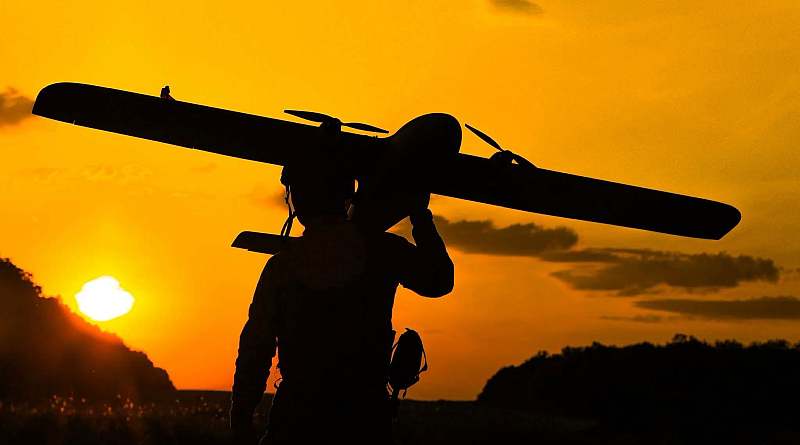
Photo: 22nd Separate Mechanized Brigade
