

Information on current losses of the Russian Federation due to sanctions as of 08.06.2026.
1. On the night of June 8, drones attacked one of Russia’s key oil facilities on the Black Sea — the Grushova transshipment complex near Novorossiysk.
– According to local residents, at least 50 explosions were heard during the attack. A fire then broke out on the Grushova industrial site.
– The Grushova Balka oil storage is one of the largest tank complexes in southern Russia and operates in conjunction with the Sheskharis terminal, owned by Chernomortransneft. This hub is used for storing and transshipping significant volumes of oil and petroleum products that are sent to Black Sea ports for further export.
– The Sheskharis complex is considered one of the most important elements of Russia’s oil export infrastructure. It handles shipments of raw materials from different regions of the country to foreign markets, making it strategically important for the energy sector and for Russian budgetary revenues.
2. Russia will reduce oil exports due to a drop in production and refining problems.
– Russia is preparing to significantly reduce crude oil exports in June amid declining production and the need to increase refinery throughput to meet domestic fuel demand.
– According to preliminary estimates, oil shipments through key ports of Primorsk, Ust-Luga, and Novorossiysk may decrease to 1.7 million barrels per day from 2.5 million barrels in May. This could lead to export volumes falling by almost a third.
– One of the reasons is the further decline in oil production. In May, production could have decreased by about 100,000 barrels per day following a sharp drop in April. At that time, losses were estimated at 300–400 thousand barrels per day compared to the average figures at the beginning of the year, marking the biggest decline since the 2020 pandemic.
– The situation has worsened due to Ukrainian strikes on Russian oil infrastructure. Drone attacks on ports, pipelines, and refineries since March have caused disruptions in the industry and reduced processing volumes.
– In April, due to infrastructure damage, Russia was already forced to cut oil production. Now, after repairs, the Kremlin is trying to increase refinery loadings to avoid reported fuel shortages in some regions.
– However, due to insufficient production volumes, additional oil for processing will have to be redirected from export supplies.
3. Russians continue to actively withdraw money from the banking system.
– In May, the cash circulation increased by 381.2 billion rubles, a record for this month since statistics began in 1995. This trend has been continuing for several months.
– In April, the cash volume in the economy increased by 678.7 billion rubles, and in March by another 301.1 billion. Since the beginning of 2026, the amount of cash outside banks has increased by 1.09 trillion rubles.
– The last time such large-scale outflows were observed was only during the pandemic. The growing demand for cash indicates increased distrust in the financial system and rising economic uncertainty.
– The population and businesses seek immediate access to money amid worsening economic conditions, high inflation, and risks of new upheavals. Additional factors include regular disruptions of mobile communications and the internet in Russian regions, leading to problems with cashless payments and access to online banking.
– Under such conditions, citizens attempt to create cash reserves. The increase in cash transactions may indicate the gradual shift of some small and medium-sized businesses into the shadow economy.
– Enterprises facing rising tax burdens, declining demand, and lack of financing increasingly seek ways to operate outside official control.
4. Russia plans to more actively use so-called “legal warfare” against Western states, turning international courts and legal mechanisms into instruments of political pressure. This is stated in the new report by the Bureau for the Protection of the Constitution of Latvia (SAB).
– According to Latvian intelligence, Moscow intends to systematically use court proceedings, international law, and legal procedures to weaken the positions of Western countries, influence political decisions, and create additional pressure tools on EU and NATO governments.
– The report notes that Russian authorities view legal mechanisms not only as a propaganda tool but also as a practical means to achieve foreign policy goals. In particular, legal arguments may be used to justify further aggressive policies and confrontation with the West.
– One direction of such a campaign could be lawsuits against the Baltic countries. According to SAB, Russia is preparing to approach the International Court of Justice, accusing Latvia, Lithuania, and Estonia of alleged discrimination against the Russian-speaking population.
– Latvian intelligence claims that relevant materials have already been prepared and could be submitted soon. SAB emphasizes that claims about “oppression of Russian speakers” have long been a key element of Russian propaganda. Now, the Kremlin is attempting to translate these narratives into specific legal actions, using international institutions to promote its political interests.
– The report also states that Moscow is attempting to coordinate such actions with other friendly regimes and is studying Iran’s experience in using international judicial mechanisms in confrontation with Western countries.
5. India has increased its purchases of Russian oil, taking advantage of the easing of sanctions pressure and disruptions in the global oil market.
– In May 2026, the import of Russian oil to India averaged 1.76 million barrels per day, which is 63% more compared to February. The increase in supplies occurred against the backdrop of the easing of certain American restrictions on Russian oil.
– Washington expects that additional volumes of raw materials on the market will help contain the rise in global energy prices and reduce the consequences of instability around the Strait of Hormuz.
– Despite Western sanctions, India remains one of the largest buyers of Russian oil. After the start of the full-scale war against Ukraine, Russian companies were forced to reorient exports from the European market to the Asian direction, primarily to India and China.
– At the same time, dependence on a few large buyers increases the vulnerability of the Russian oil sector. A significant part of the supplies is carried out with discounts, and Moscow is increasingly dependent on the political decisions and economic interests of Asian partners. Moreover, even increasing the physical volumes of exports does not guarantee a proportional increase in the revenues of the Russian budget.
– As a result of the first five months of 2026, oil and gas revenues of the Russian federal budget decreased by approximately 30%, indicating the continued serious pressure on the country’s public finances.
6. The district court of Ystad, Sweden allowed the transfer of the cargo ship Caffa to Ukraine, which is suspected of illegally exporting grain from Russian-occupied Ukrainian territories.
– The ship was detained by Swedish police and coast guard in March 2026 in the Baltic Sea off the southern coast of the country. Grounds for arrest were violations of navigation rules, use of a false flag, and unsatisfactory technical condition of the ship, rendering it unfit for safe operation.
– The Swedish court recognized the detention as legal and ruled that the ship could be transferred to Ukraine. According to prosecutor Håkan Larsson, the decision confirmed the legality of the arrest and paved the way for the transfer of the cargo ship to the Ukrainian side. Ukrainian law enforcement suspects that Caffa was used for transporting grain removed from temporarily occupied territories of Ukraine.
– Since the beginning of the full-scale invasion, Russia has repeatedly been accused of illegally exporting Ukrainian agricultural products through the ports of occupied Crimea and captured areas in southern Ukraine.
– The decision of the Swedish court may become an important precedent in cases related to the illegal export of Ukrainian resources from occupied territories.
7. The European Union is intensifying control over the transportation of Russian oil.
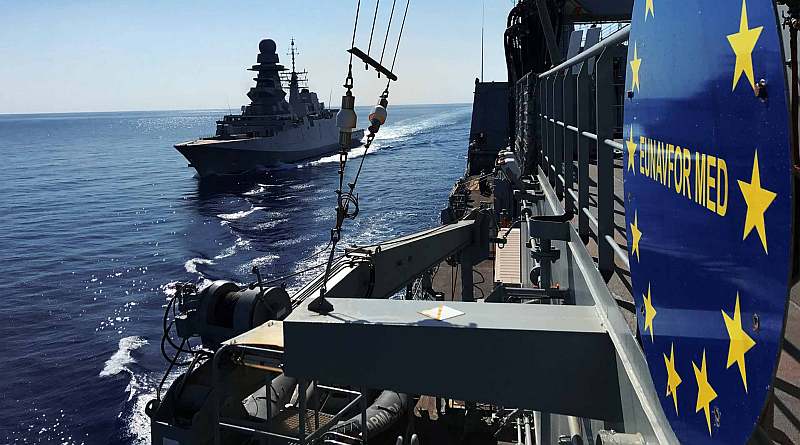
– The ships of the EU naval operation IRINI have been granted the right to detain foreign tankers in the Mediterranean Sea that may be involved in transporting Russian oil in circumvention of sanctions. This was announced by the head of European diplomacy, Kaja Kallas, before the meeting of EU defense ministers.
– According to her, the rules for the use of force and resources for operation IRINI have been amended, allowing European military personnel to detain suspicious vessels. The new powers are designed to strengthen the fight against sanction evasion schemes and the use of the so-called “shadow fleet,” which Russia uses to continue exporting oil to world markets.
– Operation IRINI has been active in the Mediterranean Sea since 2020. Initially, its main task was to monitor compliance with the arms embargo to Libya, but now its functions are expanding to include sanction control.
– The EU decision is another step in increasing pressure on Russian oil exports, which remain one of the main sources of funding for the Russian economy and the war against Ukraine. Following the introduction of the 20th package of sanctions, the European Union has already expanded restrictions on vessels, companies, and intermediaries involved in transporting Russian oil.
– In recent months, Western countries have increasingly tried to limit the activities of Russia’s “shadow fleet” — a network of tankers that often operate under convenient flags, use opaque ownership schemes, and help Moscow circumvent international sanctions.
– Granting military ships the right to detain suspicious vessels could significantly complicate the operation of such schemes and create additional risks for the export of Russian oil through international maritime routes.
Photo: EUNAVFOR MED IRINI
