
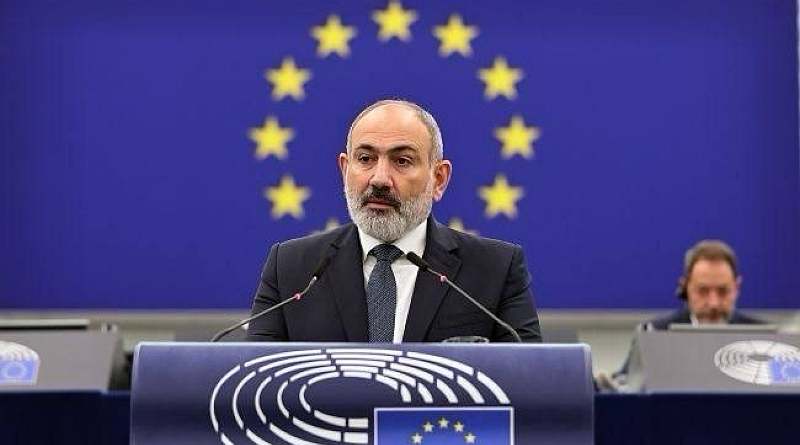

Armenian Prime Minister Nikol Pashinyan officially confirmed that his country is firmly on the path to the EU. Yerevan has declared its readiness to conduct deep reforms to meet the Euro-criteria, and this is not just a diplomatic maneuver, but the final step in the long history of parting with the Russian imperial project.
Today, we are witnessing a historic shift, driven not by whim, but by harsh reality.
Moscow has built its regional policy on the principle of “security in exchange for loyalty” for decades. However, events in Nagorno-Karabakh, where Russian “peacekeepers” effectively sanctioned the exodus of 120,000 Armenians, became a point of no return. As noted by the publication Le Courrier d’Erevan, Moscow not only withdrew – it betrayed its ally.
The war against Ukraine finally destroyed Russia’s reputation as a “constructive center of power.” Now, the Kremlin is perceived not as a guarantor of stability, but as a toxic aggressor dragging its “partners” into the depths of international isolation.
Pashinyan’s international strategy is simple and pragmatic: to lead the country into the European legal and value field while economic realities allow. Yerevan cannot abruptly sever ties with the EAEU, as exports and energy dependency are still critical. However, the prime minister makes it clear: EAEU membership for Armenia is just a temporary economic tool, without any ideological or political framework. Armenia intends to use the Eurasian market’s benefits to accumulate the resources necessary for transitioning to EU standards.
The Eurasian Economic Union model has never become a viable alternative to Western associations. It is a “club of dictators,” where rules change to suit the interests of one player, namely Russia. While Brussels allocates hundreds of millions of euros for modernizing Armenia’s state institutions, Moscow only threatens with sanctions and increases gas prices.
It is now entirely evident that Eurasian integration is living its last days. It lacks inspiration, values, and, importantly, trust. Kazakhstan, Kyrgyzstan, and Armenia increasingly seek diversification paths, turning the EAEU into an empty formality.
Moscow has destroyed its own authority with its grasping hands. The helplessness of the CSTO and the cynical disregard for Armenia’s interests in favor of deals with Baku and Ankara have shown that the “Russian umbrella” is akin to a leaky sieve.
Armenian society, actively discussing on social networks and platforms like Azatutyun the necessity of the European trajectory, is no longer afraid of shouts from the Kremlin. For Yerevan, the path to the EU is a matter of survival as a sovereign democracy.
Pashinyan voiced what was long understood in Yerevan: it is impossible to build a modern state while being tied to an archaic and aggressive empire. Armenia chooses law over force, market over corrupt schemes, and Europe over the “Russian world.” Brussels is ready to accept those who share its values, while Moscow can only watch as its influence in the Caucasus turns to dust.
