
Éanna Mackey, CEPA / Translation by iPress
Irish journalist Éanna Mackey explains how the country’s fuel crisis in April 2025 served as a vivid example of how a local economic protest can instantly escalate into a nationwide upheaval. The combination of heavy tax burdens on fuel, geopolitical instability, and accumulated public discontent led to blockades, fuel shortages, and ultimately, multi-million concessions from the government. The crisis exposed a deep rift between the authorities and the citizens who are concerned about the cost of living, housing, and immigration. The Irish experience is a warning to all of Europe: where fragile public trust meets rapidly increasing expenses, a spark can ignite a fire.
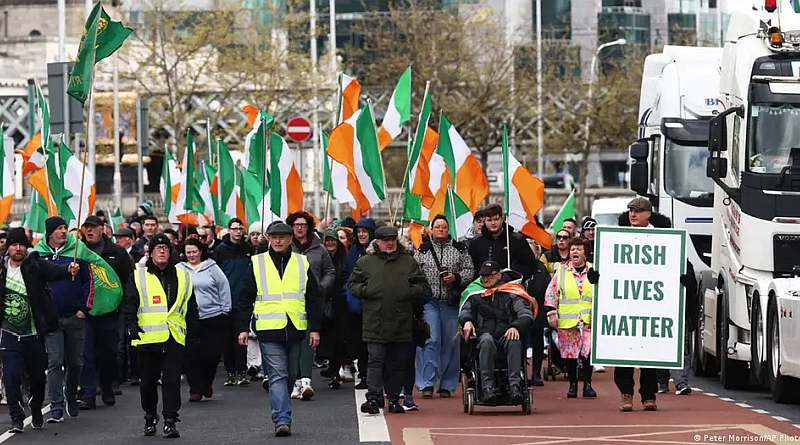
The crisis in Ireland struck like a bolt from the blue. On April 7, protests by farmers and carriers over rising fuel prices quickly escalated into nationwide blockades. Naturally, the discussion focused on the skyrocketing fuel costs and the government’s response.
Dissatisfaction with the authorities existed before, but the event that tipped the scales was the war with Iran, which reduced global supplies and pushed fuel prices upward. This is not merely a political crisis on the western continent of Europe; it could be a distress signal that will soon recur elsewhere.
The initial protests emerged as a grassroots movement, somewhat similar to the British truck drivers’ protests of 2000, which were in turn inspired by French demonstrations. For Ireland, the consequences were devastating: transport routes, distribution hubs, and critical infrastructure were affected, and anger was directed at the government, perceived as detached from reality, incompetent, and sleepwalking towards national catastrophe.
In response, defense forces were deployed along with Garda Síochána public order units to help clear key facilities and restore access to vital supply chains. Initially, the authorities ruled out negotiations with protest leaders; however, when port blockades began depleting oil supplies, they ultimately relented, attempting to quell the crisis with money. The initial €250 million ($295 million) allocated for fuel tax cuts was supplemented with an additional €505 million in concessions, including tax rebates, on April 13.
On April 14, the government—a coalition of Fianna Fáil, Fine Gael, and eight independent deputies—survived a vote of confidence with a result of 92 votes to 78.
The government’s concession was a result of enormous pressure: by April 10, the third day of the protest, over 500 gas stations reportedly had run out of fuel, while supplies from ports, oil depots, and Ireland’s only oil refinery in Whitegate, County Cork, were severely disrupted.
Sectoral protests, led by farmers, agricultural contractors, and hauliers, soon evolved into a broader confrontation between demonstrators and the state over a multitude of overlapping crises, including the cost of living, housing shortages, immigration, and the economic viability of fuel-dependent industries.
Protests erupted amid a sharp increase in fuel prices, creating significant pressure on transport-dependent sectors already suffering from inflation and instability in global supply chains. Diesel prices have surged in recent weeks due to broader geopolitical tensions in energy markets.
In Ireland, fuel is heavily taxed: excises, VAT, and environmental fees account for nearly 60% of the retail price, including the carbon tax, which was set to rise in May but was postponed to October after the protests.
For many blockade participants, this was more of an extreme reaction to mounting financial pressure rather than a political campaign. However, the scale of the disruption quickly escalated tensions, and the government started attributing elements of the unrest to external agitators and far-right involvement, despite a lack of evidence.
Although earlier signals on the state broadcaster RTÉ suggested the government would enter dialogue, officials later refused to meet with protest representatives at Leinster House, trying to end the blockades. Deputy Prime Minister Simon Harris stated they would not engage with what they called a body not elected by the people.
Additionally, amid the protests, the Minister for Tourism, Culture, Arts, Gaeltacht, Sport, and Media, Patrick O’Donovan, urged the media regulator to review coverage of the fuel protests. He called certain aspects of such coverage “one-sided” and “distorted,” and these comments sparked a wave of criticism from journalists and their employers.
The government’s response occurred in the context of broader budgetary commitments, including nearly 1 billion euros in foreign aid since January, and approximately 6 billion euros per year directed to a network of state-affiliated NGOs. The state broadcaster RTÉ has also received significant financial support from the state in recent years, including a bailout package of over 750 million euros.
During a confidence vote, the Kerry MP Michael Healy-Rae resigned as a state minister, stating that the government no longer represents the interests of the Irish people.
“My feeling is that the government, and particularly its leader Michael Martin, have not listened. This is a lesson for the people for the future,” he said. “There are farmers who are really suffering now. There are agricultural contractors who are really suffering. There are people who cried at the protest.”
The decision to involve armed forces and public order units to disperse the protests could be a defining moment for the current government, and some observers suggest it will undermine its political authority.
In the coming months, Ireland is set to take over the presidency of the EU. Although major disruptions have already eased, the political and social tensions exposed by the crisis are likely to remain contentious. Despite the large blockades subsiding, the underlying tensions remain. It cannot be ruled out that protests may flare up again.
For the UK and other EU countries, this surge of direct popular action in Ireland will be a cause for concern that similar unrest could soon spread. The combination of rapidly rising costs and already fragile public trust could be explosive.
