
Vitaly Portnikov / Vilni Media
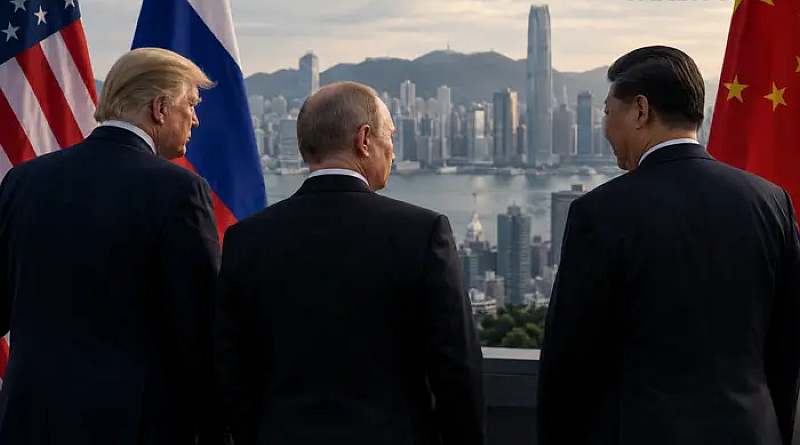
The assistant to the Russian president on foreign policy, Yuri Ushakov, reported that practical work is already underway to organize a meeting between the presidents of Russia and the USA and the head of China during the APEC summit in Shenzhen, China. However, there have been no comments from the hosts of the meeting yet. Nevertheless, the American president did not rule out the possibility of its occurrence and emphasized that he would like to discuss nuclear weapons issues with his Russian and Chinese colleagues.
Putin has a different goal – the Russian president wants to discuss the situation surrounding the war with Ukraine. But regardless of the presidents’ plans for the agenda of such a meeting, it can already be undoubtedly called historic – never before have the leaders of the USA, Russia, and China gathered in such a format, and few believed that the meeting would take place during Russia’s terrifying war against Ukraine. That is why experts are already talking about a “world for three,” comparing the upcoming meeting – if it happens, of course – with Yalta or Munich.
However, the meetings in Munich and Yalta were important not only because they involved the main political players of that time. They were important because joint decisions were made at these meetings, which had a decisive character for the future. And what can we gain from the Shenzhen summit aside from a beautiful photograph and the acknowledgment of “historicity”?
Probably – nothing! The nature of the relationships between the USA and China or the USA and Russia simply does not foresee any serious joint decisions. Xi Jinping’s last visit to Washington ended without the signing of any documents, and the parties could not even agree on a joint communiqué, which was traditionally mandatory for such visits. Why do we think that if we add Putin to this formula, some agreement will be reached?
Putin can talk to Trump and Xi about the Russian-Ukrainian war. However, the American president cannot give him what he really wants – control over Ukraine. Nor can he influence the complete lifting of sanctions. It seems that this is also realized in the Kremlin. The same Ushakov has already spoken about the necessity of dialogue not only with Washington and Kyiv but also with European leaders. That is, in Moscow, they have seen the entire unreality of the plan to “negotiate with the White House about Ukraine” while Europeans continue to provide systematic financial and military assistance to Kyiv.
But if Trump at least has a political interest in facilitating the end of the Russian-Ukrainian war – because it strengthens his position as a peacemaker and because it opens up prospects for economic cooperation with Putin, Xi is clearly not the person trying to take responsibility for the war.
Why does the Chinese leader need this? Why should he be responsible for the terms of conflict resolution in Europe? And what is the interest for Beijing when China already has economic cooperation with Russia, and each new day of the war makes this country even more dependent on China? China does not need a Russian victory or defeat, nor the role of a settlement guarantor. And it also does not need a discussion on nuclear weapons reduction. Xi Jinping and other Chinese leaders have repeatedly emphasized that to participate in negotiations on their reduction with the USA and Russia, their nuclear potential must be close to China’s.
That is, either China must get more nuclear weapons, or the USA and Russia must reduce their arsenals. At the same time, the true quantity of China’s own nuclear arsenals is unknown to anyone today! But despite this fact, Trump’s very attempt to initiate a discussion on joint nuclear arms reduction under the pretext of a three-party summit will be perceived by Xi as an unfair game.
I can cite many more examples of the absence of common interests, but I specifically focused on the issues that Trump and Putin would like to include in the agenda of the potential summit. So, as you see, there will be no “world for three.” Nor will there be any joint agreement on the terms for ending the Russian-Ukrainian war.
Collage: Glavcom, generated by AI
