
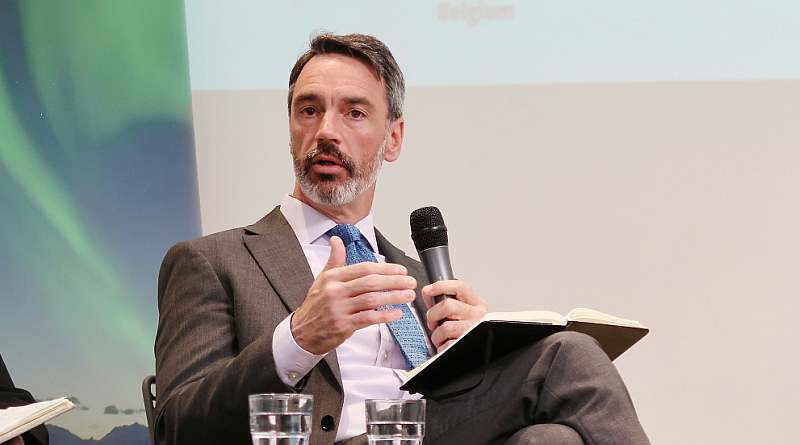
Olga Tanasiichuk, Prague / Ukrinform
Russia cannot expect NATO to return to the 1997 configuration. At the same time, the Alliance must be ready to deter Russian aggression, including nuclear, and prevent the crisis from escalating into a large-scale conflict. The most convincing security guarantee for Ukraine would be NATO membership.
This was explained by Jim Stokes, a senior expert in the “Future of Security” program at GLOBSEC, who served as NATO’s nuclear policy director from November 2023 to December 2025 and headed the staff group of the Alliance’s Nuclear Planning Group. Before that, he worked for 25 years at the U.S. Department of Defense.
RUSSIA WILL HAVE TO ACCEPT REALITY: NATO NOW HAS 32 COUNTRIES
– Mr. Stokes, in recent days, we hear that Russia likely wants to involve European representatives in negotiations regarding Ukraine, attempting to renew its demand that NATO return military presence to the state it was in before 1997. That is, to effectively “exclude” from the Alliance the countries that joined later. Can the West agree to such demands?
– This seems absolutely impossible. I can’t even imagine how Finland and Sweden’s accession to the Alliance could be reversed, let alone all 16 countries that joined after the end of the Cold War. They will not agree to leave the Alliance, and other allies will not agree to simply let them go. In NATO’s 77-year history, this has never happened.
So, Russia will have to accept reality: NATO now has 32 countries. Russia can continue to talk about it, and NATO can simply respond: “Noted. We will not change.”
The other question is whether NATO will ever allow new allies to join. Such a decision is made by the consensus of all 32 countries.
But the main issue, in my view, is what Russia has been doing in Ukraine for over ten years.
It’s the Russian war that shapes the threat perception, and that’s why Finland and Sweden decided to join the Alliance.
Thus, a significant part of the responsibility lies with Russia, which may accuse NATO of approaching Russia’s borders. I understand this is not to their liking. But in the late 1990s and early 2000s, Russia had no issue with it. They’ve turned it into a political issue, and they will now have to come to terms with it.
– Russia seeks to build a new security architecture, at least in Europe. What do you think this architecture will be? How should Ukraine, with its real combat experience, be involved?
– Given Russia’s ongoing aggression, the question of the future security architecture is now secondary compared to the vital question: how to end the Russo-Ukrainian war? This is the most urgent issue we need to resolve. Ukraine must continue to defend itself. Certain states must continue to support its defense. And NATO collectively should help coordinate some of these efforts.
Currently, the situation is dangerous all over Europe, and especially in Ukraine. This is what needs to be discussed: Russia sees how NATO is preparing for defense; it knows it is not winning in Ukraine, and it must find a way out of the situation it has put itself in. This is the consequence of its own decisions.
If we try to consider what the security architecture will look like after the end of Russia’s war against Ukraine, I believe it will partially rely on key elements that have existed in Europe for a long time: NATO will remain in its current form, and the EU will play its role. Ukraine will continue to be a powerful military force in Europe. I don’t know if it will become a NATO member – personally, I hope so, as that is the path it is on. But even if this does not happen, Ukraine will remain a very capable military force that will still be a NATO partner.
European states will need to decide how to build an interaction architecture with Russia. It is not about dividing responsibilities or spheres of influence. It is about how to prevent conflict escalation in Europe and direct confrontation between NATO and Russia. NATO is a defensive Alliance; it will not attack Russia. We do not want the crisis to turn into a conflict and an ordinary war to lead to the use of nuclear weapons. However, we must consider the worst-case scenarios and think about how to avoid dangerous situations.
We need to decide how the West and Russia can coexist in the future. In my opinion, Europe should directly engage with Russia. It should not be a matter resolved solely between Washington and Moscow. There are many different actors in Europe who have their interests here; they must come together to find a way back to what existed for a long time – peace and security in Europe, which was shattered after 2022.
– What do you think could be convincing security guarantees for Ukraine?
– Ukraine’s accession to NATO. This is the most convincing option. NATO’s deterrence has worked for over 77 years because no state has ever attacked the Alliance.
I usually don’t use the word “guarantee,” but
being under the extended nuclear deterrence of the United States, the United Kingdom, and France has its benefits.
IF MOSCOW FEELS IT IS EXPERIENCING A STRATEGIC DEFEAT, IT MIGHT CONSIDER USING NUCLEAR WEAPONS
– How realistic is it that Russia will dare to attack NATO, to try to test it? Is the Alliance ready for this?
– NATO and its allies are ready and will continue to be ready to deter any aggression.
The only thing that can change this situation is a change in threat perception. I do not think NATO allies believe that Russia will cease to be a threat in the near future; it will likely remain a threat for a long time. Therefore, it is about a long-term commitment to collective defense, as well as national defense and resilience.
There is currently a lot of subversive activity and sabotage, and Russia is obviously focused on the war against Ukraine. People are worried that if Russia is no longer involved in a protracted conflict against Ukraine, which it clearly cannot win, and this conflict somehow ends, it might switch to attacking NATO. This possibility exists, but we do not know if it will happen. Decisions will be made in the Kremlin. We in NATO, in the West, and in Europe can only be prepared for such developments.
If the Kremlin is contemplating an attack, they must ask themselves: what do we want to achieve? Can we achieve it? If we risk failure, is it worth starting at all? I hope that Russia will continue to be extremely cautious. I do not think they will want to risk such a war in the future.
The full-scale invasion of Ukraine and the subsequent war became a strategic miscalculation for Russia.
Russia thought it could win, but now things are not going very well for it. An attack on NATO would be much more challenging and extensive—considering the geography and capabilities involved. The Alliance is much larger, can spend significantly more money, and involve more people. The Russians know this. Even in their own doctrine, they view war against NATO as a conflict on a completely different level.
There is distrust towards Moscow, as it might do something again…
– Irrational.
– … irrational or foolish. I don’t think that in 2022, the Russians fully thought the situation through. So we cannot be sure that Russia will act correctly and not attack NATO. Therefore, we must be prepared for such a scenario.
– In a conventional war, Russia is unlikely to have a chance against NATO. But it does threaten the world with its nuclear arsenal. Could Putin, finding himself cornered, use this last “argument”?
– I would say that such an option is possible. And in saying this, I don’t want to scare anyone.
Fortunately, for over 80 years, since 1945, nuclear weapons have not been used in wars. I think there are many factors that restrain their use; hopefully, we will never see them again—and we strongly wish for this, as no one truly desires such weapons to ever be used.
Russia has not yet used its nuclear weapons against Ukraine. I don’t think it feels a real need for it; it seems Moscow is trying to win this war without resorting to such extreme measures—despite all the rhetoric, saber-rattling, etc.
However, there is a significant difference between trying to use a nuclear arsenal (or talking about it) for intimidation and its actual use. There are specific scenarios that, in my opinion, cause concern.
– Which ones?
– Well, if Russia finds itself at war with NATO—in the format of a conventional (non-nuclear) conflict—and begins to lose, losing key territories or feeling a threat to the regime itself, it may seriously consider the likelihood of using nuclear weapons. NATO must be clearly aware of this. We need to closely monitor Russian nuclear forces, listen to Moscow’s statements, and deter any attempts at nuclear use—even in the midst of a conventional conflict, so Russia does not decide that it needs to cross this line. So it’s about a complex balance: on one hand, it’s necessary to protect the Alliance from any aggression, and on the other hand, prevent Moscow from perceiving it as a strategic defeat that could lead to regime change or something similar.
I believe there are ways to avoid such a development. One of the key elements is communication—both public and diplomatic, including through informal communication channels.
DURING A CRISIS, NATO CAN MAKE DECISIONS VERY QUICKLY
– And what if Russia does cross the nuclear threshold? What will NATO’s response be?
– Obviously, this is the worst-case scenario. I thought about it when I worked at NATO headquarters.
In this hypothetical situation, if Russia uses nuclear weapons, NATO will have to respond. It is necessary to convince the adversary that they have not just crossed a certain line—such a step fundamentally changes the nature of the conflict itself. The response must be convincing. NATO has stated that they are prepared to inflict damage that would significantly exceed any possible benefits. This could be a nuclear response, a response using conventional weapons, or a combination of both. The decision on this will be made later. It is not advisable to reveal to the adversary where these red lines are and how exactly the response may be formed and applied. This should encourage a degree of caution. I think this is the case: we see restraint not only regarding the use of nuclear weapons but also concerning involvement in any conventional conflict, as it could mark the beginning of a dangerous path leading to uncontrolled escalation.
– NATO, like European institutions, is often criticized for bureaucracy. But in the worst-case scenario, time will be crucial. Can NATO act quickly in an emergency?
– Sometimes people imagine that NATO will endlessly hold meetings at its headquarters in Brussels. During relatively peaceful times, indeed, there are many committee meetings and sessions of the North Atlantic Council. But in a crisis, the Alliance can make political decisions and implement them very quickly.
In addition, member countries can act independently and very rapidly.
The United States, the United Kingdom, and France can independently and autonomously use their nuclear forces to deter any aggression against the Alliance—not just nuclear attacks.
They can react extremely swiftly. And this is a huge advantage for the Alliance.
It is essential for NATO and political leaders in 32 capitals to have options for decision-making during a crisis. This will help prevent the conflict itself, and if war does begin, not allow it to cross a nuclear threshold.
– Is NATO discussing the possibility of placing additional American nuclear weapons in Europe? Countries like Poland, Finland, and Lithuania are being mentioned. Meanwhile, Donald Trump is again talking about nuclear disarmament. How does this align?
– NATO is adapting its nuclear deterrence system. The Alliance is modernizing its nuclear forces: a decision was made in the late 2000s to transition to fifth-generation F-35 aircraft and to modernize American nuclear weapons stationed in Europe. After Russia’s full-scale invasion of Ukraine, where Russia was identified as a threat to the Alliance, the change in the security environment became an important factor in how NATO considers the adaptation of nuclear deterrence, as well as in what the US, UK, and France are doing independently or as a complement to NATO efforts.
The locations of American nuclear weapons in Europe are not publicly disclosed, although it is known that the weapons are in Europe. This is a sensitive matter. The level of security and protection surrounding these weapons is so high that they cannot simply be moved from point A to point B or stationed in a new location.
The key question is whether the Alliance’s nuclear deterrence needs further adaptation. Exercises and all preparation for a potential NATO nuclear operation indicate that the Alliance can conduct it extremely effectively with current capabilities and in the current configuration.
An important question concerns the long-term perspective: if the threat from Russia persists and it continues to have a large arsenal of so-called non-strategic nuclear weapons, will NATO need additional capabilities? Russia has thousands of nuclear warheads capable of hitting targets across Europe with various types of missiles. Does NATO need other types of nuclear capabilities? Currently, the Alliance’s combat aircraft can use free-fall nuclear bombs. Some advocate the capability to launch missiles from the sea, land, or air. In my opinion, all options should remain on the table. The security environment has changed significantly. Politically, Europe is no longer the same as in the 1980s.
There is real concern that Russia could again miscalculate and resort to aggression against the Alliance, so there is readiness for certain changes.
DETERRENCE AND DE-ESCALATION CAN WORK TOGETHER
– We are talking about building up military forces and nuclear deterrence. Yet is disarmament and risk reduction still relevant now?
– I think today this is not the main focus of NATO’s activities.
The Alliance has once again focused on deterrence and defense as the main means of ensuring its own security.
Perhaps arms control is not yet on the agenda of Russia and certainly not of China. The United States has been advocating arms control for some time, and President Trump is trying to propose a trilateral format for such control. If we could get the Russians and the Chinese to reduce the number of warheads they have (or limit the buildup from China), it would be a beneficial outcome for us.
There are many steps that can be taken even without a formal agreement. If the US and Russia or the US, Russia, and China in a trilateral format can agree on reducing escalation risks, that would be good. And this might be easier to achieve than reaching a formal arms control agreement.
Therefore, in my opinion, both approaches are needed. There is such an example in NATO’s history: in 1979, the Alliance decided to modernize its tactical nuclear forces while being open to arms control negotiations with the Soviet Union. Ultimately, this led to the Intermediate-Range Nuclear Forces Treaty. Deterrence and defense can be developed, strength can be increased — in the US, this is called “peace through strength” — and at the same time, one can be open to arms control negotiations and other risk reduction measures. These approaches do not contradict each other. One only needs to offer appropriate initiatives and see if the other side responds.
– Many Ukrainians believe that it would make sense for Ukraine to work on its nuclear program. Would this be a good “guarantee” for us?
– This is, undoubtedly, an extremely difficult decision. I view it from several perspectives. First, the decision to create one’s own nuclear capability should not be taken lightly. And I say this not just from the perspective of international nuclear non-proliferation norms; of course, no one wants further nuclear proliferation, given that currently only a limited number of states possess it.
At the same time, I can understand national security considerations: nuclear weapons are the highest guarantee of national security and sovereignty.
So, I understand the supporters of this idea. But I want to remind you that political commitments, financial costs, necessary technical knowledge and technologies, as well as the time and funds needed to create a certain amount of nuclear weapons must be considered. How many warheads are needed to feel secure if, for example, Russia already has thousands? Delivery systems, doctrine, command and control procedures, and many other auxiliary capabilities are also required. All of this requires significant effort. I say this as someone who has long worked on countering the proliferation of weapons of mass destruction.
Throughout my career, I observed how North Korea transitioned from a non-nuclear state to one that possesses nuclear weapons. But let’s remember that North Korea is a rogue state. Do Ukraine, Germany, or South Korea – like politicians in other countries who sometimes raise this issue – really want to withdraw from the Nuclear Non-Proliferation Treaty, become rogue states, and potentially face sanctions? Does this truly guarantee the security they seek?
Therefore, such a path does not seem very appropriate. Time, money, and effort are better directed towards conventional defense; if there is a possibility to be part of a nuclear alliance, enhance its mechanisms, for example within NATO; or seek other forms of security guarantees. It seems there are better options than creating a national nuclear program.
NATO WILL REMAIN AS LONG AS THERE IS A THREAT FROM RUSSIA
– Europe is strengthening militarily, and for this, thanks can be given, among others, to Donald Trump. Will the USA manage to distance itself from NATO, and will other alliances emerge instead of the Alliance itself?
– The long-standing policy of the USA – at least since the Obama administration, and in fact, since the 1960s – is for European allies and Canada to invest more in conventional defense. The current administration has made this one of its main points of rhetoric. And fortunately, we have achieved the desired result: this refers not only to increased defense spending but also to the further deployment in Europe of increasingly numerous and capable military forces that can be involved in NATO’s collective defense.
This does not mean that the USA has lost interest in NATO or distanced itself from it. In fact, it is not so much about shifting the burden as it is about ensuring that the Alliance is strong, resilient, and capable of defending itself.
As an American who has completed a career in the Department of Defense, I believe that the United States, even the current administration, remains interested in preventing conflict in Europe, especially direct conflict with NATO.
Judging by reports in the media, the recent visit of the CIA director to Moscow was also a signal to it: “Do not risk such a step!”.
War does not serve anyone’s interests—neither from the perspective of security, economics, nor purely on a human level. However, it is better to prepare for war than to suffer from its consequences later. Ukraine is experiencing this now, and in my opinion, this should be the central argument for further support of Ukrainian defense—as long as it takes until Russia stops the war. After this, we must continue to be ready to defend NATO, as well as other countries around the world, if they face their own security challenges. This should be done until the perception of threat changes and states understand that they are not dangerous to each other. History knows cases where countries that were once at war later became allies, including within NATO.
NATO will remain a long-term commitment, likely for many years—due to the mere threat from Russia. I started working at NATO headquarters in February 2022, just as Russia launched a full-scale invasion of Ukraine. Therefore, all of my experience working in the Alliance fell during this period. I know the Alliance is very dedicated to this cause. I believe that the efforts of certain countries and NATO’s collective support of Ukrainian defense are convincing. I hope that such support will not have to be provided for much longer, because we want the war to end. Any efforts that can help end it are good, but only on terms favorable for Ukraine.
Photo: Photo: Olga Tanasiychuk/Ukrinform
