
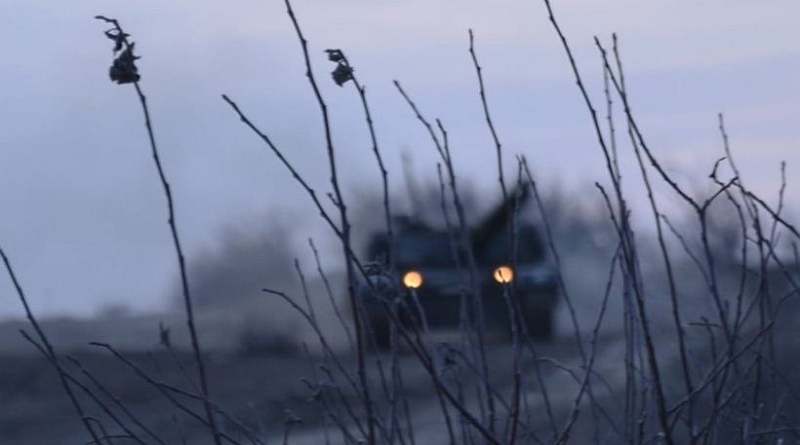
We are beginning a series on the Southern Strategic Operational Zone.
Novopavlivsky – Velykonovosilkivsky direction.
The enemy (Russian forces) continues to maintain active defense in the zones of their 29th Combined Arms Army, the “Vostok” troop group, and the 90th Tank Division (TD) of the “Center” troop group, to prevent further advancement of the Ukrainian Armed Forces (UAF) across the operational-tactical directions of Piddubne — Bohatyr and Voskresenka — Velyka Novosilka.
For this purpose, the Russian command focuses its main efforts on holding the positions of its forward units and subunits north and south of the N-15 Zaporizhzhia — Donetsk road along the Vovcha River, as well as along the Mokri Yaly River north of Velyka Novosilka.
As of the evening of 24.10.2026, the enemy managed to minimize the pace of advancement of the forward Ukrainian units in these directions. However, they have not yet fully stabilized the situation in the zone of their 29th Combined Arms Army. The forward units of the UAF have made advances in the tactical zone in a number of areas.
1. In this direction, the enemy operates with the following forces and means (approximately):
29th Combined Arms Army:
– 36th Separate Motorized Rifle Brigade;
– 39th Separate Motorized Rifle Brigade of the 68th Army Corps (AC);
– Composite Tactical Group from the 18th Machine-Gun Artillery Division, also part of the 68th AC;
– 430th Motorized Rifle Regiment;
– 200th Artillery Brigade;
– Possible presence of part of the forces of the 90th Tank Division (likely units of its 6th Tank Regiment and 228th Motorized Rifle Regiment);
– Also, possible presence of part of the forces of the 120th Marine Division of the Baltic Fleet. This is the reformed former 336th Separate Marine Brigade.
90th Tank Division:
– 6th, 80th, and 239th Tank Regiments (the first likely regrouped part of its forces into the zone of the 29th Combined Arms Army);
– 228th and 428th Motorized Rifle Regiments (the first likely also regrouped its main forces into the zone of the 29th Combined Arms Army);
– 400th Self-Propelled Artillery Regiment;
– Possible presence of several units from the 41st Combined Arms Army of the “Center” troop group, as reinforcement means.
Regarding the 120th Domain, which effectively operates at the junction of the Russian 36th and 29th Combined Arms Armies, it is likely that its main forces are deployed in the zone of the first in the Aleksandrovsk direction. The presence of the 90th Tank Division units in the 29th Combined Arms Army zone will likely continue until the situation in that direction is fully stabilized.
It is worth noting that part of the 90th Tank Division zone (on the northern flank) is probably transferred to the 41st Combined Arms Army zone and occupied by the units of its motorized rifle brigades. About a month ago, several units of the 90th Tank Division were recorded operating toward the city of Druzhkivka along the Kazenny Torets river in the zones of the 51st Combined Arms Army with Operational Group “Center” and the 8th Combined Arms Army with Operational Group “South”.
2. Current Situation in this direction is characterized by quite intense confrontational battles in the tactical zone in a number of areas and, accordingly, quite slow advancement of the forward Ukrainian units. In particular:
– On the Novopavlivka — Orikhove direction, the positions of the sides have hardly changed. The Armed Forces of Ukraine (AFU) continue to hold positions almost on the western outskirts of Orikhove. However, on the Novopavlivka — Dachne direction, forward Ukrainian units operating along the road have reached a distance of 3.3-3.5 km from the northwestern outskirts of Dachne.
Furthermore, on the Yalta (village) — Dachne and Zaporizhzhia (village) — Dachne directions, the AFU, acting from the confluence of the Mokri Yaly river with the Vovcha river along the northern and southern banks of the latter, managed to reach a distance of less than 3 km to the village of Dachne.
Meanwhile, Russian forces continue to hold several positions in the area of the village of Filiya and in the forested area to the southwest of it with independent infantry groups (toward Ivanivka), supplying them through the forest between Dachne and Filiya.
– Stubborn battles continue south of the Zaporizhzhia — Donetsk road, where the AFU are apparently gradually “curling” the enemy’s defense along the Mokri Yaly river. Thus, acting in the Zaporizhzhia (village) — Perebudova, Piddubne — Perebudova, Myrne — Komar, and Voskresenka — Fedorivka directions, the forward Ukrainian units evidently managed to sequentially push the enemy out of the villages of Perebudova, Komar, and Fedorivka.
In these villages themselves, there were quite fierce battles for several weeks. The enemy offered rather stubborn resistance, sometimes attempting counterattacks. However, currently, he has managed to hold positions along the Mokri Yaly river only between Komar and Fedorivka, as well as to the east of Druha.
His advanced infantry groups still hold several houses on the northeastern outskirts of Perebudova, in the forest beyond the northeastern outskirts of Komar, and in the area of the destroyed farmhouse southeast of this village. In the Fedorivka area, it is likely that forward Russian units have completely withdrawn from the village across the Mokri Yaly river.
– West of the Mokri Yaly river on the section from the Zaporizhzhia — Donetsk road to the city of Velyka Novosilka, the enemy holds only the area Vesela — Novocheretuvate — Velyka Novosilka — Burlatske with an average depth of up to 6.4 km.
Moreover, apparently, the AFU, continuing active assault operations in the Shevchenko – Burlatske, Shevchenko – Vilne Pole, and Shevchenko – Pryvillya directions, managed to practically reach the northern outskirts of the latter two. They also achieved a tactical result in the Maliivka — Skudne direction, advancing southwest of the village of Vesela and reaching a distance to the village of Skudne of 3.1 km.
Thus, it can be stated that during the reporting period (from October 12 to 24), advanced Ukrainian units managed to advance in several sectors (mainly south of the N-15 road, to the west and east of the Mokri Yaly River) on average by 1.5-2 km, and in some areas up to 3.2-3.3 km. However, this was enough to displace the enemy from a number of settlements east and west of the Mokri Yaly River in the area between the aforementioned road and the city of Velyka Novosilka.
3. Regarding the further development prospects in this direction, several factors should be noted, including:
– It is apparent that the pace of advancement of the advanced Ukrainian units in the strip of the Russian 29th Combined Arms Army has slowed to minimal, especially north of the Zaporizhzhia-Donetsk road. Their advance has essentially been limited to two sectors south of it — the Komar village area, including the villages of Perebudova and Fedorivka, as well as the Shevchenko village area and the Maliivka — Skudne direction.
– Clearly, at the moment, the Armed Forces of Ukraine need to pause their active actions in this direction or regroup their forces and assets with which they are conducting offensive actions in the strip of the Russian 29th Combined Arms Army. Firstly, due to the limited volume of these forces and assets. Secondly, because of the need to select a narrower area to apply their main efforts, as Ukrainian forces are already experiencing quite evident difficulties in continuing the offensive on such a significant front line, especially in diverging directions (simultaneously towards Odradne, Bohatyr, and towards Velyka Novosilka). They will clearly have to choose one if they wish to continue this offensive.
– However, the position of the advanced parts and units of Russian troops in their 29th Army strip still looks quite vulnerable in a tactical sense for further offensive actions by the Armed Forces of Ukraine. At least in two tactical areas — in the village of Dachne region (considering that Ukrainian units are already near Orikhove, i.e., quite deep beyond their right flank, and managed to approach the village of Dachne on both banks of the Vovcha River) and towards the Shevchenko — Burlatske direction (considering active actions of Ukrainian forces towards Skudne and Dniproenerhiia).
Of course, all these considerations will only become relevant if the Ukrainian command decides to continue offensive actions in the Russian 29th Combined Arms Army strip with more or less significant forces. So far, it has not demonstrated such readiness.
In operational terms, the diminishing advance of the Armed Forces of Ukraine in the Russian 29th Combined Arms Army Eastern Group’s strip, as a result of which they managed to liberate a fairly significant area in the western part of the Donetsk region (Zelenyi Hai — Zaporizhzhia (village) — Shevchenko — Komyshuvakha), has so far not led to significant changes. The enemy continues the offensive on the left flank of the Eastern Group in the general direction of Huliaipole — Orikhiv and in the operational zone of the Central Group towards Dobropillia.
However, it would be quite naive to think that this has not influenced the actions of the Russian command at all. In this sense, the situation could have become much more complicated for the Armed Forces of Ukraine than it is now. For example, the appearance of the Russian 120th Division on the junction of the 36th and 29th Combined Arms Armies was clearly initially not planned by the Russian command and became a necessity.
Given that the Russian command views the marine units and formations as a kind of “highly mobile” component of their strategic reserves, the appearance of this formation instead of the Huliaipole direction (along with the 40th Naval Infantry Brigade) on the Oleksandrivska direction was clearly unplanned and happened precisely because of the Ukrainian advance in the sectors of the Russian 36th and 29th Combined Arms Armies (CAA).
In this sense, it is also worth noting the regrouping of part of the forces of the 90th Tank Division into the 29th CAA sector. Although, apparently, it was initially planned to regroup its main forces on the right flank of the “Center” Operational Group to radically strengthen the offensive on Druzhkivka. Instead, only separate units appeared there, with a significant portion ending up in the sector of the 29th CAA.
However, it should be remembered that the overall operational significance of the Ukrainian advance in the aforementioned directions may increase significantly, but only if it is successfully continued. If the Armed Forces of Ukraine (AFU) manage to approach Velyka Novosilka from the northwest and simultaneously physically cross the Huliaipole — Velyka Novosilka road with more or less significant forces (for example, in the area from Uspenivka to Novoivanivka, more on this in the next review), then the command of the Russian “East” Operational Group will simply be forced to deploy part of the forces and assets of their 5th CAA with the front from the west to the north to ensure the stability of its right flank. Moreover, this may happen even regardless of whether they want it or not.
And if the AFU manage to “jump above their heads” and start turning the flanks of their strike operational-tactical groups “inward,” that is, into the interfluve of the Mokri Yaly and Yanchur rivers (even at the cost of refusing their hypothetical breakthrough to Velyka Novosilka), then the situation in the entire operational zone of the Russian “East” Operational Group in general will begin to acquire “particular sharpness.” But more on this later.
* * *
We continue the cycle regarding the Southern Strategic Operational Zone.
Oleksandrivska direction.
The enemy (Russian forces) continues to actively defend in the sector of their 36th Combined Arms Army (CAA) of the “East” Operational Group to prevent further advancement of the forward units and subunits of the Armed Forces of Ukraine (AFU) between the Mokri Yaly and Yanchur rivers in the directions of Novooleksandrivka — Novomykolaivka and Orestopil — Zeleny Pole.
The Russian command is clearly trying to completely exclude a breakthrough of forward Ukrainian units and subunits south of the Huliaipole — Velyka Novosilka road, for which they stubbornly hold their forward positions and lines to the north and northwest of it, counterattacking from time to time in certain areas of the 36th CAA sector.
To accomplish this task, the forces (troops) of the Russian 36th CAA defending in this direction were previously reinforced with a range of forces and assets both from the operational reserve of their “East” Operational Group and from the strategic reserves of the “General Staff of the Armed Forces of the Russian Federation.” As a result, during September-October this year, the enemy managed to stabilize the situation in the sector of their 36th CAA and prevent the advancement of forward units and subunits of the AFU south of the Huliaipole – Velyka Novosilka road.
1. In this direction, the enemy is operating with the following forces and means (approximately):
The 36th CAA likely operates in the Oleksandrivska direction with its main forces:
– 37th Separate Motor Rifle Brigade;
– 5th Separate Tank Brigade;
– 30th Separate Artillery Brigade.
Means of reinforcement:
– The 120th Marine Division is essentially a restructured former 336th Separate Marine Brigade of the Baltic Fleet, reinforced by several additional regular assault battalions. It operates in the 36th CAA sector with its main forces and part of its forces in the 29th CAA sector;
– possible presence of several units of the 34th Separate Motor Rifle Brigade, 49th CAA Operational Command “Dnepr”;
– the presence of units and groups of the 14th Separate Special Purpose Brigade “Eastern Military District” is also recorded in the 36th CAA sector;
– the 69th Separate Cover Brigade from the 35th CAA Operational Command “Vostok” likely also operates with part of its forces in the 36th CAA sector (most likely at its junction with the 29th CAA);
– the 38th Separate Motor Rifle Brigade from the same 35th CAA Operational Command “Vostok” acted slightly earlier in the 36th CAA sector with its separate units. Its main forces are currently participating in offensive actions in the Huliai-Pole direction in the 35th CAA sector. It seems that the Russian command of Operational Command “Vostok” regrouped these units back to the Huliai-Pole – Orikhiv direction a few weeks ago, considering the situation in the 36th CAA sector already “stabilized”.
Additionally, it should be noted that in the sector of the Russian 36th CAA, there are likely several formations of “territorial troops” and “mobilization reserve” at the level of “separate motor rifle/rifle regiment” and “separate rifle battalion”. They mainly belong to the regular forces and units of the 36th CAA or are attached to them under operational control as a means of reinforcement. For example, the 113th and 125th Separate Motor Rifle Regiments (MR), formed in the occupied territories of the Donetsk region, or an entire array of Territorial Defense battalions (numbered from 1000 to 1015), formed by the Eastern Military District’s recruitment offices.
2. Current situation in almost all of the Oleksandrivka direction, except for a few sectors and areas, is mainly characterized by the transition of the Armed Forces of Ukraine to holding and consolidating their advanced positions and lines previously reached during their offensive actions. Additionally, there is an effort to improve the tactical position of their forward units by the enemy.
As a result, the sides continue to occasionally carry out attacking/assault actions in the tactical zone, but only in certain areas, and their scale and level of intensity are clearly quite limited. Specifically:
– In the directions of Ternove — Novoheorhiivka and Maliivka — Komyshuvakha, Ukrainian units, previously managing to push the enemy out of the Novoheorhiivka area, succeeded in advancing east of Komyshuvakha. However, the enemy continues to hold positions in the forest strip along the road between Ternove and Novoheorhiivka, as well as on the western and southwestern outskirts of Komyshuvakha. The village itself is likely a “gray” (contested) zone, for which battles are ongoing.
– Ukrainian forces continue to hold confidently the area of Kalynivske — Berezove — Zaporizke — northwestern part of Novomykolaivka, having repelled a series of enemy counterattacks in the directions of Obratne — Berezove and Temyrivka — Kalynivske earlier.
Furthermore, it is evident that they have completely “cleared” the remaining small enemy infantry groups that were previously infiltrated into their battle formations as a result of these counterattacks in the area of the villages Stepove and Verbove.
Currently, the enemy holds several positions in the forest strip crossing the Berezove – Novomykolaivka road and half of Novomykolaivka itself. However, it is quite difficult for them to do this, as advanced Ukrainian units are already in the Zaporizhzhia area and have managed to advance south and west of Novomykolaivka by at least 2.5-2.7 km.
Thus, the “supply line” from Obratne to the part of Novomykolaivka held by Russian units, and further into the forest strip between it and Berezove, no more than 3 km wide, is effectively “pierced” by flanking fire from advanced Ukrainian positions with a wide range of weapons, including most infantry weapons, not to mention drones.
– Further southwest, it is evident that advanced Ukrainian units continue to consolidate in the area of Pryvilne and Pavlivka, where they managed to reach earlier, moving south from the Krasnohirsk — Novohrigorivka line along the eastern bank of the Yanchur River. They are now separated from the outskirts of Uspenivka and Novovasylivske only by the Yanchur River itself.
However, it is clear that the local Ukrainian command is in no hurry to force the river and start battles for these villages. There is a quite obvious explanation for this — the enemy between Novohrigorivka and Novomykolaivka continues to maintain a tactical penetration up to 3 km deep and 1.3-1.4 km wide (i.e., on the left flank of the units of the Armed Forces of Ukraine, which previously broke through to Pryvilne and Pavlivka).
Moreover, the enemy occasionally attempts to counterattack in the direction of Novoivanivka — Novohrigorivka, trying to expand it even further. Given that Russian troops continue to hold positions south of Rybne and in the area of the village of Solodke on the opposite bank of the Yanchur River, a premature attempt by Ukrainian units to liberate Uspenivka and Novovasylivske “with one decisive strike” across the river could only “worsen” this encircling position concerning the Ukrainian units.
In fact, that is why both sides are currently quite intensively “fighting for the flanks” (the area of Novohrigorivka on the eastern bank of the Yanchur River, the area of the villages of Rybne and Solodke on its western bank). Moreover, as I understand it, both sides are fully aware that if the Armed Forces of Ukraine can completely push Russian units from these areas, they will immediately try to oust the enemy from Uspenivka and Novovasylivske.
– It is precisely these considerations, in my opinion, that determine the fact that the enemy is actively trying to counterattack in the area of Zlahoda — Rybne — Pryvilne — Solodke in the northwest direction.
As a result, a rather complicated tactical situation has developed in the area between Zlahoda and Solodke. It is clear that the Russians have at least 3 infantry (assault) groups here, each numbering about 3-4, possibly up to 5-6 soldiers, who managed to advance from Solodke to the northwest up to 3.5 km and entrenched in the forest strips in the battle formations of the Ukrainian units west of Rybne and southwest of Zlahoda. However, the assault groups of the Armed Forces of Ukraine are ALREADY in Solodke and are clearly engaged in fierce battles for its complete liberation, having broken through there from the direction of Rybne.
Thus, it can be asserted that although the command of the Russian 36th Combined Arms Army and its attached forces managed to stabilize the situation in their sector operationally, it continues to change and develop quite actively in the tactical zone across several areas. And, evidently, not always to their advantage.
3. Regarding future development prospects, I would highlight three areas (directions) where there is a fairly high probability of further activation of the enemy, at least on a tactical level:
– Clearly, the Russian command will try to hold their positions in the area of Komyshuvakha, as this has significant tactical (and under certain conditions, operational-tactical) importance for further actions of the Ukrainian Armed Forces in the sector of the neighboring Russian 29th Combined Arms Army toward Shevchenko — Burlatske and further towards Velyka Novosilka.
– Additionally, the Russian command will likely attempt to exploit two of its tactical penetrations in the sector of the 36th Combined Arms Army (between Berezove and Novomykolaivka, and also north of Novohryhorivka). The enemy will most likely try to use the first to push forward Ukrainian units out of the Zaporizke area, and the second clearly to act on the flank of Ukrainian units that have broken through to Pryvilne and Pavlivka.
– Furthermore, the continuation of rather fierce battles throughout the area of Zahodia — Novohryhorivka — Uspenivka — Solodke is also highly probable. The enemy will clearly try to prevent the advance of forward Ukrainian units to the Solodke – Uspenivka line on the western bank of the Yanchur River and their movement further along the eastern bank to its intersection with the Huliaipole – Velyka Novosilka road (in the area of Uspenivka and Novovasylivske).
Now, regarding the “operational” factors of the potential further development of the situation on the Oleksandrivka direction.
– If the Ukrainian Armed Forces still achieve the aforementioned results on the left flank of the Russian 36th Combined Arms Army, it is clear that the operational significance of all their offensive actions in the sector of the Russian 36th Combined Arms Army, conducted this summer and fall, will start to collectively increase. Primarily, regarding the situation in the sector of the Russian 5th Combined Arms Army, adjacent to the 36th Combined Arms Army, which is currently attempting to advance north along the Haichur River towards Dobropillia and west of it towards Vozdvyzhivska.
Currently, this significance is minimal. Since the depth of the actual advance of the Ukrainian Armed Forces along both banks of the Yanchur River is clearly insufficient at the moment. However, if they continue to advance along the river to the south, almost with every kilometer they can cover, the situation on the entire right flank of the Russian 5th Combined Arms Army will evidently start to become increasingly tense for them.
For example, from the forward positions of the Ukrainian Armed Forces in the area of Uspenivka to the village of Poltavka (this is already the operational rear of the Russian 5th Combined Arms Army, and quite a deep one behind its right flank) — 6.7 km as the crow flies. I believe the conclusion is quite obvious here — continuing to pressure this area on the defense of the Russian forces has quite a tangible operational sense for the Ukrainian forces.
– Another operational level factor is the overall situation in the entire strip of Russia’s 36th CAA. It is apparent that the Russian command has more or less stabilized the situation in this context, although on the extreme flanks of this army (at the junctions with the 5th and 29th CAA of the “Vostok” Group), let’s say, the situation continues to “crack” in a tactical sense. The Ukrainian Armed Forces continue to advance, albeit slowly and gradually, towards Velyka Novosilka and have also approached Uspenivka closely.
Moreover, in my opinion, if the command of Russia’s “Vostok” Group continues its stubborn offensive on Orikhiv, then the Ukrainian command, in turn, may naturally feel the inclination to further “intensify” the operational significance of its active actions in the strip of the adversary’s 36th CAA.
For example, as an option, to abandon the offensive on Uspenivka and further south along the Yanchur, as well as the further advance on Velyka Novosilka, and begin to “turn” the flanks of their offensive into the operational structure of the entire Russian 36th CAA. Specifically, to initiate active actions in the direction of Shevchenko — Vil’ne Pole — Zelenе Pole and simultaneously redirect the forward units from Pavlivka not towards Uspenivka, but in the direction of Novoivanivka and Novopil.
The implementation of such a plan, in my opinion, meets two objective “demands of the moment” — it is undoubtedly a limited-scale task (accordingly, it can be implemented with limited forces and means, which is currently very relevant for the Ukrainian Armed Forces). Furthermore, if successfully implemented, this plan will allow for a significant defeat of Russia’s 36th CAA troops (at least its forward parts and units), comparable to what happened to Russia’s 20th CAA in the Lyman direction, but unlike it, this could result in a clear operational effect in the entire operational area of the “Vostok” Group. Since the 36th CAA currently objectively covers from the north the deep operational rear of the advancing Russian 5th CAA, and if it is defeated at the center of its own operational structure, it clearly will not be able to continue doing so effectively.
Overall, the number of options for further actions by the Ukrainian Armed Forces in the entire Southern strategic operational zone, including the strips of Russia’s 36th and 29th CAA of the “Vostok” Group, has now “sharply increased.” And this has happened precisely due to the Ukrainian Armed Forces’ offensive actions in this zone in the summer and fall of this year.
We will discuss this at the end of our series.
Photo: General Staff of the Armed Forces of Ukraine
