
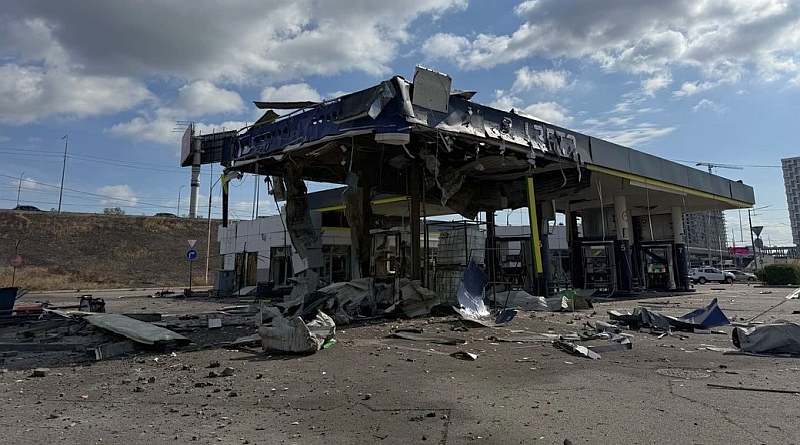
The Russian campaign of systematic strikes on Ukrainian gas station networks continues, and the main reason for this is obvious — it’s a mirrored response to the efficient and consistent series of strikes on Russian oil refineries.
Last month, Russia recorded an all-time historical minimum in the transportation of petroleum products via the RZD network, which serves as the most significant and objective intelligence marker of our successes: daily volumes fell to 440,000 tons, and the overall decline in September compared to previous years exceeded 20%.

Why are we observing a 20% drop in transportation, while direct processing at Russian refineries has fallen by almost 40%? The issue is that the opponent is feverishly engaging schemes to import fuel from India and South Korea, massively using additives, alcohols, and technological supplements to dilute the raw material and maintain the domestic market at any cost.
However, the situation for them remains extremely unpleasant, which can be easily verified on numerous aggregators and monitoring sites: the number of red gas stations in Russian regions is consistently increasing, and the absence of gasoline at stations in Petersburg or Kuban has become commonplace.
In these conditions, the higher military-political leadership of the Russian Federation ordered a mirrored response, as the conditional “Tambovs” and “Spartaks” demand images of destroyed Ukrainian infrastructure.

But how to respond symmetrically if our entire fuel system is maximally decentralized? Gas stations turned out to be an ideal solution for them. It provides a quick, vivid picture for television, creates additional economic pressure on jobs, and is an attempt to deprive the Ukrainian Defense Forces of key hubs for rest, fueling, and quick stops in areas adjacent to the line of combat contact.
Even if a regular gas station is not comparable in scale to a refinery, for the Russian IPSO, it is enough to show a burning pack of pumps to report on the next “acts of retribution.”
There are currently over 6,000 gas stations operating in Ukraine, including both official network complexes and the gray sector. In addition, there is a significant layer of departmental and army gas stations directly within units, which are not included in civilian statistics, yet function seamlessly. It’s one thing to hit gas stations along the LBS with reactive artillery such as the “Tornado-S,” missiles from S-300 complexes, or guided aerial bombs. It’s quite another to target civilian retail networks deep in the rear, where a significant portion of their “shahids” and cruise missiles are destroyed by our air defense or knocked off course by the hard press of electronic warfare means.

The strategic sense of this Kremlin plan is simple: the Russians cannot physically take out all six thousand stations as they do not have such an astronomical surplus of strike means to work against retail. The main task of these strikes is to force the owners of Ukrainian fuel networks to raise retail prices due to increased risks and insurance costs, as well as to try to collapse the delivery logistics from wheels in the frontline zones, where civilian gas stations operate as operational pit stops for military transport, medical pickups, and volunteers.
What we are observing now—systematic strikes on gas stations, “Silpo” warehouses, “Nova Poshta” terminals, and McDonald’s restaurants—is a clear marker of their strategic dead-end.
The enemy has finally resorted to a tactic of a thousand small cuts to our decentralized economy. Unable to isolate the battlefield or collapse Ukraine’s macro logistics, they attempt to disrupt operational delivery to make civilian life more expensive, increase business tariff rates, and provide a media scene for their own brainwashed population.

The main focus areas for enemy efforts remain Kharkiv and some adjacent regions, Zaporizhzhia, Kherson, the southern logistics corridor towards Romania, and Kyiv. Massive targeted strikes on refueling complexes began in April 2026. As of today, around 350 gas stations have been hit and damaged across the country, which accounts for approximately 6% of the market volume. Meanwhile, the real ratio of completely burnt objects to partially damaged ones is roughly 70 to 280.
The director of the consulting group “A-95,” Sergiy Kuyun, confirms that about 80% of stations nationwide quickly resume operations after enemy strikes. Unlike Russia, where gas stations regularly stand empty, there is no fuel shortage in any region of Ukraine. Where the enemy manages to deliver a full package of missiles or S-300, indeed, a large-scale fire occurs.
However, a direct hit on a deeply embedded reinforced concrete tank with a volume of tens of cubic meters is a rare occurrence. This number of damages cannot collapse our decentralized fuel supply system, as the first destroyed and damaged objects have already been rebuilt and put into operation. The main value and simultaneously the least vulnerable element of any modern gas station is that the main volume of fuel is stored underground. The reservoirs are securely buried, have double steel walls, and are covered with a thick layer of concrete. Ordinary drones or debris from nearby downed missiles cannot physically reach them.

That is why the repair teams of the network quickly cover the broken windows of stores with OSB boards, replace hoses damaged by shrapnel at fuel dispensers, install a new Starlink terminal — and the gas station on the highway resumes diesel supply for logistics within a week. It is simply impossible to penetrate the infrastructure, which is deeply buried underground, with drones.
The capital here is an ideal litmus test. According to the Kyiv City Military Administration, as of mid-September 2026, 16 gas station complexes in the capital were damaged. This was the same peak period when the enemy tried to systematically terrorize the capital’s retail. From the latest episodes — a drone strike on OKKO in Obolon, which damaged dispensers, but the tanks themselves remained intact, and people were not harmed. In addition, there is an official statement from the company “Ukrnafta” dated September 22: it directly reported that absolutely all its complexes in Kyiv, which were hit by recent drone attacks, have already fully restored their primary function and are operating in normal mode.
We have also begun actively targeting the enemy’s refueling infrastructure in the border area of Belgorod region and temporarily occupied territories — about 60 objects have already been hit. Meanwhile, we are preserving the main bulk of long-range strikes and middle-strikes for significantly more important targets — Russian refineries, chemical plants, defense industry facilities, and air bases. Nevertheless, we have joined this race of attrition, because why not?

In conclusion, our wheel-based delivery system bends but does not break. As of October 2026, this is the situation. We are under very serious pressure, but the enemy cannot and will not be able to achieve its strategic goals by striking the gas station network.
On the cover: Damaged Ukrnafta gas station due to a Russian drone strike in Kyiv, September 11, 2026. Photo: Suspilne Kyiv/Stanislav Svirid
