
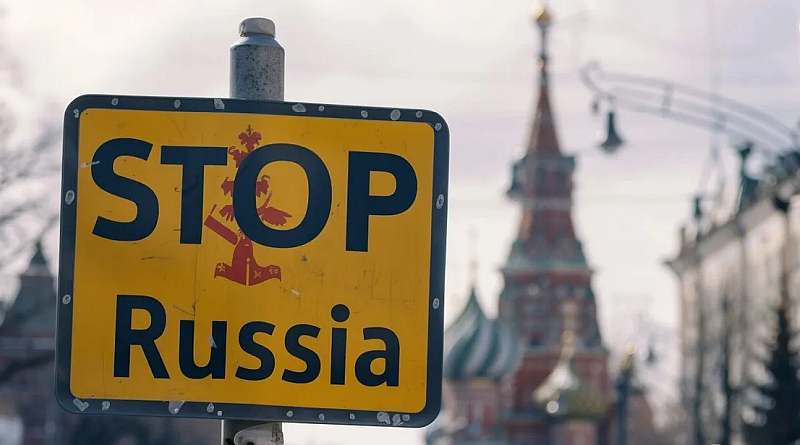

Information on current losses of the Russian Federation due to sanctions as of 21.11.2026.
1. Since the start of the full-scale war, the construction of 43 large medical facilities with a total value of over 438 billion rubles has been delayed in Russia.
– These include hospitals, dispensaries, and clinics funded by the federal budget. The construction of these facilities has already begun, but their commissioning has been postponed multiple times.
– Among the problematic long-term projects are the medical-diagnostic buildings of oncology dispensaries in Stavropol, the occupied Sevastopol, and Nalchik. In these regions, patients complain about long wait times to see oncologists. Construction of six children’s medical facilities, including hospital buildings in occupied Yevpatoria, Kursk, Chita, Tuva, Tver, and Chelyabinsk, is also unfinished.
2. Russia is reducing state funding for the electronics industry development program due to a budget deficit.
– From 2027–2029, it will allocate 12.2 billion rubles less than previously planned. This follows from the federal budget project adopted by the State Duma in the second reading.
– In 2027, program funding will be reduced from 116.7 billion to 108.1 billion rubles, in 2028 from 117.4 billion to 114.3 billion, and in 2029 from 112.4 billion to 111.8 billion rubles. This is not the first cut: in 2025, spending on the program was reduced by at least 12 billion rubles. The program was supposed to increase the share of Russian electronics in the domestic market to 70% by 2030.
– The government plans to fund part of the industry support through a technology levy on imported and Russian-produced electronics. Its introduction is planned for December 2026. The Ministry of Industry and Trade expects to collect 136 billion rubles from the levy over six years — about 22 billion rubles annually.
– Amid the budget deficit, the government is reducing direct funding for the industry and seeking alternative sources of funds for its support.
3. Since the start of the full-scale war, the European Union has transferred more money to Russia for energy resources than it has allocated to support Ukraine.
– According to the European Commission’s response to the inquiry by Member of the European Parliament Moritz Körner, from 2022 to mid-October 2026, the EU and its member states provided Ukraine with approximately 231.5 billion euros in aid. During the same period, import payments from the EU to Russia amounted to 232.05 billion euros, including for gas and other energy resources.
– The nearly identical sums highlight the contradiction in EU policy: simultaneously financing Ukrainian resistance while European countries continue to provide Russia with significant revenue from energy exports. Part of these revenues supplements Russia’s budget, which funds the war against Ukraine.
– France has transferred about 40 billion euros to Russia for energy resources, while allocating approximately 16 billion euros in support of Ukraine. A similar disparity is recorded in the case of Italy.
– MEP Moritz Körner criticized EU policy. He stated that European countries are effectively financing the Russian energy sector on a scale comparable to the aid for Ukraine and urged for increased support for Kyiv and reduced funds flowing to Russia.
– Importantly, the 232.05 billion euros represents the cost of import payments, not the amount that directly went into the Russian budget. Part of the funds covers production, transportation, and company operating costs. However, energy purchases remain one of Russia’s sources of foreign currency income.
4. Tankers with Russian diesel fuel arrived in Brazil instead of the USA, where they were reportedly supposed to deliver fuel under agreements between Washington and Moscow.
– None of the tracked Russian shipments have yet reached American ports. The Leruo tanker, under the flag of Sierra Leone, loaded in Primorsk, arrived at the anchorage in Itacoatiara, Brazil. A Russian product tanker “Primorye” also arrived there. The third vessel, Beast, is traveling along the South American coast, with its signal indicating Brazil as the destination.
– Each of the three tankers may carry about 40,000 tons of diesel fuel. Other ships, previously considered part of the deliveries to the USA, changed course and headed to Mediterranean ports.
– Previously, an agreement was reported for supplying up to 300,000 tons of Russian diesel to compensate for the deficit on the global market. However, deliveries to the USA have not yet occurred. Possible obstacles include sanction risks and resistance from American politicians.
– Brazil continues to accept Russian energy carriers. According to data cited by Brazilian media, referring to the Centre for Research on Energy and Clean Air, the country has received 34 shipments of Russian diesel this year, totaling about 1.11 million tons.
5. Denmark calls on the EU to tighten entry restrictions on Russians.
– This occurred following the prevention of a likely assassination attempt that, according to Danish law enforcement and intelligence services, was being prepared by Russian intelligence in September.
– The potential target was an American-Ukrainian rapper. Danish Foreign Minister Lars Løkke Rasmussen called such actions unacceptable. Copenhagen has already expelled a Russian military attaché.
– In a letter to EU governments, Denmark proposes suspending the issuance of tourist visas to Russian citizens and rejecting the recognition of non-biometric Russian passports in all 29 Schengen Area countries.
– Copenhagen also urges more frequent issuance of national visas, which do not allow free movement within the Schengen Area, and tightening restrictions for current and former Russian combatants. The package of proposals is to be discussed by EU ambassadors in Brussels on Monday.
– The Russian embassy dismissed the accusations, calling them unproven. European Commission President Ursula von der Leyen expressed solidarity with Denmark.
– Brussels is also preparing a new security strategy and the 22nd package of sanctions, within which additional visa restrictions for Russians are being considered.
