
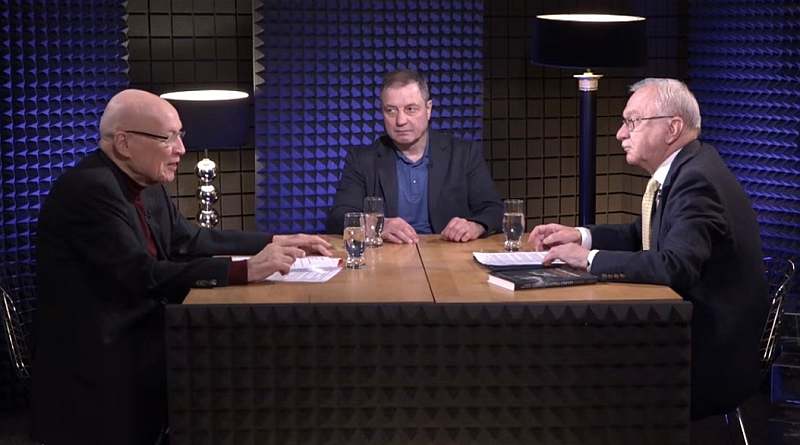
The book “The War of the Future” has been published, another joint work of Volodymyr Horbulin with Valentyn Badrak. This is their third joint fundamental work dedicated to the Russo-Ukrainian war (“Russian War Against Ukraine. How to Finally Break the Four-Hundred-Year Cycle” (2025), “Over the Abyss. 200 Days of Russian War” (2022)). Even before the full-scale invasion, Volodymyr Horbulin published the book “How to Defeat Russia in the War of the Future” in 2020.
This new book became the occasion for a meeting and provided an opportunity to discuss the global context, the impact of the war in Ukraine on the world order, the formation of alliances, the balance of power, and the vision of the future. After all, the Russo-Ukrainian war marked the beginning of the destruction of the world order established after World War II.
Ihor Dolhov (I.D.): – The book “The War of the Future” is not your first research on the Russo-Ukrainian war, which is quite understandable, as Ukraine has been in a state of war since 2014. You wanted to summarize the experience of four years of full-scale warfare. Since, as known from the times of von Clausewitz, war is the continuation of politics by other means, how can this Putin’s war be assessed in a geopolitical sense? Has the change in the world order already taken place or is the process ongoing?
Volodymyr Horbulin (V.H.): – I would not rush to make final conclusions. It seems to me that we are in a pivotal time because this war has brought a lot of new elements, even from the nature of the war. And this is probably the main conclusion. Secondly, today no one can firmly state when it will end.
That is why this book appeared – our joint idea with Valentyn. This is not the first book written during the war. In 2022, we very carefully recorded and reacted to everything happening on the fronts, then the first book titled “Over the Abyss. 200 Days of the Russo-Ukrainian War” appeared. And at the end of 2023, the second book was published, titled “Russia’s War Against Ukraine. How to Finally Break the 400-Year Cycle.” In both of these books, our joint work reflected everything happening in Ukraine-Russia relations, in Europe-Ukraine relations. And the United States was still present and continues to be present, maybe not to the same extent as before, in this war.
Four years of war have provided very serious material for reflection on what is happening in the world today. Because after the Second World War, and later, when the Soviet Union collapsed and ceased to be a great power, there were many, I would say, hopes that everything that happened in the 20th century, humanity seemed to breathe out: thank God, two wars took place, there were a lot of casualties, especially the Second World War, which claimed 50 million lives. And the confrontation of the nuclear blocs – the Western bloc and the socialist camp – also ended, as everyone remembered the events that practically brought the world to the brink of nuclear war, and it could have ended the existence of this world. This did not happen, and everyone hoped that when we entered the 21st century, we would finally breathe out and leave it all behind. But it didn’t happen.
Valentyn Badrak (V.B.): – In fact, now we have seen, before our eyes, how Putin, with Xi Jinping’s blessing, has effectively destroyed the global security system. And the world, especially the Western camp, was absolutely unprepared for this. There was a moment when I personally thought that the Western camp might go on the offensive. I’m talking about the G7 summit in May 2023 in Japan, where there was a very timely idea to move to a situation where Russia would be banned from any exports except food and medicine. This was announced, but they couldn’t implement it, they were afraid. And it was a turning point when the Western world effectively programmed a sustained defeat at a certain stage. Only now do we see that such positions are returning, and surprisingly, they are coming from Europe.
I.D.: – Indeed, retrospectively, certain things are more noticeable, things to which we could not pay due attention or fully understand. But the world found itself in such a situation, and Ukraine became the object of Russian aggression. You said this happened with Xi Jinping’s permission. Was this the only reason why Putin dared to attack? Just because he sought revenge? Because the West had lost its sense of threat?
V.H.: – From the very beginning of Putin’s coming to power, I had some concerns, and here it’s impossible not to mention the Second Chechen War, the complete bombing of the Chechen capital, and then the explosions in Volgodonsk, in Moscow, and then the theater hostage situation in Moscow and all subsequent events. This set the tone for a very serious attitude toward the person who took the helm in Russia at that time.
Next, everyone seems to tie the open declaration of Russia’s aggressive intentions to 2007, to Putin’s speech at the Munich conference, where he said that the greatest tragedy of the 20th century was the collapse of the Soviet Union. But I would shift the timeline slightly to 2003, when Russia attempted to build a dam and annex our island Tuzla near Crimea to its territory. On that day, President Kuchma was heading to Brazil with a visit, where we had serious plans regarding a range for joint missile programs, and I was accompanying Leonid Danylovych.
Initially, Russia’s actions seemed like a joke, but the unfolding events showed that it was a serious threat to Ukraine as a state, primarily because of Crimea. I can say that Leonid Danilovych tried several times to contact Putin by phone, but in vain, he couldn’t get through to Mr. Putin. Kuchma decided to return; he flew to Simferopol and then by helicopter to Kerch. He then gave the appropriate commands, after which this, I would say, “peaceful attack” on our Tuzla Island ceased.
I.D.: – Let’s return to the major events that change the course of history. After World War I, the League of Nations was created, and after World War II, the United Nations emerged. The beginning of the Cold War was marked by the creation of NATO by Western countries. Then there was détente, and the OSCE was formed. The end of the Cold War was marked by the dissolution of the Soviet Union and the disappearance of the Warsaw Pact. Then there was NATO expansion, EU expansion, and the transformation of the EU into a supranational organization. What will be the next step? How will this war end? Will there be institutional signs that a new stage is coming?
V.G.: – What is happening today could not have been seen before, especially in Europe. Practically all European countries began to feel, I would say, the chill that came with the start of the Russian-Ukrainian war. Suddenly, European countries, especially northern countries and those of the former socialist bloc, felt that the possibility of war was at their borders. This could not help but be concerning as a geographical factor. But there was also a political effect; it was essentially a violation of all the agreements between the Soviet Union and the United States when the confrontation between the two blocs ended, and even to some extent, the temperature of the nuclear arms race decreased.
And suddenly – open military aggression that put the whole world on alert. And everyone suddenly began to feel that the United Nations was no longer completely the organization that could stop everything.
I.D.: – So this happened, as is always the case in history, for a sum of reasons. The question is – what next? You said that no one can now predict when this war might end. Moreover, you said: “Russia can only be defeated with asymmetric actions. This is not guerrilla warfare, not chaos, it is finding the enemy’s weak spots and striking there.” You also stated that Russia and Putin have two objectives: “…the first is the destruction of the Ukrainian state and its statehood, the second is the return of Russia’s global political leadership in the world. The first goal is intermediate, the second is strategic. However, achieving the second without the first is impossible.” And these goals have not changed in the four years of war, as in your book, nor in the four years and several months as it is now. The conclusion suggests itself: as long as Russia exists in its current form, there will be a threat to Ukraine. Is that so?
V.G.: – I would agree without any doubt with your conclusions. Moreover, it is essential to recall the year 2018 and Putin’s address to the Federal Assembly of the Russian Federation, where there were two messages that could not be ignored. Firstly, he said that the three nations – Russian, Belarusian, and Ukrainian – have one root and should be together. Secondly, he cited examples of several developments made at that time by the military-industrial complex of the Russian Federation, including medium-range missiles and a new intercontinental missile complex to replace the Dnepropetrovsk-created complex R-36M2, considered the best in the world.
I was surprised that practically no one in Ukraine reacted to these messages at the time; we somehow remained silent. This caused me serious concern and led me to feel that something was approaching. Therefore, in 2020, I published a book with a very clear title: “How to Defeat Russia in the War of the Future.”
After this, I received many complaints and accusations that I was almost a “warmonger,” pitting Russia and Ukraine against each other. I understood at the time and saw things that not everyone saw, I saw a state that at that time took more than one step, which allowed such a conclusion.
V.B.: – But in the end, it turned out as you wrote in this book. And this has been acknowledged during the current war. I would add that Volodymyr Pavlovych touched on a military aspect – the asymmetric response. And quite rightly, because now we see how asymmetric strikes work.
Regarding the geopolitical decision, it is worth mentioning that in 2018, the Joint Expeditionary Force, international forces led by the United Kingdom, became operational. Therefore, it seems to me that the first level of ensuring protection in the geopolitical arena will be the creation of a subregional union, which might be the solution. And right now, powerful international exercises are being conducted, where Ukraine plays a leading role. I think this is the first level of the solution.
V.G.: – I support this message, it is very important.
I.D.: – We will develop it now. But before we talk about possible developments, I would like to ask you about the fate of the “Collective West.” Does it still exist? Are the United States still the leader of this Collective West? Did Trump, when elected for the second time, instead of opposing Putin, only strengthen him? Did two stars converge? What’s next?
V.G.: – You are a bit mistaken, there are not two stars in the world now, but three. At least, our world is imagined in my opinion by the esteemed President Trump: it’s him, Xi Jinping, and the third is Putin. Certainly, Trump constantly repeats that the United States is the most powerful country in the world. But some of his actions surprise me: Greenland, Canada, the Venezuelan story, which will forever remain in world history, as nothing like this has ever happened. And at the same time – all his flirtations and constant negotiations with Putin.
V.B.: – I would add that Trump pushed NATO to the brink of collapse, and now a Russian attack scenario is quite realistic. Even if not an attack, at least a hybrid operation, for example, against Estonia or even against Poland. The West, in my opinion, currently lacks a clear leader. In fact, I mentioned these Joint Expeditionary Force, because the UK could fully claim leadership, as Northern Europe, the UK, and the eastern flank are more decisive because they feel the threat more keenly.
I.D.: – You mentioned NATO, about Trump dismantling NATO. So, maybe NATO has played its role? Maybe that’s just what’s needed? Perhaps this is the logical evolution of history, and something else is forming? Incidentally, Commissioner Kubilius also spoke about this. He said NATO membership is currently inaccessible for Ukraine, but Ukraine should focus on creating a separate mechanism that allows for the rapid unification of military resources of partners.
V.G.: – Frankly speaking, I’m somewhat coming to that conclusion myself. In my opinion, it would be very interesting to have such a union outside NATO – the United Kingdom, Poland, and Ukraine. It could be a sort of “binding line” from the British Isles through France, Germany, and Poland to Ukraine. This could then create a very interesting peace assurance line in Europe.
I.D.: – One could argue that we are seeing prototypes of this, and it is no longer just an idea; it’s to some extent a practice. We have Ramstein – a response to Russian aggression, but not only that, it’s also the formation of a broad coalition. There is also the Coalition of the Willing, France and its leadership. There are currently interesting processes happening as the EU realizes that the UK, Ukraine, Norway are needed for future security; without these countries, it will be difficult, if not impossible. Thus, the European Union is waking up, though very slowly. Just a few weeks ago, Macron said after the European summit in Cyprus that Europe needs to wake up, saying “we need to wake up.” After four years of war, how long can they take to wake up?
V.G.: – It seems to me that he is late with such conclusions. But you know, the constant threat that prevailed during the standoff of two blocs always looms over Europe. And they did not forget that it could happen that Europe would be the first to lose its borders: not because they would be captured, but because it could become a battleground. And it was close to the Soviet Union.
V.B.: – This spring, in fact, proves that there is real integration of the Ukrainian military, Ukrainian defense industry into the European defense space. And basically, now we are seeing the beginning.
I.D.: – These are very important signals. But, as you have already noted, one of the key issues arises – nuclear deterrence. In a situation where the United States is gradually withdrawing, Europe needs to increase its nuclear options. And it logically raises the question of Ukraine’s possible participation in these processes. They have already begun, with Poland and France talking about joint actions, Britain expressing its opinion on this topic, albeit very cautiously, and President Zelensky speaking at the political community summit in Yerevan about the need for Europe to be able to defend itself, understanding missile defense but also possibly nuclear deterrence. Is it possible? How long could it take?
V.G.: – Firstly, this political thought appeared earlier, not now. And we must give credit to the leadership of France and England, who stated that their nuclear potential is insufficient to counter Russia.
Such statements were made, and around this, searches began for what could be done next. Ukraine once played a very significant role in the creation of missile weapons, which are carriers of nuclear weapons, but actually never engaged in the development of nuclear weapons. So there were concerns about whether to start from scratch or not. And I allowed myself to write in one article that
the simplest path that Europe can take together with Ukraine is the creation of joint developments of nuclear weapons.
I believe that the foundations and, I would say, the creative potential of Ukraine, specifically the creative potential, could significantly add to the support of France and Germany to create European nuclear weapons.
I am not calling for this, but it must be thought about. It may not happen today; it is a distant future, but it could be tomorrow’s reality.
V.B.: – I want to add that when we prepared the book and got ready for today’s conversation, we concluded that missiles must remain the number one weapon. Because missiles can destroy infrastructure and military-industrial capabilities, and therefore
politically, it would be very beneficial for Ukraine to work with Europe on missiles.
Just recently, Turkey demonstrated its intercontinental ballistic missile, and Germany with France are now working on a ballistic missile with a range of 2000 kilometers. We should aim to join this missile club.
I.D.: – I hope we have not lost experience and knowledge in this field. And this is perhaps Ukraine’s primary task and opportunity – to contribute to the creation of carriers for various purposes.
V.G.: – Yes, medium-range missiles – that’s from one and a half to five and a half thousand kilometers – are insufficient for solving a number of tasks. And long-range ballistic missiles – that’s from five and a half thousand and beyond. Therefore, it’s a very interesting aspect.
I.D.: – Certainly, we have had contacts with other countries in this field before, and they need to be not only maintained but also strengthened. Especially since the time and circumstances are favorable; Europe has realized the need to form a joint defense complex, and this is already being done.
But let’s now return to the ground, to the theater of war. There is a constant theme of peace negotiations, although their content and subject are not very clear. Moreover, there are experts, including the British analyst James Sherr, who said that Europeans are increasingly realizing that there is a fundamental incompatibility of interests and goals between Ukraine and the Russian Federation. The only reasonable course is to continue to stand by Ukraine and not allow Moscow to win by military or political means. And the conclusion: “Any resolution of the war will occur on the battlefield.”
V.G.: – Frankly speaking, I have not read about this, but I agree with the conclusion of the esteemed Mr. Sherr. The very nature of this war has introduced new impulses in terms of the logic and development of the war and, most importantly, in terms of anticipation. This war may end, or it may not. There has never been such a war in the world.
V.B.: – I will add two tactical aspects. I already mentioned that this spring is a very significant episode of the entire global confrontation. Now, in particular, mid-strike drones are starting to play a key role. This is not such a great range as required to hit, say, an oil refinery somewhere 1700 kilometers away; the fundamental difference is that the drone needs to overcome the frontline zone to destroy logistics centers, headquarters, control points, and so on. And now Norway is financing the production of mid-strike drones for 7 billion dollars, and Germany has also announced the production and supply of a very large number of such drones.
And from here, the main point follows:
when we dominate in mid-strike, that is, we can knock out logistics, it will create prerequisites for de-occupation, prerequisites for victory.
I.D.: – So, we have a common understanding of what is happening and what might happen next. I would like to quote Churchill, which I think is very timely and directly related to peace talks. He wrote about concessions to Hitler: “But it was useless to think that if we try to make peace now, we would get better terms than if we fought.”
V.G.: – Churchill did a lot for the victory and the involvement of the States in the coalition. He did not refuse to act even against his will; during the war, he took many steps that caused misunderstanding in England, no one expected him to behave like that. He did a great deal to defeat Germany. And his position was, I would say, tough, even towards his friends.
I.D.: – The lessons of history, unfortunately, are noted for not being very well learned. To be confident and win on the battlefield, we need partners and allies; on our own, against a major nuclear power, we are unlikely to do it, if it’s possible at all.
V.G.: – I have already written somewhere that Ukraine cannot defeat Russia in the war on its own. I drew a lot of criticism, but we must not forget that Russia is the second nuclear power in the world.
I.D.: – In your collection “Chronicles of Predictions,” many of your forecasts have actually come true.
V.G.: – That’s right. This book compiles articles I published in “Dzerkalo Tyzhnya” from 2006 to 2017. There is a very interesting article from 2017 called “The House That Trump Builds.” Now that the events of the past two years have unfolded, people have called me asking how I managed to portray the esteemed Trump in 2017 without erring in the vision for 2026. I say it’s just a prediction and nothing more. I just remember I was criticized for that article back then.
I.D.: – Regardless, we have reliable partners and others whom we still need to convince and attract to our side. We will, I hope, continue to do so, especially since the war in the Gulf provided such an opportunity.
The Ukrainian experience and Ukrainian drones have been appreciated, primarily in those countries that were attacked by Iran. Are drones and their use in systems and interactions already part of future warfare? Has the war of the future already begun?
V.G.: – This topic is very difficult to discuss. On one hand, fragments of a possible third world war practically exist. And they exist not only in the post-Soviet space, they also exist in the Middle East. They do not fade in the relations between China and India, and they are even more noticeable in the Far East, with events that occur from time to time on the Indochinese Peninsula, as well as around the Philippine Islands and Taiwan. All these are wounds that have not fully healed, and they carry a threat.
Will humanity have enough sense? Considering that a third world war might be the last, I understand what I am saying, and I have hope there will be enough. But what is happening today in international relations, and I mentioned Greenland, Canada, and Venezuela for a reason, absolutely does not correspond to the canons of normal international diplomacy. The situation is extremely complicated, and at any moment, an unexpected spark could occur somewhere else, leading to a local conflict that could unpredictably escalate into a world war. Today, the whole world is in great tension. I think everyone should remember this.
V.B.: – Indeed, much of what is happening now will be in the war of the future. But if we look at the overall panorama of events, we are currently on a wave of technological competition, but still quite far from the crest of the wave.
I.D.: – And at the crest of the wave – does artificial intelligence reign there?
V.B.: – I think artificial intelligence and weapons based on new physical principles will be 100% present.
V.G.: – Already today, artificial intelligence is present in almost all kinds of weapons. I don’t know where it’s not present. Valentin and I discussed the nature of this war, and I even found a definition for it: the trajectory of military-technological innovations.
Let’s look closely at the Russian-Ukrainian war. It has been ongoing for five years now, and I don’t know anyone today who could say when it will end because it has absolutely new traits.
And one more thing. We are increasingly moving towards the use of cheap but mass weapons, and everyone understands that quickly establishing the production of ballistic missiles is impossible for anyone now. That’s the first point. Furthermore, military actions are increasingly mixing with what can be called the economic factor of war.
And further – one cannot help but notice that no one is talking about tanks or armored personnel carriers anymore, which have been withdrawn so far from the line of direct contact that you can’t even see where they are located.
I.D.: – Indeed, the changes are impressive, predicting them would have been nearly impossible. Moreover, we now see how the US, with all its might, intelligence, analytical apparatus, and military capabilities, faces unexpected problems in Iran, whose unpredictable consequences affect the entire world.
V.G.: – And Trump declared victory, but in reality… And the funniest thing is the size of the Strait of Hormuz. It seems like you could gather from both sides and block it with your hands. Yet, the truce never happens.
I.D.: – In conclusion, I would like to return to your book. It was conceived and written as a summary of four years of war. At the end, you talk about three possible scenarios for the development of events after four years. Now it’s been longer, now there is the experience of the war in Iran, a slightly different understanding has been added, because time does not stand still. How would you assess today whether the probability ratio between these three scenarios has changed?
V.B.: – The situation looks like the ratio has changed in our favor. In principle, we predicted this because the hardest winter was expected. But the issue was not just to survive the winter; it was also about building up several components. Firstly, unmanned forces dominate the battlefield, including ground robotic complexes. This is very important because it involves saving the lives of our soldiers and increasing the losses of Russian soldiers. For example, Russia operates 20 types of UAVs, while in Ukraine, there are over 250 manufacturers of ground robotic complexes. And if last year 15,000 such complexes were contracted, now already in just half a year, 25,000. This is the first point.
Secondly, as I have already said, it is the revelation of middle-strike capabilities, i.e., medium-range drones destroying logistics, and this is an extremely important element, a precursor to de-occupation.
And thirdly: we very much tied our advantages to missiles. Unfortunately, there are certain delays on the part of the state sector; although we have a state serial ballistic missile, it still has a significant number of deficiencies. But now we have eight private manufacturers and developers of ballistic missiles, and we would like the state to support them more quickly.
Because missiles are weapon No. 1; without them, we will not destroy Russia’s defense industry. Drones with a 50 kg warhead won’t do it. But missiles with a 350-450 kg warhead – that’s a completely different story.
V.G.: – I would like to add one thing. When the fierce fighting began and the enemy stood near Kyiv, we felt the spirit of war, and the thought kept recurring: what will happen next and how will it be? Then everyone must do everything, forgetting about their personal interests. And this was a very important element because the nation then, in the first months of the war, rallied. And this is a very good characteristic of the Ukrainian nation as such.
I.D.: – Very true, without unity, we wouldn’t have everything we have now. I want to say that your conclusion that Ukraine now has more confidence and more opportunities completely aligns with what Antony Blinken, the former Secretary of State of the United States, stated. He said that Ukraine is now seizing the initiative, and it is indeed the case.
In conclusion, I would like to wish, and hope it happens soon, that we gather here to discuss your new book – “How We Defeated Russia.”
Photo: Danylo Antonyuk/Ukrinform
