

The international confrontation over the export of Russian hydrocarbons moved from legal-sanction measures to direct force on the night of June 14.
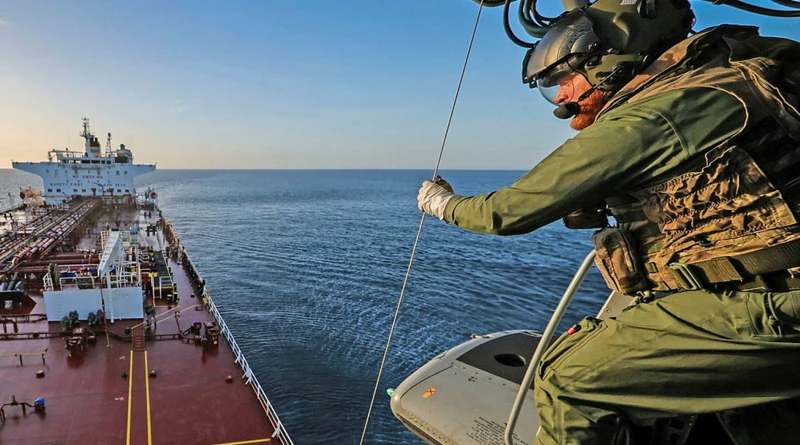
Elite units of the Royal Marines of Great Britain, in cooperation with operatives from the National Crime Agency, landed and arrested the oil tanker Smyrtos in the English Channel. The vessel, carrying 100,000 tons of Russian crude oil of the Urals type from the Ust-Luga terminal to India, became the first in history of the Russian “shadow fleet” tankers to be physically captured by the UK in its territorial waters.
The six-hour military-police operation was prepared under strict secrecy and in close coordination with the French side. The operation involved the frigate HMS Sutherland, the minesweeper HMS Ledbury, the Royal Air Force’s P-8 Poseidon long-range radar reconnaissance aircraft, as well as helicopters from the Naval Air Group.
Currently, the tanker has been escorted and forcibly anchored off the southern coast of England under the pretext of investigating environmental risks and security violations.
The legal basis for the storming was the international legal status of the vessel. The Smyrtos tanker (Aframax, deadweight around 107,000 tons, built in 2009) previously sailed under the flag of Cameroon. However, shortly before the incident, Cameroon, as part of a large-scale cleanup of its registry, excluded the vessel from the register.
Finding itself de jure “without a flag,” the vessel lost its sovereign immunity, which allowed Britain to apply Article 110 of the UN Convention on the Law of the Sea, granting the right to inspect and arrest stateless ships.
The forceful arrest of Smyrtos by London logically continues a series of recent tanker detentions by France, including the recent interception of the Tagor vessel in the Atlantic, and the ships Deyna and Grinch. Western countries are moving from a declarative “price cap” policy to creating a solid barrier at key chokepoints in global logistics, specifically in the English Channel and the Danish straits. The ultimate goal is to completely sever the Baltic ports of Russia from the Asian market.
What’s happening seems like a demonstrative dismantling of the previous system of maritime law and the legalization of state “privateering” practices. The West is shaping a new normal where forceful dominance replaces conventions.
The use of the formal pretext of “lack of Western P&I insurance” or “technical flag cleansing” frees the coalition’s hands for targeted arrest of any vessel carrying Russian raw materials. The Ukrainian side has already called on EU countries to take the next step: to move from detentions to complete confiscation of transported oil.
The signal from the British authorities provoked an immediate reaction from shipowners. Immediately after the boarding of Smyrtos, other “shadow fleet” tankers, particularly Maini, Lion I, and Sona, carrying Russian oil, urgently changed course to avoid entering the English Channel. Vessels are forced to reorient to a much more extended, dangerous, and economically costly route around the British Isles through the North Atlantic or around Ireland.
The created precedent will inevitably lead to an explosive increase in the cost of chartering “shadow” tankers, increasing insurance premiums, and lengthening the delivery chain. This hits the profitability of Russian exports, partially offsetting revenues directed to finance military needs.
The episode with the Smyrtos tanker shifts the confrontation at sea to the level of direct physical opposition. The hunt for the Russian “shadow fleet,” comprising over 700 vessels removed from Western control, is officially open. Moscow faces a critical challenge: either to develop mechanisms of asymmetric, including military-political, response to boarding actions by NATO countries in international straits, or to come to terms with the gradual strangulation and forced reformatting of the entire maritime export map of Russian oil.
In the image: Scenes of the British special forces landing on the “shadow fleet” tanker. Photo: Ministry of Defense of the UK
