
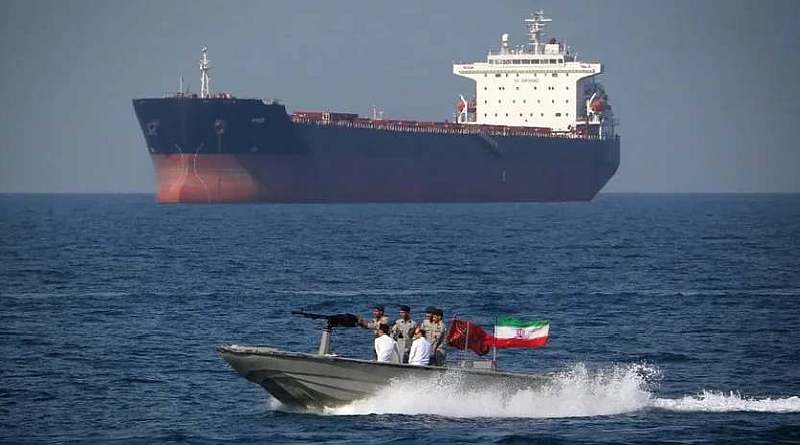
Donald Trump stated that he agreed to suspend bombing Iran for two weeks on the condition that Tehran immediately unblocks the Strait of Hormuz. Iran confirmed its readiness to agree to a ceasefire, putting forward a number of conditions. Peace talks are expected to start in Pakistan on April 10.
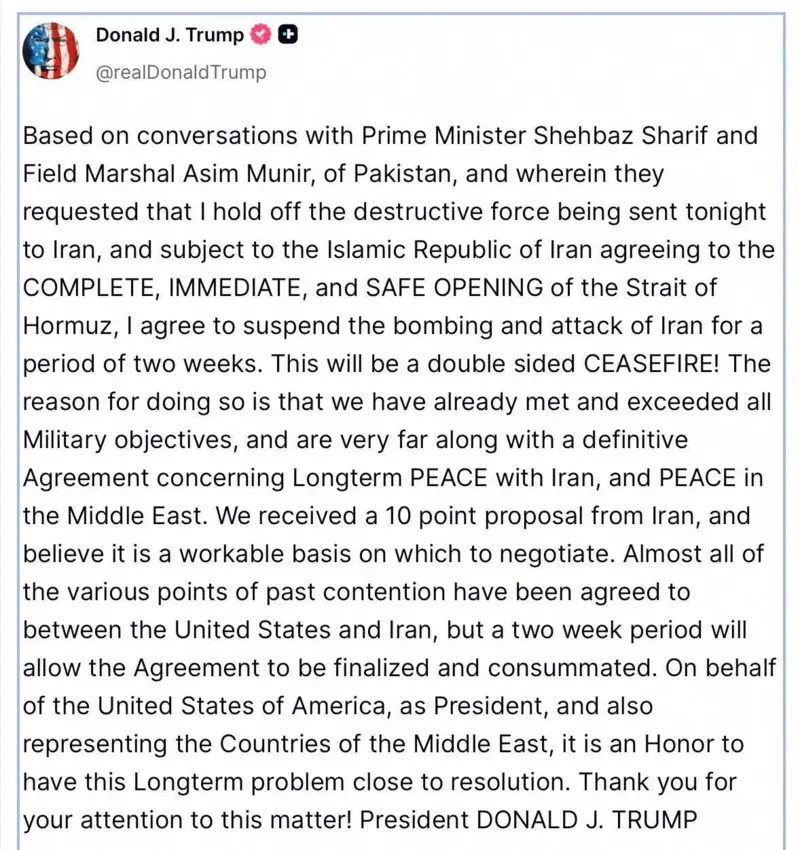
“I agree to suspend bombing and attacks on Iran for a period of two weeks,” Trump wrote on social media.
According to him, he received a “10-point proposal” from Iran, which he considers a “working basis for negotiations.” Trump noted that two weeks are needed to negotiate a final agreement.
If Iran refuses to unblock the Strait of Hormuz, through which 20% of the world’s oil and liquefied gas passed, Trump threatened to bomb Iran’s infrastructure, including bridges and power plants, as well as destroy the “Iranian civilization.”
The ultimatum was to expire at 01:00 GMT (03:00 Kyiv time) on April 8. When Trump wrote about the “ceasefire,” there was a little over an hour left until this time.
In the last hours, Pakistan, acting as a mediator between Iran and the USA, publicly announced that it had conveyed a peace proposal to the parties, which required Washington to suspend bombing for two weeks and Tehran to open the strait.
In his post, Trump mentioned that he had spoken with Pakistani Prime Minister Shehbaz Sharif and Field Marshal Asim Munir, and they asked him to “hold back the destructive force directed at Iran tonight” (it was still evening in the USA).
“Almost all previous contentious points between the United States and Iran have been agreed upon, but the two-week period will allow the agreement to be finalized and implemented,” the president wrote.
Approximately an hour after Trump’s statement, Iranian Foreign Minister Abbas Araqchi, as well as separately the Supreme National Security Council, announced that Tehran agrees to a two-week ceasefire and the resumption of shipping through the Strait of Hormuz.
Araqchi noted that the movement of ships will be possible “in coordination with the Armed Forces of Iran and with due consideration of technical limitations.”
A few hours after the announcement of the ceasefire, Trump posted on Truth Social, calling this moment a “great day for peace around the world.”
“Iran wants this, enough is enough! As with everyone else.”
He noted that the US “will help with congestion in the Strait of Hormuz”:
“Many positive actions ahead! People will make big money. Iran can start the rebuilding process. We will prepare various resources and just be there to make sure everything goes well. I’m sure it will. Just like in the USA now, the Middle East can have its own ‘Golden Age.’
The Minister of Foreign Affairs of Ukraine, Andriy Sibiga, wrote about welcoming the agreement between President Trump and the Iranian regime regarding the unblocking of the Strait of Hormuz and a ceasefire, as well as Pakistan’s mediation efforts.
“America’s determination is working. We believe it is time to show enough resolve to force Moscow to cease fire and end the war against Ukraine.”
Following the ceasefire announcement, Iranians gathered in the country’s capital with flags and portraits of Iran’s Supreme Leader Mojtaba Khamenei.
Reaction to the truce in Iran is mixed, reports BBC Persian correspondent in Washington, Khashayar Joneidi.
People feel relief, as now no one will attack power plants. However, regime opponents will again confront the government, which has become angrier.
Peace in 10 Minutes
Iranian state television almost immediately reported Trump’s statement, presenting the situation as follows: “Trump announced a two-week ceasefire, accepting Iran’s terms to end the war.”
His statement was also called a “humiliating retreat from anti-Iranian rhetoric.”
Pakistani Prime Minister Shehbaz Sharif announced that the ceasefire took effect “immediately.” According to him, the parties agreed just 10 minutes before the ultimatum expired.
Although the ceasefire was supposed to take effect, during those minutes, air raid sirens sounded in U.S. allied countries: Israel, the United Arab Emirates, and Saudi Arabia. According to the army, Israel was repelling an Iranian missile attack, and Gulf countries were being hit not only by missiles but also by drones.
Iran claimed that it only blocked shipments through the strait belonging to its “enemies,” and some tankers indeed passed through the section of the strait belonging to Iranian territorial waters. However, the flow of goods through the strait significantly decreased, affecting not only oil and gas but also other important goods — fertilizers, spirits, sulfur, and sulfuric acid, all by-products of oil refining.
After the ceasefire announcement, oil prices fell on global markets, but prices still remain significantly higher than before February 28, when the war began.
The war with Iran was unpopular in American society: even many Trump supporters were dissatisfied with the rising cost of gasoline and the risk of increasing inflation.
Some of them also perceived the president’s actions as a breach of promises not to start new wars.
Position of Israel
Israel stated that it supports Trump’s decision to suspend strikes for two weeks on the condition that Iran immediately unblocks the strait and ceases all attacks on the U.S., Israel, and regional countries.
Israel also supports U.S. efforts to ensure that Iran no longer poses a nuclear, missile, or terrorist threat to America, Israel, its Arab neighbors, and the world.
The United States assured Israel that in future negotiations, they aim to achieve these goals, which are jointly shared by the U.S., Israel, and its regional allies.
The office of Israeli Prime Minister Benjamin Netanyahu released a statement saying that the ceasefire regime “does not apply to Lebanon.”
In recent weeks, Israel has deployed ground troops into southern Lebanon. The country’s authorities claim they will maintain control over the territory south of the Litani River until they eliminate any threat from “Hezbollah.”
The Israeli army is destroying houses and villages in areas where, according to their reports, “Hezbollah” militants operated. As a result, hundreds of thousands of people have left their homes. Israel emphasizes that it will not allow them to return until “Hezbollah” forces are ousted.
Shortly before the ceasefire announcement, Lebanon’s Ministry of Health reported that an Israeli strike on the city of Sidon in the south of the country killed eight people and injured 22 others. In recent weeks, “Hezbollah” has continued to launch rocket attacks on Israel.
The leader of the Israeli opposition, Yair Lapid, criticized Benjamin Netanyahu’s handling of the war. Lapid calls the situation a “political disaster” for Israel.
“Israel wasn’t even at the negotiating table when partners were making decisions about the foundations of our national security,” notes the opposition leader.
“The army did everything required of it, the people demonstrated incredible resilience, but Netanyahu suffered a political and strategic failure and achieved none of the goals he set for himself.”
What is the 10-point proposal?
Donald Trump mentioned a “10-point proposal” in his post, which is known from a statement on Iranian state television. In his summary, these points are:
- Complete cessation of war in Iraq, Lebanon, and Yemen.
- Full and permanent cessation of war against Iran without any time limitations.
- End all conflicts across the region.
- Open the Strait of Hormuz.
- Establish protocols and conditions to ensure freedom and safety of navigation in the Strait of Hormuz.
- Full compensation to Iran for reconstruction expenses.
- Full commitment to lifting sanctions on Iran.
- Unblock Iranian funds and frozen assets held by the United States.
- Iran fully commits not to pursue possession of any nuclear weapons.
- Immediate ceasefire on all fronts begins once these conditions are approved.
The Supreme National Security Council of Iran listed additional conditions in its statement, which it claims the US agreed to:
- Guarantee not to repeat aggression against Iran.
- Preserve Iran’s control over the Strait of Hormuz.
- Recognize Iran’s right to uranium enrichment.
- Cancel all sanctions — both primary and secondary.
- Terminate all UN Security Council and International Atomic Energy Agency resolutions.
- Withdraw American troops from the region.
- Cease military actions on all fronts, including those against the “Islamic Resistance in Lebanon.”
Negotiations between the US and Iran will take place in the capital of Pakistan, Islamabad. According to the Council’s statement, they are allocated no more than 15 days.
