
Russia is taking the use of unmanned systems to a qualitatively new level. The aggressor is systematically deploying a new type of military force with a unified digital framework, forcing Ukraine’s Defense Forces to respond to new challenges. In this war, the winner will be the one who quickly converts combat experience into systematic solutions.

By the end of summer, it became clear that the lack of interceptor missiles for missile defense is a bottleneck for Ukraine’s Armed Forces, prompting the aggressor country to build up this very component of terror. Throughout the fall, the enemy used about 150 ballistic, 80 cruise, and 360 small-sized cruise missiles of the “Banderol”/”Dan-T” type. This campaign should be seen not only as an attempt to destroy Ukraine’s energy sector but also as an operation to weaken Ukraine’s strategic resilience.
But as they say, not missiles alone. During the same period, 10,946 strike UAVs of the Shahed-136/131 type, “Geran-1/2”, “Gerbera”, and “Parodiya” UAVs (the latter are not strike but overload the air defense system) flew into Ukrainian airspace. And the hit of the season — jet UAVs: 9,458 units of Shahed-238, “Geran-4/5”, and other jet modifications.
The average interception rate is 80% for regular UAVs and 60–70% for jet ones.
It’s not just energy suffering damage. Odesa has now become a test ground for new tactics and technologies. Before the war, the strategic importance of the Greater Odesa ports was described by the figure of 66% of Ukraine’s seaport cargo turnover. And this has been unsettling to the Kremlin for several decades.

This autumn, Odesa was attacked 55 times. On September 1, the Orlivka checkpoint, an international ferry checkpoint on the Romanian border, was hit. On September 29, port facilities were damaged, and on October 18, a large-scale impact on power grids occurred. On November 2–3, repeated strikes on the DTEK power facility, and on November 10–11, attacks on DTEK substations happened again. As a result of the autumn phase of aerial terror, up to 135,000 households were temporarily left without power, WHO medicine storage sites, logistics centers, and much else were affected.
In the context of the military use of robotic systems, the Black Sea cannot be overlooked. In 2026, the aggressor significantly increased attacks on commercial ships in the Black Sea. Over 570 ships were attacked (including 387 from July to September), with at least 40 sailors killed. The number of strikes on ships in ports increased significantly. The threat of strikes reduced traffic. Fewer than 10 ships passed through Ukrainian ports in Greater Odesa in September compared to nearly 400 in July.
All these facts indicate that our enemy is elevating the use of unmanned systems to a new level — a system level. Generalized thoughts on this matter were outlined by the enemy back in December of last year in informational-technical bulletin No. 35, “Application (Operation) of Weapons, Military and Special Equipment in a Special Military Operation.” The author – Head of the UAV Forces of the Russian Armed Forces.

According to this war criminal, unmanned systems and complexes are not a separate type of weapon. The enemy is building an integrated unmanned ecosystem where reconnaissance, mapping, situational awareness, target distribution, strike management, electronic warfare, FPV interceptors, loitering munitions, and ground and marine robotic complexes are united in a single digital network. Here it’s time to ask the Yobliki hunters: “And how about us?”
To understand how the ecosystem is supposed to work (at least according to the enemy’s plans), let’s take a general look at how it is organized. OSINT intelligence has gathered and summarized the available information and illustrated the following picture:
– in the ground forces of the enemy, it is planned (and almost everywhere already exists) to have the following units: in a platoon – a UAV section, in a company – a platoon, in a battalion – a company. In a brigade, division, and corps – a UAV battalion, in an army and military district – a regiment;
– in the Navy: on each fleet – a regiment (Baltic Fleet – 90th, Black Sea – 85th, Northern – 5th, in the Pacific they are still forming, readiness by 2027). Such a regiment has two surface divisions and one underwater. Everything we see in the territorial waters of Romania and Bulgaria is most likely the work of the 85th regiment;
– in the Aerospace Forces, they decided not to form anything, as they are still dealing with manned aircraft!
– in the Airborne Forces, the 23rd and 26th UAV brigades have been deployed.
Other interesting formations of unmanned systems forces:
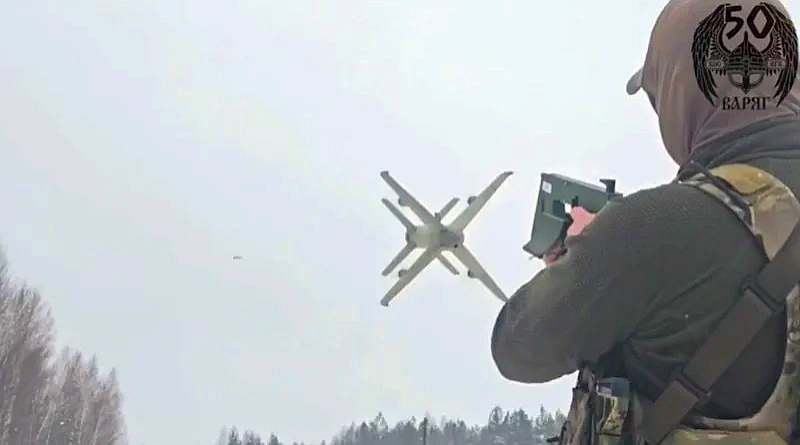
– 19th, 25th, 27th, 40th, 50th separate brigades of unmanned systems. The 50th has the personal name “Varang” and is a brigade of the Supreme High Command;
– 924th State Center for Unmanned Aviation.
Groups of unmanned partisans and those who joined them:
– Luhansk separate battalion of unmanned systems (suspected to have joined the 3rd army, but no evidence found);
– Separate regiment of unmanned systems “Burevestnik” of the “Volunteer Corps”;
– Separate brigade of unmanned aviation “THUNDER ‘Cascade'”;
– Volunteer Special Purpose Center for Unmanned Systems “Bars-Sarmat” (here the name makes it clear that the fragment of the Ukrainian shell that entered “above the right shoulder blade” of Dmitry Rogozin in the restaurant and hotel complex “Shesh-Besh” in occupied Donetsk on December 21, 2022, touched something important responsible for naming).
Operational support for the troops is provided by the 4th separate engineering and sapper regiment.
From the BARS system, two formations emerged: “Bars-Sarmat” (25th BARS detachment) and “GROM ‘Kaskad'” (BARS ‘Kaskad’ detachment). It’s understandable – being cannon fodder is somewhat less appealing than being a UAV pilot. It was precisely the “Kaskad” that directed the strike on the formation of the 128th Defense Forces Brigade in the Zaporizhzhia region.

The most interesting and most dangerous component of these forces – the “Rubicon” Center for Advanced Unmanned Technologies – was left for last. The center combines five district training centers in its structure: the 56th, 212th, 415th, 467th, 473rd, and the 242nd Airborne Training Center. “Rubicon” is an integrator of combat experience, personnel training, technology development, tactic creation, and it also liaises with the industry. Our side confirms the high skill and mastery level of the enemy, but this fact does not prevent us from striking, as was recently done in the Lyman direction. “Rubicon” suffered very painful losses.
Nevertheless, this center implements the chain of activities “combat application – detection and elimination of faults and failures – tactic change – software refinement – new requirements communication to manufacturers.” This is how frontline improvisation transforms into a standardized military-industrial cycle, which is the main danger of this center.
What are the Russians creating there?
A system of systems – the “Svod” digital platform. Assisting it are a series of applications that significantly shorten the “detection – strike” cycle. Attention is paid to the use of loitering munitions “Lancet”, “CUB”, “Klin”, BM-35. Small air defense also has its place in the system.
But as always in Russia, every groundhog is its own agronomist: as with the development of any military and weapon control systems, where everyone does their own budget management and ends up with incompatible software products, nothing new happened here. Software products from different manufacturers are incompatible, management bodies duplicate each other (in the structure of the troops we reviewed above, there are no communication and control units), the communication system is built on outdated principles and equipment, making management unstable and vulnerable to electronic suppression, and there is no satellite component (try controlling sea drones at a distance of 300-500 km!). All of this is compounded by the shortage of personnel (Russian IT specialists are in no hurry to sign contracts, leading to a lack of those who can train neural networks, set up computer vision, fix errors in automatic target recognition) and the absence of quality optics.

If you unfold these events in chronological order, you get the following sequence:
– second half of 2025 – completion of the formation of unmanned systems forces, deployment of mass training of pilots and technicians, development and implementation of UAVs with AI elements, beginning deployment of small air defense formations armed with interceptor drones, deployment of the ACS “Svod” as the foundation of situational awareness systems in military groups conducting combat operations against Ukraine;
– start of 2026 – significant increase in the supply of unmanned systems to the troops. The forces reach a strength of 40,000 people, deploying at an accelerated pace which industry cannot keep up with. How they manage to simultaneously have poorly trained personnel and a shortage of equipment is unclear, give well-trained drones to them, the rest send to continue training, what’s the problem?
– second half of 2026 – appearance of jet UAVs and the beginning of their massive use.

We see that the enemy takes a systematic approach to the deployment of a new kind of forces, which already includes, besides the main combat units, intelligence, communication, electronic warfare, and logistics units, a closed-loop “application – combat experience analysis – personnel training,” capable of rapidly formulating operational and technical requirements for equipment improvement, and has acquired the capability not only to maintain partnerships with manufacturers but also to procure import components.
In this confrontation, the winner will be the one who converts combat experience into technical solutions faster and scales their production.
On the cover: An occupant from the “Varyag” unit of the Russian army. Photo: Bezbasheni Gamers Group
