
Jonathan Sweet and Mark Toth, INTREP360 / Translation by iPress
Economist and security expert Mark Toth and former military intelligence officer Jonathan Sweet claim on the pages of their intelligence project INTREP360 that the U.S. missed the opportune moment to decisively increase pressure on Russia and secure Ukraine’s victory, and Donald Trump’s bet on de-escalation and diplomatic “deals” only gave Putin time to continue the war. In their view, the removal of Keith Kellogg from the negotiation process regarding Russia and the arrival of Steve Witkoff and Jared Kushner increased pressure on Kyiv to concede the defensive “fortress belt” in the Donbas, while the Kremlin seeks to exchange economic promises for political concessions from the U.S. Simultaneously, the authors consider Iran’s nuclear program as another part of a broader global confrontation, in which Russia, China, and their allies are waging a war against the West. Washington and allies can still turn the situation around, but to do so, they need to secure Ukraine’s victory and end the current regime in Iran.
Almost two years ago, we wrote in the New York Post about why victory in “World War III” was in President Donald Trump’s hands.
No, we did not call for overt use of American military force. On the contrary, we argued that Putin and his so-called “special military operation” in Ukraine were on the brink of defeat, and a victory over Russia could mean a victory for the West in World War III – thanks to Ukraine’s triumph.
We hoped that the paralysis of Biden’s policy caused by fear of escalation regarding Ukraine, especially with the involvement of then-National Security Advisor Jake Sullivan, was becoming a thing of the past. Instead, as time showed, Trump focused on de-escalating the war, thereby giving Putin time and space to continue attacks on Ukraine.
We had substantial reasons to believe that the U.S. was on the verge of a significant victory. Others, including retired U.S. Army General Jack Keane, saw the same as we did: upon returning to power, Trump would face a “grand strategic shift” – the Russia- and China-led “axis of evil” is already at war with the West.
Moreover, Trump appointed retired U.S. Army Lieutenant General Keith Kellogg as his chief special envoy on Russia and Ukraine. In our column for The Hill, we wrote that Kellogg was the right person to deal with Putin.
At that time, all the cards were in Trump’s hands—and consequently, in Kellogg’s. By early December 2024, Russia had suffered 747,340 losses in Ukraine. After Sweden and Finland joined NATO, which now included 32 countries, the Baltic Sea effectively became a “NATO lake”. The Black Sea Fleet of Russia was forced to flee from Crimea, and the Russian Navy had to leave the Mediterranean port of Tartus amid the collapse of the Assad regime.
At that point, Putin had been successfully bluffing with the nuclear card before the Biden administration for 34 consecutive months. We repeatedly and continuously warned about this and emphasized: Putin uses Russia’s nuclear arsenal as a sort of Russian “teddy bear” to reassure Russians whenever things go badly in Ukraine.
Kellogg, possibly more than anyone else, given his service in the 82nd Airborne Division of the US Army, had particularly favorable opportunities to finally expose this bluff and to tell Putin face-to-face what was obvious to us back in December 2022: Russia is losing the war in Ukraine and has no path to victory through conventional, non-nuclear means.
But there was a problem. Putin didn’t want to meet with Kellogg, and Trump acceded to his demand, effectively demoting the uncompromising general to merely a special White House envoy on Ukrainian issues.
Kellogg was out, replaced by Steve Witkoff and Jared Kushner. Since then, thousands more Ukrainian military and civilians have died because Trump appeased Putin and relied on two developers who weren’t properly trained for such a mission.
The price was also paid by the Russians. Despite Trump’s repeated boasts that he could end the Russian-Ukrainian war “in 24 hours”, the war dragged on for another two years, and Putin’s army suffered an additional 849,670 losses during this time.
And the situation is only worsening. For the fourth consecutive month, Russia suffers losses in Ukraine of at least 40,000 military personnel killed and wounded. In October alone, Putin’s forces lost 54,400 killed or wounded.
In total, this is 1,597,010 Russian losses since February 24, 2022. Of course, Putin doesn’t care. If he is not stopped, he will not cease his attempts to seize all of Ukraine and create a land corridor along the Black Sea—from Russia through Crimea, Odessa, and Transnistria to Moldova, and possibly beyond.
The removal of Kellogg was a precursor to further events. As in his first presidential term, Trump trusts his military advisors less and less.
Instead of listening to them, he often relies on his own business instincts. As a result, especially regarding wars in Ukraine and Iran, conflicts get out of control and turn into precisely the “endless wars” he promised to end during his campaign for a second term.
Putin understood this fairly early. After persuading Trump to remove Kellogg, the Russian dictator appointed Kirill Dmitriev, the head of Russia’s direct investment fund, often called “Putin’s cash register,” as his chief envoy to the United States.
In the worst-case scenario for the Kremlin, Dmitriev was to thwart Trump’s efforts to end the war, and in the best case, to buy from Trump what the Russian army could not achieve on the battlefield: the surrender of Ukraine or capitulation in Donbass.
Given Trump’s obsession with “deals,” the second option became Dmitriev’s main course of action. To this end, he enticed Trump with the prospect of business deals worth over 14 trillion dollars, hoping to sway him to betray Ukraine’s interests.
Vitkoff and Kushner eagerly took the bait and have since been trying to persuade Ukraine’s President Volodymyr Zelensky to commit, from a military perspective, national suicide by giving up the strategic “belt of fortresses” in Donbass, which holds back the Russian onslaught on the way to Odesa, Kyiv, and the rest of Ukraine.
This, as we have repeatedly said, will not happen. The Ukrainians as a nation did not fight so hard and pay so much blood and resources to win the war, just to stop and allow Trump, through Vitkoff and Kushner as his representatives, to lose it for them. The ghosts of the fallen will not allow them to do so.
Moreover, Dmitriev’s deals, as we wrote three weeks ago in The Hill, are just fool’s gold meant to dupe Trump’s team. That’s why a week later in The Hill we wrote that Trump must stop trying to give Ukraine to Putin.
Iran, as we will explain in the next publication in The Hill, quickly learned the same lesson, but in its own way. Tehran played on Trump’s vanity as a deal-maker and thereby turned the “endless truce” we warned about in USA Today, into what is perceived in Iran as an electoral defeat of the president during the Republican debacle in the elections.
In one thing, Iran is right. Elections in the USA were and remain a turning point in the question of who will ultimately win World War III.
Tehran’s nuclear weapons program will not disappear. If Trump retreats after a strike on Iran, Tehran will swiftly move towards creating nuclear weapons.
If Trump simply continues to act as he has, that is, waiting for American economic sanctions or airstrikes to work, this “endless truce” will eventually turn into an expensive endless war, depleting the financial and military resources of the United States.
This is a real “catch-22.” Trump will not be able to achieve his repeatedly stated goal of preventing Iran from obtaining nuclear weapons unless he ensures a complete regime change in the country. Nothing less will work.
However, neither the Democrats nor the Republicans in Congress are currently even close to supporting regime change—especially after Trump decided in March not to bring the war to a decisive end, even though victory was near.
The American public, in general, does not support this course given the results of the midterm elections. People are understandably concerned about the cost of living and wages, which are rising no slower than inflation. Simply put, Trump has not been able to adequately explain what is at stake and what the consequences of inaction might be.
Meanwhile, once again we respectfully remind you: in analyzing national security issues, we do not take sides politically and by no means consider ourselves political experts. We fully understand that U.S. decisions in national security and foreign policy, especially regarding the war in Iran, are likely to be increasingly politicized by all sides for party gain.
We saw this on November 4, when Vice President J.D. Vance, apparently trying to garner support from isolationists like Tucker Carlson with a view towards 2028, blamed the Republicans’ defeat on the war in Iran. Similarly, we saw some Washington isolationist media, including The Federalist, attacking everyone who advocates for preventing Iran from acquiring nuclear weapons, labeling them neoconservatives.
Our goal here is not to dive into all this politics. We gladly leave it to others. Our sole task is to break through the fog of party strife and ensure that all Americans are aware of the very real national security threats to the United States.
We cannot simply wish away the very real nuclear weapons program in Iran. Nor can we ignore it, especially given that it poses an existential threat to the United States.
We also cannot impose solutions. At the same time, we hope to create a platform where, on a bipartisan basis, we can determine how to contain or completely eliminate the Iranian threat to the United States—through enforced regime change.
In the 1930s, the U.S. was reluctant to recognize the threats posed by imperial Japan and Nazi Germany, which ultimately led to Pearl Harbor. We cannot and must not repeat this mistake in 2026 given the current state of Iran’s nuclear program.
Bipartisanship is the key to preventing this from happening. Equally crucial is the outcome of the Third World War, which, although not resembling the Hollywood version with nuclear mushrooms and nightmare “next day” scenarios, is already being waged against the West by Russia, China, and their “axis of evil” allies.
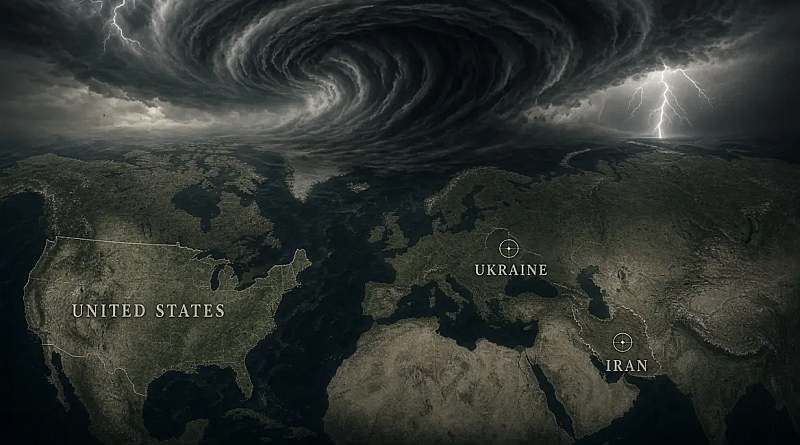
The US and its allies can still win it. To do so, it is essential to achieve victory in Ukraine and put an end to the extremely brutal and repressive regime in Iran. Otherwise, we might ignore the approaching storm and ultimately pay a bloody price for it.
Illustration of the approaching global storm created with the help of AI Grok/NTREP360.
