
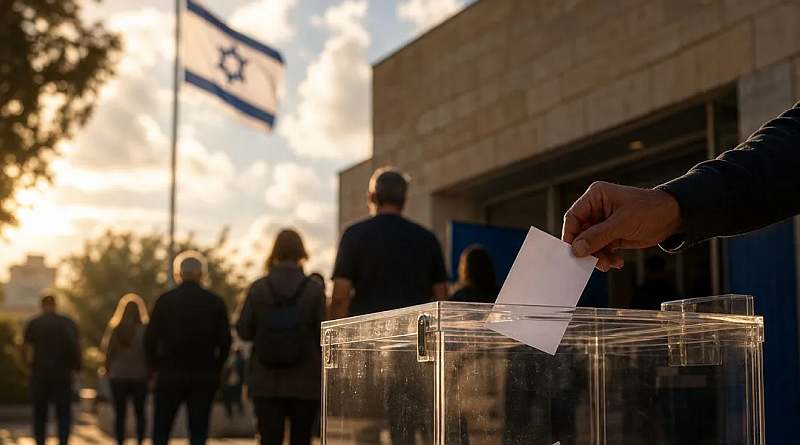

Let’s look at Israel, because there is much to learn from there.
1. Why is it relevant?
Firstly, Israel is beginning the process of forming a government following the election results. The first attempt will be made by the head of the opposition party “Yashar,” former IDF Chief of Staff General Gadi Eizenkot.
He received the trust of 67 newly elected Knesset members (61+ needed), and Israeli President Isaac Herzog gave Eizenkot a mandate that must be implemented by December 6 (with the option to extend until December 20). Success is not guaranteed. If unsuccessful, the next candidate will try.
Theoretically, this could be Benjamin Netanyahu, who continues to navigate precariously, particularly by heavily demonizing the Arab parties (who supported Eizenkot) and openly branding them as “accomplices of terrorists.”
A possible change in government in Israel will affect not only the Middle East.
Secondly, this occurs against the backdrop of publicly acknowledged changes in attitudes towards Israel in the US and Europe, where there are now more opponents than supporters.
The opposition blames Netanyahu for what happened. Netanyahu himself, pointing to objective circumstances, proposes the concept of “This is Sparta!”: emphasizing the need to prepare for life in a siege fortress mode, up to sanctions. Because Israel’s adversaries in the West are strengthening in power, relying on public sentiment.
It is up to the Israelis to sort things out internally. But it’s interesting to see how they plan and debate. Because we will also face a transformation in attitudes (already in process), albeit for completely different reasons.
2. Another reason: Trump’s recent statement about his willingness to end military aid to Israel ($3.8 billion), which caused a storm of emotions.
The current aid program for 2018-2028 of $38 billion was approved in 2016 (under Obama). It provides for $3.3 billion annually in grants for the purchase of various weapons and $500 million for missile defense.
Some Israelis, including many Russian speakers, exclaimed that the cancellation is a nightmare and betrayal! That Netanyahu refused the aid in exchange for verbal and textual support from Trump! Their position boils down to the thesis “20 bucks is always 20 bucks!”
Five years ago, I would likely have agreed with this approach without hesitation. However, our experience of interaction with the US pushes us to take a closer look at the arguments of Netanyahu and his supporters. The essence is that:
• As aid, the most modern weapons are never provided;
• Aid often includes not what you need but what the donor decides to offer;
• The mentioned money doesn’t leave the American circuit: it goes to American manufacturers of military equipment;
• Aid involves reciprocal obligations and restrictions, both political (the USA regularly restrains Israel’s actions) and strictly military-technical with economic ones. Specifically, emphasis is made on the USA gaining access to the latest Israeli developments in exchange for outdated hardware.
Netanyahu has long voiced the idea of maximizing Israel’s independence. He began to clearly promote this idea in 2026, directly indicating he would like to reduce aid to zero in 10 years. The first step is not to renew the agreement in 2028 in its entirety.
I cannot judge whether this is more about political opportunism and gestures to Trump before elections (amid negative attitudes towards Israel and Trump’s thesis of not giving anything away for free) or a real intention to implement a long-standing idea.
The material basis for the refusal is the thesis that by giving up aid, Israel will also reduce its obligations. It will reformat relationships from client-patron to partnership. And will earn more from selling weapons.
In any case, we are at a stage that Israel has technically gone through before. It would be useful to understand the trajectory and what it is based on, at least in general terms.
The obvious difference is that 1) the USA guarantees political and military support to Israel in case of aggression, but not to us. 2) The USA is willing to sell Israel weapons it sells only to its closest allies, but not to us. In general, we need to delve into it.
3. In light of these circumstances, there are a number of lay observations that I consider useful to note. Once again, I emphasize the limits.
Firstly, this is by no means “expertise,” as one needs to know the context exhaustively to label phenomena and processes.
Secondly, I rely only on open information and tips from competent people (thank them!), which helps with lay interpretation. But I don’t have any outstanding insider knowledge to make judgments: this is a big success, and that is a failure. To do this, one needs to know the intent and the volume of efforts invested.
The plus of a lay perspective is that the most prominent and visible things catch the eye. So, here it is.
4. Previously I noted: an acceptable resolution for Ukraine regarding Russia will have to be sought not in a bilateral format, but in a broader framework. Multilateral. Multilevel.
This is precisely the environment where Israel has historically operated. It’s interesting to see how they (had) organized it. And what corrections will be made.
To start, let’s tentatively outline the conceptual slice.
We tend to look for a certain image of Ukraine to promote in the world, which is not simple and methodologically questionable. Because the world is extremely diverse.
That is, for success, a well-developed and concretely supported diversity is literally required.
In addition to the textbook public image of the “startup nation,” Israel has at least two more tried and tested templates at its disposal.
The first is the image of a tiny Jewish island in the vast Arab-Muslim ocean. A little David confronting a monstrous Goliath-like monster.
This side of Israel was turned towards democratically-humanistic-liberal societies. Add the tragic experience of World War II. In this construction, Palestinians appear as an Arab-Muslim torpedo whose sole mission is to harm Israel. Their own identity, rights, and interests are elusive, leaving little room to choose a side.
Just remember. For the majority of our audience, the mention of the Arab-Israeli conflict evokes the idea of many Arabs encroaching on Israel (“from the river to the sea”), hindered in their struggle for survival by Britain, France, and the USA.
And the conclusion: Arabs have two dozen states, why not distribute a few Arabs among these states to make everything better? In the discussion of “two states,” there’s always someone questioning “why not disperse them?” And it’s not just in the Oval Office – it’s heard in many places.
This is the result of a well-constructed mythology rooted in the views of the fathers of Zionism.
The intriguing nuance is that:
• There is no such thing as Muslim unity. Neither on the Israel/Palestine issue nor in general. If hypothetically Iran, Turkey, and the Saudis truly united efforts according to the rhetoric, Israel would have been obliterated.
• There is no such thing as Arab unity. We just don’t see it clearly from afar.
Arab-Muslim unity is somewhat like Slavic-Orthodox “unity,” manifestations of which we experience daily.
In fact, we observe a different aspect: a huge David terrorizes a group of loose Goliaths. Clearly showing that it can pummel, but mutual beneficial agreements are possible.
This side is turned towards the part of the world that is more at ease with democratic-humanistic-liberal views and various human rights.
Israel’s visible tactic literally boils down to breaking down the conflict field into a series of one-on-one confrontations. And in such a struggle, competing with Israel isn’t very pleasant. Especially when the USA looms in the background.
This was visibly realized as early as the 1970s, when Israel dismantled the united position of opposing Arab states and sequentially reached agreements with Egypt and Jordan.
The approach – not escalating simultaneously with multiple opponents and fragmenting the negative – forms the basis of the tactic. The mentioned lack of Arab-Muslim unity is largely the result of the effective efforts of Israeli diplomacy, intelligence, and the entire state machinery.
What has changed and why has it become more difficult?
I can only rely on an assessment that seems logical to me.
Firstly, the number of representatives from the Arab-Muslim world in the west has physically increased sharply. Simply put, a protest can materialize in any regional center. The wars in Congo claimed many lives. A negligible resonance. No widespread visualization.
Secondly, the properties of Western societies have changed, where the etiquette in response to physical aggression is to hold a series of ruthless roundtables with uncompromising receptions and fervent lantern-lighting. Plus, anger management training.
And here Israel clearly appeared as a bloodthirsty Goliath. It shattered the template of the historical victim.
Contemporary media revealed Israel’s side unintended for the humanist world. Against this background, it’s easier to promote the “globalize the intifada” approach in the most unexpected places.
Without evaluating as “good/bad,” it can be stated that diversity has been successfully functioning for decades. It is important to understand what can be learned.
5. Besides the conceptual aspect, the operational angle is also very interesting.
For visualization, look at the map. Israel is surrounded by Arab-Muslim countries, with its perimeter in turmoil (southern Lebanon, Syria, the West Bank, Gaza…). But what is happening on the periphery of the Arab-Muslim world?
To the west of this region is Morocco, with which Israel has the warmest relations, based on defense cooperation. Morocco was the first to express readiness to send police to Gaza as part of stabilization forces (500 officers have already been trained).
This context easily led to the rumor that Mossad agents personally inflated duck-shaped floats for Moroccans to invade Ceuta by sea to overthrow the detested socialist regime of Pedro Sánchez, who became almost the main critic of Israel in Europe.
King Mohammed VI of Morocco is an Alawite. He doesn’t care what those of lower birth think of him. Therefore, he can appoint a woman as prime minister and quickly silence all critics.
The strongest move in my opinion was on October 12, 2026, in the city of Fez (where the ruling dynasty has been established since the 17th century), where a museum of Moroccan Jewish culture was opened as part of the historical center’s restoration that began in 2019, featuring 1,200 square meters of exhibition space. It is located in the historic (since the 15th century) Jewish quarter.
This museum opened just a hundred meters from the Al-Batha Museum of Islamic Art and is positioned as 1) part of a unified space and 2) the first exclusively Jewish museum in Arab-Muslim countries built with state funds.
Looking east of Israel, in October 2026, a museum dedicated to the Jewish community opened in the historic Jewish school building in Baghdad (!). Slightly unconventional these days, isn’t it?
Looking south of Arabia, at the end of December 2025, Israel officially recognized the formally separatist entity of Somaliland. It’s not in our consciousness, and it doesn’t appear on our maps. But de facto it exists and opens a platform for influencing the Houthis. Incidentally, Somaliland opened a representation in Jerusalem.
Looking north, there is a lot of interesting activity.
In 2023, Israel signed a military cooperation agreement with Albania. In 2025, the Israeli company Elbit Systems undertook the rehabilitation of an aviation school, training military and civilian pilots, air traffic controllers, and teaching the use of modern simulators. Plus, cybersecurity. And these are, I remind you, Muslims.
On August 31, 2026, Greece agreed to purchase a comprehensive air defense/missile defense system from Israel for 3 billion euros.
On October 22, 2026, Cyprus bought a new combat ship from Israel and agreed on the modernization of another patrol ship.
As you can imagine, both news items caused great excitement in Ankara. If you go around Turkey from the other side, here’s what you see.
On October 8, 2026, in Azerbaijan, a factory for the production of M4 rifles, based on the American AR-15 platform, was opened with the participation of the Israeli company ARI Arms. This happened against the backdrop of Turkey’s disapproval of the idea to ban hijabs in Azerbaijani public schools. Much has been said about Baku’s close cooperation with Israel (and the flow of criticism for it), so I won’t repeat it.
On November 2, during the 10th meeting of the Kazakhstan-Israel Intergovernmental Commission on Trade and Economic Cooperation, among other things, agreements were made on cooperation in the field of space technologies, satellite communications, etc. Israel will also assist Kazakhstan in the field of education (which is not welcomed by everyone).
This is happening amidst Kazakhstan’s readiness to join the “Abraham Accords” (patriarch Abraham would have been quite surprised). Additionally, the possibility of forces from Albania and Kazakhstan being present in Gaza is being explored.
Such is the periphery.
6. Another interesting storyline is the parallel tracks of cooperation between Israel, Serbia, and Kosovo.
Israel recognized Kosovo (February 2021), and Kosovo opened a representation in Jerusalem. Kosovo also appeared in the context of potential presence in Gaza, meaning a politico-diplomatic track.
Meanwhile, full-fledged large-scale defense cooperation is developing with Serbia. Serbia purchased weapons from Israel (in 2025 a contract for $1.64 billion, a wide range). On September 17, 2026, a plant was opened in Serbia for the production (assembly) of Israeli UAVs for the needs of the Serbian army and for export. This is a joint venture of Elbit Systems (51%) and the Serbian state company Yugoimport SDPR (49%).
One can wander further through Arab, Muslim, and simply conflicting countries where Israel is concretely present.
The logic is quite clear: the list of materialized projects over the last 2-3 months is impressive. A deep cultural-historical layer intersects with cybersecurity and arms.
At the same time, the League of Arab States can indeed condemn the opening of the Colombian embassy in Jerusalem (October 14). It’s a matter of life — everyone has their own job.
This does not mean that Israel’s actions are flawless and deserve unconditional support. We especially understand and dislike Israel’s cooperation with Russian thugs. As well as the disgusting manifestations of various riffraff settled in Israel. In the arms market competition, Israel is also not ceremonious; everything is tough.
However, the results are difficult to ignore even at a layman’s level. Israelis skillfully infiltrate and establish themselves in initially toxic environments, then adjust them.
Therefore, it’s easy to believe that allegedly Israel is handing out neat, clean Palestinian flags to rioters in European countries, who (the rioters) do not fully understand what they have in their hands, perceiving it as akin to a Che Guevara T-shirt. People come up with such things!..
We must survive, and then live in this multi-layered, multi-system world. I’m confident that acquiring suitable knowledge from everyone is neither inappropriate nor immoral.
