

National traumas of Europe. The recent condescending and arrogant remarks by the Trump administration towards European leaders, NATO, and individual countries require an answer to the question: on what grounds does the US consider that such a tone is permissible? When did this start, how did it become the norm, and who is to blame? Here, the clock of history should be rewound again to “Postwar: A History of Europe Since 1945” by Tony Judt.
First and foremost, it is worth noting that Europe between the great wars and post-WWII are entirely different ethnically. Before the Second World War, the settlement of peoples was different.
“During 1939-1943, Stalin and Hitler uprooted, relocated, expelled, deported, and dispersed about 30 million people. When the Nazi coalition began to retreat, a reverse process began.” (c) Tony Judt.
Here Judt emphasizes that on the wave of the Reich’s advance, Germans managed only to replenish the old German settlements scattered across Eastern Europe, and as the USSR began its advance, Germans became the main wave of refugees fleeing the red ‘liberators.’
But they were not the only ones leaving their homes…
“From the east came the Balts, Poles, Ukrainians, Cossacks, Hungarians, Romanians, and other peoples: some were driven by the horrors of war, others fled westward to escape communist rule…
From the Balkans came not only ethnic Germans but also over 100,000 Croats—supporters of the ousted fascist military regime of Ante Pavelić, fleeing from the wrath of Tito’s partisans.” (c) Tony Judt.
By the end of the war, on the territory of Germany and Austria, besides millions of Wehrmacht prisoners of war, there were soldiers of the Allied armies liberated from German captivity, representatives of various nationalities who fought on the side of the Reich: Russians from the anti-Soviet army of General Vlasov, French, Norwegians, Dutch, Belgians, Ukrainian volunteers from the structures of the “Waffen SS,” those who collaborated with the Nazi regime even in one status or another, were in every country in Eastern Europe and they were seeking refuge from Soviet retribution.
There was also the forced labor force of German industry, or 280,000 Italians forcibly relocated to Germany after Italy capitulated and exited the alliance with the Third Reich. But besides those brought by force, in Germany there were also voluntary laborers who had been working since before 1939 and remained. Among the Ostarbeiters who were fortunate enough not to end up in a concentration camp for work, there were those whose situation in Germany was better than in the USSR. These people were not supporters of the Nazi regime, but they were also not happy with the approach of the ‘liberators.’
A separate category of people was the liberated prisoners of concentration camps. Among them were Jews, who fared the worst.
“Of those who were liberated, four out of ten (!) died within a few weeks of the arrival of the Allied armies: Western medicine was unable to help people… But the Jews who survived, like many other homeless Europeans, made their way to Germany. It was in Germany that Allied representations and camps were to be located, and in any case, Jews didn’t feel safe in Eastern Europe. Following a series of POST-WAR (!) pogroms in Poland (!), many Jews who managed to survive left for good: 63,387 people went to Germany from Poland just during July-September 1946.” (c) Tony Judt.
“Everything that happened in 1945 and lasted for at least a year was an unprecedented experiment in ethnic cleansing and population migration. Partially, this was the result of ‘voluntary’ ethnic separation, as in the case of Jews leaving Poland, where they felt threatened and unwanted, or Italians who preferred to leave the Istrian peninsula rather than live under Yugoslav rule.
Since 1939 there was the resettlement of Romanians and Hungarians in disputed territories of Transylvania. The Soviet authorities carried out a series of forced population exchanges between Poland and Ukraine in 44-46 years. Bulgaria relocated 160,000 Turks to Turkey, and in 1946 Czechoslovakia exchanged 120,000 Slovaks residing in Hungary for a corresponding number of Hungarians living north of the Danube in Slovakia. Similar exchanges took place between Poland and Lithuania, between Czechoslovakia and the USSR, 400,000 people from Southern Yugoslavia were relocated to the northern part of the country instead of Germans and Italians who left these territories. In these cases, as everywhere else, the consent of the people was not sought. The largest relocation affected the Germans.” (c) Tony Judt.
German communities, even quite old ones, in Yugoslavia, Hungary, Poland, from the Baltic region, and the western part of the USSR (Ukraine and Belarus) were doomed and knew it.
In 1942, Britain agreed to the Czechs’ demand for post-war expulsion of the German population of the Sudetenland. In 1943, Moscow and Washington agreed to this. In 1945, Edvard Beneš announced that they “decided to eliminate the German problem… in the republic once and for all.” Germans and Hungarians had to surrender all their property to the state. In June 1945, their land was taken, and on August 2 of the same year, they lost their citizenship. Over the next 18 months, 3 million Germans were expelled from the Sudetenland. During the expulsions, 267,000 people died.
From Hungary, 623,000 Germans were expelled, from Romania – 768,000, from Yugoslavia nearly 500,000, from Poland – 1 million 300,000. The largest number of Germans fled from German territories that were decided to be given to Poland.
A new reality arose. Eastern Europe was forcibly cleansed of the German population. On paper, the resettlements were supposed to occur in a humane manner, but in reality… The New York Times wrote in October 1946:
“The scale of this resettlement and the conditions in which it took place are unprecedented in history. No eyewitness to these horrors doubts that these are crimes against humanity, for which history will exact a terrible price.”
“At the end of the First World War, borders changed and were redrawn, while people generally stayed put. After 1945, the opposite happened… With some exceptions, what emerged was a Europe of nation-states that were ethnically more homogeneous than ever before.” (c) Tony Judt.
«The USSR remained a multiethnic empire, diversity persisted in Yugoslavia and Romania (Transylvania)… In contrast, Poland – until 1938, only 68% of the population were Poles, and by 1946, they became the absolute majority. Czechoslovakia, before the Munich Agreement, had 22% of the population as Germans, 5% Hungarians, 3% Ukrainians, and 1.5% Jews – after the war, mostly Czechs and Slovaks remained… Of the 55,000 Czechoslovak Jews, by 1950, only 16,000 remained.
Ancient European diasporas – Greeks and Turks in the Southern Balkans and around the Black Sea, Italians in Dalmatia, Hungarians in Transylvania and the northern Balkans, Poles in Ukraine and Lithuania, Germans from the Baltic to the Black Sea and from the Rhine to the Volga, Jews throughout Europe – diminished and disappeared. A new, more ‘orderly’ Europe was born” (c) Tony Judt.
And these changes were partly an inevitable consequence of the war – interethnic and intraethnic relationships between supporters and opponents of various war factions. But to a large extent, the reshaping of Europe came with the blessing of the victors. The USA, USSR, and Britain redrew maps, fully aware that on the ruins of World War II, it was primarily not about national interests and the reconstruction of peoples, but about the division into two new opposing camps.
Europe did not have enough resources to handle the relocation of millions, the burden of resettling refugees in camps, feeding them, and sending them home (or to new homes) fell largely on the USA. After Lend-Lease, this was the next stepping stone in the foundation of American superiority over the Old World. And for Europe – one of the trauma-causing reasons for further weakness and the conscious second place in interactions with Washington. Moreover, it was a painful migration experience, even if it was intra-continental and predominantly mono-religious, but…
To be continued…
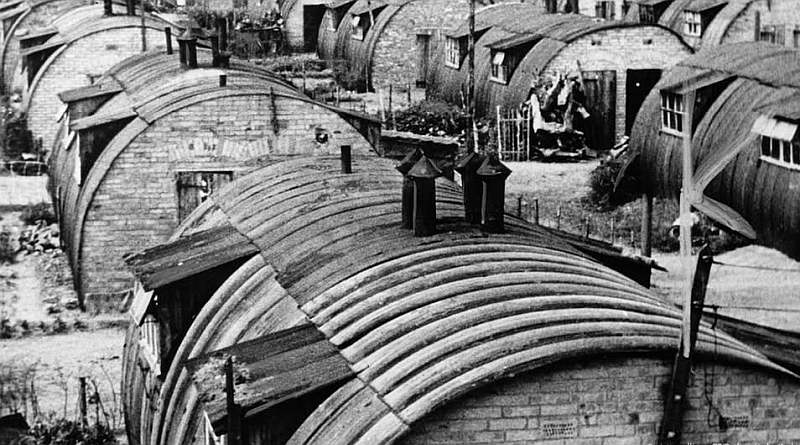
On the cover: one of the types of barracks for resettlers in Endorf near Neumünster, 1949
