

The Eurasian Economic Union is experiencing the deepest systemic crisis in its history, as internal contradictions among member countries reach critical levels.
Economic integration, conceived as a tool for uniting the region’s states, has turned into a mechanism of political pressure and a lever of influence for Moscow over partners wishing to pursue independent foreign policies.
The degradation of the union’s mechanisms is especially pronounced in the relations between Yerevan and Moscow. Armenian Prime Minister Nikol Pashinyan publicly predicted the beginning of the end for the EAEU when he emphasized that the union’s structure is almost completely paralyzed and barely functions due to constant violations of the fundamental principles of free trade. Although Yerevan currently lacks an officially approved plan for an immediate exit from the union, the very fact of such an assessment indicates a complete loss of trust in the integration project.
The conflict surrounding the railway infrastructure is a vivid confirmation that economic ties within the bloc have reached a dead end. Yerevan is actively considering the possibility of appealing to international arbitration and conducting legal proceedings on issues directly related to the activities of the South Caucasus Railway, which is a subsidiary of RZD.
According to statements by the Armenian leadership, the country intends to demand through the courts up to $2 billion a year from Russia for the lease and operation of the national railway network, as the management conditions of the transport system no longer meet Armenia’s state interests.
Simultaneously with legal disputes, direct politico-economic confrontation is escalating, during which the Kremlin presents uncompromising demands to its allies. The Russian Federation is firmly demanding that Armenia decide whether the republic will continue its course towards rapprochement with the European Union or remain part of the EAEU.
As a tool of persuasion, Moscow habitually uses methods of economic blackmail, resulting in the systematic introduction of artificial restrictions on Armenian imports to Russia under the pretext of violating sanitary norms and regulations.
The situation around Armenia reflects the general trend of the union’s disintegration, as other member states also face protectionism and unilateral sanction risks. The unified EAEU market is effectively ceasing to exist, as instead of free movement of goods, services, capital, and labor, countries face new barriers, tariffs, and customs inspections daily.
International experts and analysts agree that the integration bloc has lost its appeal and has turned into a toxic formation, bringing more losses to the economies of member countries than actual benefits.
The increasing isolation of the Russian economy is destroying logistical chains built over decades, forcing the bloc’s partners to seek alternative trade routes bypassing Moscow.
The Kremlin’s attempts to keep former Soviet republics within its sphere of influence through economic sanctions and trade wars have the opposite effect, accelerating the dismantling of post-Soviet institutions. When the integration structure relies solely on coercion and ultimatums, its eventual collapse becomes only a matter of time.
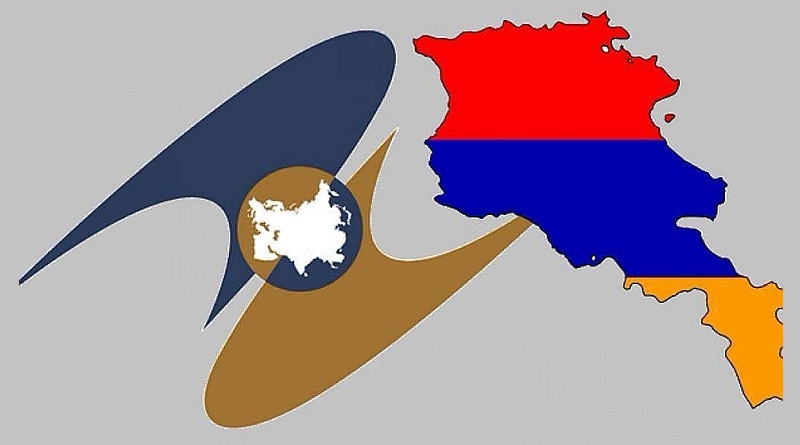
The image on the cover combines the EAEU logo with a map of Armenia painted in the colors of its national flag. Armenia officially joined the EAEU in 2015.
