
Kupiansk Direction
The enemy (Russian forces) continues offensive actions on the right flank of its troop grouping (TG) “Zapad” with the aim of eliminating the Kupiansk bridgehead of the Armed Forces of Ukraine (AFU) and capturing the city of Kupiansk, focusing its main efforts on the general direction Pishchane – Kurylivka – Kupiansk-Vuzlovyi.
The core of the enemy grouping operating in this direction consists of units from the 1st Tank Army (TA) TG “Zapad”, reinforced by several forces and means of the 6th Combined Arms Army (CAA) and, possibly, the 11th Army Corps (AC) TG “Sever”.
As of last evening, the enemy still has not achieved the aforementioned objectives. Ukrainian forces continue to hold the eastern part of Kupiansk (the so-called Zaoskillia), as well as areas to the east and southeast of the city.
1. In this direction, the enemy is operating with the following forces and means (approximately):
The 1st Tank Army operates in this direction with at least half of its forces (troops):
– 47th Tank Division (td) – 26th and 153rd Tank Regiments (tr), main forces of the 272nd, 347th, and 380th Motor Rifle Regiments (mrr), 744th Self-propelled Artillery Regiment (sar);
– 27th Separate Motor Rifle Brigade (smrb);
– 288th Artillery Brigade (abr), likely also operating in this direction with most of its forces;
– Also in this direction, there may be several units and subunits from the 2nd Motor Rifle Division (MRD) and the 4th Tank Division (TD) of this army. Most likely, this concerns the 1432nd mrr of Territorial Troops (TT), which is operationally subordinated to the 2nd mrd or the 27th smrb, the 1st Tank Regiment of the 2nd mrd, as well as several subunits of the 12th tr of the 4th td.
The 6th CAA operates in this direction only with part of its forces, which interact with the 1st TA and, presumably, are organizationally part of the TG “Zapad”:
– The 68th mrd – operates in this direction with at least two of its regiments, and most likely three (121st and 122nd mrr; presence of the 1009th or 1843rd Motor Rifle Regiments is also quite possible);
– From the 11th AC, units of the 7th Separate Motor Rifle Regiment (smrr), as well as the 1431st mrr of the 18th mrd of this corps, may be present in this direction.
It is evident that in the near future, the command of the Russian Western Military Group “Zapad” is unlikely to plan a significant increase in the composition of its forces and means operating in this direction. Primarily, this is due to the situation on the left flank of its operational zone (Lyman direction, 20th and 25th Combined Arms Armies), which objectively requires the priority use of most of its operational reserves there. Especially in the context of the ongoing Slovyansk-Kramatorsk offensive operation by Russian forces south of the Siversky Donetsk. In turn, the forces concentrated and deployed in the Kupyansk direction are probably considered sufficient by the Russian command to perform the above-mentioned tasks.
2. Current Situation in this direction is characterized by a rather complicated situation for Ukrainian troops in the tactical zone both at the Kupyansk bridgehead and directly in the city of Kupyansk.
During the reporting period, the enemy, aiming to split the Ukrainian bridgehead into two parts (north and south), managed to infiltrate several of its infantry (assault) groups into the combat formations of the advanced Ukrainian units operating at the bridgehead, as well as in the western part of Kupyansk and to the northwest of it. Specifically:
– In the directions of Kalynove – Tyshchenkivka and Holubivka – Radkivka, directly in the area of the villages of Tyshchenkivka and Radkivka, several small enemy infantry groups are observed.
– They are evidently also present in the northwest and northern parts of Kupyansk (in several blocks near the “Ukrnafta” gas station, along Pershotravneva Street up to the local House of Culture, and in the area of the settlement Myrne).
– Very small groups of Russian infantry (2-3 infantrymen), or even individual Russian servicemen, are likely also encountered on the western outskirts of the city (near Lermontov Street) or in its southern part near Tsyurupy Street and Shkolny Lane.
– In the eastern part of the city (“Zaoskolye”), small Russian infantry groups are noted near Lyceum No. 7 (to the north of the Kupyansk dairy canning factory) and between Kucheryvka and the wholesale store “Ambar” (“Komora”).
– They are likely present in the western part of Podoly village (southeast of Kupyansk), as well as in a fairly large area east of the village of Petropavlivka.
– In the direction of their main efforts, the Russian command with its 47th Motorized Rifle Division, apparently reinforced by assault infantry from other units and formations of the 1st Tank Army, persistently, despite losses, stubbornly attempts to break through from Pishchane to Kupyansk-Vuzlovy (from the side of Kurylivka and the “military town”), primarily along the small Lozovatka River and the railway stretching from the east to Kupyansk-Vuzlovy, as well as in the directions of Pishchane – Kivsharivka and Pishchane – Novoosinove.
It is evident that the local (tactical) Russian command has managed to equip several areas (positions) for the accumulation of its assault infantry (probably in the Kurylivka area and to the northeast of Kivsharivka and Novosinove), from where it regularly and simultaneously sends several infantry groups towards Kupyansk-Vuzlovy, Kivsharivka, and Novosinove, mostly in groups of 2-3 (less often 4-5) infantrymen for penetration and further consolidation in these settlements.
Although Ukrainian units defending these areas regularly “clear” them, some still remain occupied for a time. Therefore, the presence of Russian small infantry groups continues to be recorded in these settlements.
In this context, it should be noted that objectively the enemy surpasses Ukrainian forward units in this sector in terms of assault infantry numbers, allowing them to maintain a fairly intense and relatively high pace of penetrating actions. Meanwhile, Ukrainian units require both additional time (mainly due to the high intensity of enemy actions) and additional personnel to conduct search-and-raid actions within their tactical zone.
Moreover, to infiltrate their assault (infantry) groups, the enemy regularly tries to exploit the terrain features (numerous buildings and structures, areas with dense vegetation, and the rugged nature of certain terrain sections), as well as favorable weather conditions (rain, fog, strong wind, etc.), when the use of drones for timely detection and targeting of advancing infantry is significantly hampered. The enemy also attempts to support the advance of its assault groups with intense artillery and mortar fire, periodic air support, and active use of their own drones.
– In the southern part of the bridgehead, it is evident that the Armed Forces of Ukraine are still holding their positions near the villages of Hlushkivka and Kolisnykivka, blocking attempts by Russian infantry to penetrate. Furthermore, the area between the Ukrainian positions near Kolisnykivka and Kruliakivka, where advanced Russian units have reached the eastern bank of the Oskil River and hold positions there, reportedly barely exceeds 1.5-1.6 km (according to some sources), while others report it to be 4 km. This in itself raises considerations about the feasibility and possibility of restoring the integrity of the Ukrainian operational bridgehead on the Oskil River by eliminating this “gap,” which the enemy has nevertheless failed to widen over a considerable period.
3. Regarding the prospects for further developments in this direction, primarily in operational terms, I would like to highlight several factors:
– Obviously, the command of the Russian WV “West” has a very clear and unequivocal order—to bring their earlier inadequate statements by their “senior officials” about “capturing Kupiansk and clearing it of small groups of Ukrainian infantry” into line with reality in the near future.
However, the main operational problem for the Russian WV “West” command in this sense is that apart from the task assigned to it in the Kupiansk direction, it evidently has a rather “unplanned” and “non-standard” problem in the Lyman direction, which requires urgent resolution on its own.
It is obvious that these do not align well. Above all, concerning the use of most of the operational reserve of WV “West.” After all, its even distribution (in a 50/50 format) across these directions significantly increases the likelihood that successfully accomplishing tasks on BOTH directions simultaneously will not be possible. They will have to either prioritize one direction or sequentially shift these reserves back and forth.
This becomes particularly relevant under conditions where the “assault on Kupyansk” in the usual way (i.e., by gradually and slowly accumulating small assault infantry groups) is, let’s say, not very successful. Especially when they are periodically and significantly “cleansed,” as recently happened in the southern part of the Russian 6th Combined Arms Army’s bridgehead on the Oskil River north of Kupyansk.
Under these conditions, in order to maintain a high tempo of infiltration of its assault infantry over a long period, the command of the 1st Tank Army and the part of the 6th Combined Arms Army interacting with it in the Kupyansk direction must have a lot of this infantry, significantly more than they currently have.
And if the active actions of the Armed Forces of Ukraine in the Lyman direction continue in one form or another, for example, in the form of an attempt to create a Ukrainian tactical bridgehead on the Chornyi Zherebets River, then the command of the “Zapad” Operational Group will have to “search” for reserves in its most hidden and carefully accumulated “storages.” And undoubtedly, this will primarily concern its Kupyansk direction.
– The second factor is that currently, the Russian 1st Tank Army cannot quickly and effectively take stable control even of the eastern part of Kupyansk (“Zaoskillia”). Accordingly, the allocation of any significant forces from its composition for actions (reinforcement) in the operational zone of the “Sever” Operational Group, for example, in the South-Slobozhansky (Vovchansk) direction, as the Russian command previously practiced, is also quite difficult. Everything that was more or less combat-ready from the “reserve” category of the “Zapad” Operational Group obviously recently moved under Lyman to stabilize and stop the Ukrainian “Vivaldi.”
In this sense, the “stagnation” of the 1st Tank Army’s troops in the battles for Kupyansk directly affects the situation in the entire northeastern “corner” of the Kharkiv region of Ukraine. After all, the “kettle” imagined by the Russian command there, as well as the breakthrough eagerly desired by them towards Prykolotne and Bilyi Kolodiaz, resolutely refuse to coincide with reality.
This operational connection between the Russian “Sever” and “Zapad” Operational Groups in this sense becomes even more pronounced if we remember that in the Kupyansk direction, not only a part of the Russian 1st Tank Army is stuck, but at least the majority of one of the two “staff” motor rifle divisions of the 6th Combined Arms Army – the 68th MRD. Which, evidently, would not be superfluous for the command of this army, especially in the Vovchansk area.
– And the third factor, which I hinted at above, is also quite obvious. The current situation the Russian “Zapad” Operational Group finds itself in forces it to almost SIMULTANEOUSLY solve two primary tasks (complete the assault on Kupyansk or at least its eastern part and stabilize the situation to the north and northeast of Lyman) over the next period, clearly does not promise it peaceful times. After all, the Russian “Zapad” Operational Group is forced to do this on its OPPOSITE flanks.
In these conditions, any sudden and decisive, and most importantly ADDITIONAL counterattacking actions by the Armed Forces of Ukraine, for example, north and northeast of the village of Borova on the flank of the 1st Tank Army troops, directly aimed at the Ukrainian Kupyansk bridgehead, can potentially have an operational effect.
Whether the Russian command sees this threat or not, I do not know for sure, but the presence of the majority of its 4th Tank Division’s forces from the 1st Tank Army, reinforced by several other forces and means, precisely in this area, is evidently not accidental in this sense.
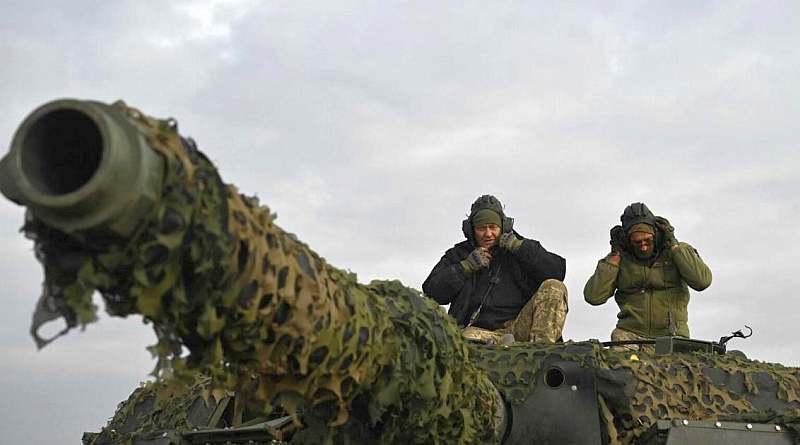
Photo: General Staff of the Armed Forces of Ukraine
