

His name was Fabian Ware. He was a journalist, educator, and manager before World War I. Then he became a Red Cross volunteer. Ware witnessed how chaotic burials of fallen soldiers vanished amidst the chaos of warfare along with the names of the deceased. Hundreds of thousands of bodies became impossible to identify or even find after a short period because burials were near roads, fields, farms… wherever they happened to be.
In 1914, Fabian Ware was 45. He saw how state military bureaucracy failed to systematically address these issues, and he began organizing grave records, documenting burial sites, gathering information about the deceased, and photographing graves for families.
In 1915, this activity was officially recognized by the British military command. Then a structured system of accounting was developed. On May 21, 1917, the Imperial War Graves Commission was established by royal charter. It not only organized records but also formed a fundamentally new state memory policy.
The British Empire at the beginning of the 20th century was a distinctly hierarchical society. Social origin, title, wealth, and military rank determined many things, including how a person was honored after death. As a result, the family of a wealthy officer could afford an expensive headstone, while families from the middle class or working-class backgrounds often could not. On the front, both could die in the same trench.
The Fabian Ware Commission proposed the principle that “military rank, origin, and wealth should not determine the degree of posthumous honor.” This led to a system of standardized headstones, uniform basic forms, principles of placement, and rules of care.
On the stone—name, rank, unit, date of death, appropriate symbolism. Where possible, a personal inscription from the family. Whether officer or enlisted, aristocrat or hired worker, regardless of which region of the empire they came from, the graves were to receive equal dignity.
This did not erase the individuality of the fallen; rather, it allowed their personal name, military and religious identity to be preserved without property or stylistic distinction. A uniform headstone did not make people identical, but it signified that their sacrifice had no social price—meaning it was equally priceless.
Another crucial decision was the refusal to repatriate remains at the request of individual families. The deceased were to be buried and honored near the places where they fought. This met with resistance. Wealthy families wanted to bring their men home, erect monuments, or bury them in family vaults and had the resources to do so. But such a possibility created a divide—some would return home because their family could afford it, while others would remain in foreign soil.
The commission defended common rights. It was a political decision, articulated in the language of memorial architecture.
The next paragraph is particularly important for the Ukrainian experience. In the context of the controversial creation of the National Military Memorial Cemetery and frequent scandals surrounding military burial sectors in the regions, or controversies over inadequate memorialization policies, the following sentence should be written in capital letters:
TO CREATE MILITARY CEMETERIES AND MEMORIALS, LEADING (!) BRITISH ARCHITECTS WERE ENGAGED – EDWIN LUTYENS, HERBERT BAKER, REGINALD BLOMFIELD.
Once again – not just any architect, whose portfolio includes a village council, warehouse, or shop, but LEADING… LEADING national-level architects. And they created the recognizable spatial system.
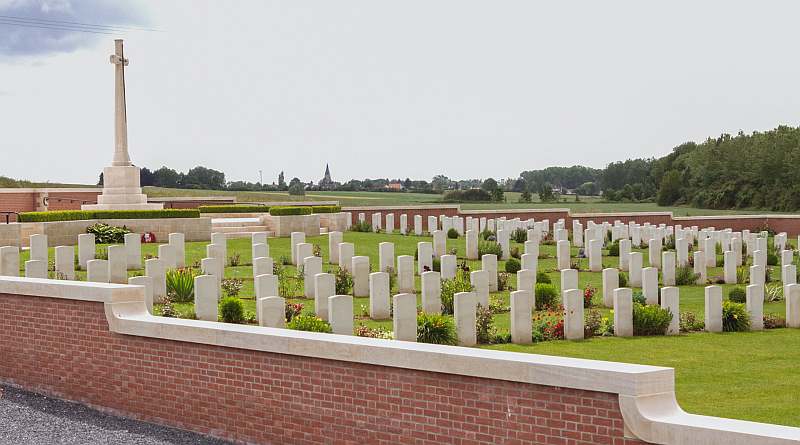
This is the lightning-quick recognizable picture: rows of bright (!) headstones, a well-maintained lawn, monumental architectural elements, the Cross of Sacrifice, the Stone of Remembrance.
This was not a random cluster of graves, but a cohesive visual code. Through architecture, the state conveyed to everyone: these people belong to a shared history, and the memory of them is not only a matter for relatives.
Separately they decided – what to do with those whose graves do not exist? What to do with those who went missing, those who cannot be identified, whose names are preserved in documents, but the burial place remains unknown?
This led to the creation of the system of Memorials to the Missing — memorials for the fallen with unknown burial places. The Menin Gate in Ypres, the Thiepval Memorial on the Somme, the Tyne Cot Memorial – tens of thousands of names on stone. These structures were not resting places for the named individuals in the ordinary sense. They served another important mission – “When it is impossible to preserve a grave, the name must be preserved.”
The state may not know exactly where the missing are buried, or to whom the remains belong, but the state definitely knows by name who did not return from the war. Thus, the name became the main element of the memorial. Not an abstract sculpture of a soldier or an allegory of mourning, or a monument commemorating victory – the name, surname, military affiliation, and specific unit of the individual.
Of course, in that process, not everything went perfectly. Hierarchy did not disappear, and the proclaimed principles were not perfectly implemented. By 2021, the contemporary Commonwealth War Graves Commission officially acknowledged violations of this principle, particularly concerning African and Asian servicemen and auxiliary personnel. Some of the deceased did not receive proper commemoration, and this is an important clarification because the history of state memory is not a history of flawless decisions. It is a history of principles, institutions, mistakes, and most importantly, the ability to recognize and correct them.
Fabian Ware died in 1949. The system initiated by him still exists. The modern Commonwealth War Graves Commission cares for the memory of 1.7 million war dead from two world wars. These are cemeteries and memorials in 150 countries and territories.
More than a century has passed. Borders have changed, the British Empire evolved into the Commonwealth, governments and generations of military personnel have changed. But the institution and principles continue to operate, including the approaches to the aesthetics of memorialization established back then.
Memory policy is not only a monument. It includes regulations, records, archiving, names, architecture, symbols, as well as land, maintenance, financing, and legal responsibility. And, above all, it is the state’s decision that the memory of the deceased cannot depend on the political whims or prejudices of current leaders, the popularity of any particular hero, or the wealth or status of a family.
A monument can be unveiled in one day, but for memory to serve the nation and its society a hundred years from now, an institution is needed along with unwavering adherence to declared meanings and rules. The State honors its fallen not when it ceremoniously unveils a memorial, but when it understands its overarching mission, message, and takes on the long-term commitment to preserve the names of the people and the essence of their deeds.
If you have read this far, it means you are not indifferent to the topic of memory policy and memorialization. And it is precisely the time to ask yourself—why does Ukraine not have its own Fabian Vera, instead of swindlers in politics, architecture, and unfortunately history, who care nothing for institutions, respect, aesthetics, and meanings through the ages?
And the images are already illustrations of another problematic issue—what should be an aesthetic monument filled with meanings.

 |
 |
 |
Cover: The Fromelles (Pheasant Wood) Military Cemetery — a memorial cemetery of the Commonwealth War Graves Commission (CWGC) near the commune of Fromelles in northern France (Hauts-de-France region). It is dedicated to those who died in the Battle of Fromelles on July 19–20, 1916, during the First World War. Here are reburied 250 Australian and British soldiers whose remains were exhumed from mass graves near Pheasant Wood (Bois du Faisan) in 2009.
