

While official Budapest hides behind rhetoric of “peace protection,” the real actions of Viktor Orban’s regime increasingly resemble the work of a deeply covert agency. At the center of this dismantling of European unity is Foreign Minister Péter Szijjártó. His activities are not just Hungary’s “special path,” but a consistent campaign to undermine EU and NATO security in the interest of the Kremlin.
The latest revelations, published in March 2026, particularly the sensational article in The Washington Post, confirm the worst fears of allies: Minister Szijjártó is effectively working as an informant for Moscow. According to sources, the Hungarian minister regularly calls Russian Foreign Minister Sergey Lavrov during EU Council meetings, promptly “leaking” the content of confidential discussions.
This mentioned betrayal aligns with the investigation by Direkt36, which previously proved that Russian intelligence services, namely the GRU and FSB, had full access to the IT networks of the Hungarian Foreign Ministry for years. Szijjártó knew about the breaches but took no action to protect NATO’s encrypted communication channels, preferring to leave the doors open for Russian hackers.
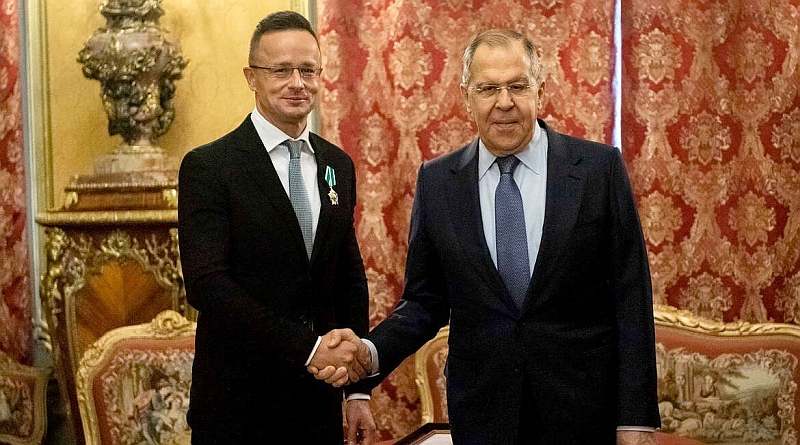
As Russia continues its strikes on Ukrainian cities, Szijjártó remains the only EU foreign minister who not only maintains extensive contact with Lavrov but also proudly displays the Russian “Order of Friendship.” These meetings in Moscow and St. Petersburg are not a quest for peace, but a coordination of actions to block military aid to Ukraine, battling against Russian aggression.
The cynicism of Hungarian diplomacy knows no bounds. Mr. Szijjártó does not shy away from meddling in the internal affairs of sovereign neighbors. Investigations confirmed that in 2020 he acted as a mediator, “bargaining” with the Kremlin for a visit for then Slovak Prime Minister, now President Peter Pellegrini. Budapest literally organized an election show in Moscow to help pro-Russian forces in Slovakia retain power, blatantly violating Bratislava’s diplomatic etiquette and sovereignty.
To divert attention from his destructive role, Orban’s regime launched a massive campaign to discredit Ukraine and the free press. In March 2026, Szijjártó and Orban’s propaganda stirred hysteria over the alleged “wiretapping” of the minister by Ukrainian intelligence with the involvement of independent journalist Szabolcs Panyi.
This scenario pursues two clear goals. First, it’s about discrediting Kyiv in the eyes of the Hungarian public to justify blocking financial aid. Second, it’s about clearing the media field, as accusations against Panyi, one of the few who investigates Orban’s ties to Russia and his corrupt conglomerate, of “working for foreign intelligence” is the most classic authoritarian tactic to suppress the free press under the pretext of protecting national security.
In the end, it is clear that, unfortunately, Péter Szijjártó has ceased to be a diplomat of a sovereign state. He is now a mere informant for Lavrov, essentially a tool of Putin’s hybrid war within Europe from the Hungarian base. The “bridge-building” policy that Budapest claims is, in reality, the construction of a pontoon crossing for Russian interests into the heart of the EU. If Brussels and Washington continue to ignore this “Trojan horse,” the cost of Hungarian betrayal for the collective security of the West will become exorbitantly high.
