

Information on current Russian losses due to sanctions as of 04/09/2026.
1. On the night of April 9, Ukrainian drones attacked one of the key elements of Russia’s oil infrastructure in the Krasnodar region.
– A major oil pumping station near the city of Krymsk, through which oil and petroleum products are transported to Black Sea export routes, was hit. The attack targeted the Krymsk linear production-dispatch station—one of the key nodes of the southern Russian pipeline system. A fire broke out at the site following the drone strikes.
– This station ensures the pumping of oil and petroleum products through the main pipelines “Tikhoretsk — Novorossiysk,” “Krymsk — Grushovaya,” and “Krymsk — Krasnodar,” as well as the product pipeline “Tikhoretsk — Novorossiysk.”
– These routes transport raw materials to Black Sea terminals and further for export. From the node in Krymsk, oil and petroleum products are also directed to the Novorossiysk port as well as for processing to the Ilsky oil refinery and Afipsky oil refinery.
– The station is part of the Chernomortransneft structure—a subsidiary of Transneft, which manages the region’s oil export pipeline system.
– An attack on such a facility indicates increasing vulnerability of Russia’s southern oil logistics. Disruption of such nodes could affect raw material transportation to Black Sea ports, creating additional risks for Russian oil exports.
2. The deficit of Russia’s federal budget in the first quarter of 2026 has sharply increased and has already exceeded the annual plan.
– According to official data, the budget “gap” reached 4.576 trillion rubles in January–March, which is approximately 133% more than the same period last year.
– With revenues of 8.309 trillion rubles, the Russian government spent 12.885 trillion rubles, meaning expenses exceeded revenues by about one and a half times. As a result, the deficit already exceeded the planned level for the entire 2026 by about 700 billion rubles, reaching 3.8 trillion rubles.
– One of the main reasons was the sharp decline in oil revenues. Income from oil and gas fell by 45% and amounted to only 1.445 trillion rubles — the lowest figure since the pandemic period. Income from other sectors of the economy, despite increased tax pressure, grew by only 7.1% — to 6.866 trillion rubles, which could not compensate for the loss of raw material rent.
– The budget expenditures in the first quarter reached 12.9 trillion rubles, which is approximately 17% more than a year ago. Such a massive deficit at the end of the first quarter is unprecedented for the wartime period.
– For comparison, in the first quarter of 2025, the deficit was about 1.96 trillion rubles, in 2024 — 0.6 trillion, in 2023 — 2.4 trillion, and in 2022, the budget even had a surplus during this period.
– Even a possible temporary increase in oil revenues in the coming months is unlikely to fully cover the gap. Against this background, the risks of further expansion of the deficit are increasing, which raises the likelihood of a budget revision or reduction in government spending.
3. The Central Bank of Russia stopped publishing part of the data on foreign exchange operations of the largest exporters, which were previously used to assess the real state of the country’s foreign exchange market.
– Since November 2022, the regulator has disclosed the volumes of net foreign currency sales by 29 largest exporters monthly, as well as the share of foreign currency earnings they converted into rubles. In the March review, these indicators effectively disappeared from the main publication.
– In the new report, the Central Bank of Russia only noted that in March the ruble weakened by approximately 5.2% against the dollar and by 4.5% against the yuan. This occurred due to a reduction in currency sales by exporters and the suspension of Ministry of Finance operations with the National Wealth Fund’s funds within the budget rule.
– Part of the data was preserved only in the statistical appendix to the report. According to these figures, net currency sales by the 29 largest exporters in March amounted to only 2.4 billion dollars — the minimum figure for the entire period of publication of such data.
– The dynamics of recent months show a sharp reduction in currency sales. In December, they amounted to about 4.7 billion dollars, in January — 5.1 billion, and in February only 3.5 billion dollars. For comparison, in the first half of 2024, large exporters sold an average of about 12 billion dollars per month.
– The reduction in currency supply from exporters means a decrease in foreign currency inflow into the Russian market and creates additional pressure on the ruble’s exchange rate.
– The concealment of part of the statistics only reinforces doubts about the real state of currency flows and export revenues in the Russian economy.
4. The Russian economy entered a phase of recession at the beginning of 2026.
– It is estimated that GDP fell by -1.5% in January, -1.7% in February, and around -1.5% overall for the first quarter. The annual forecast has been downgraded to -0.6%, although the actual contraction may reach -2% due to inertial production decline, shrinking tax base, and decreased investment.
– Negative trends have continued for several quarters, indicating a transition of the economy into a phase of systemic crisis. Tight monetary policy has led to a cash flow deficit: in March alone, the money supply under aggregate M2 decreased by approximately 1 trillion rubles (about $11 billion). Simultaneously, investment lending is effectively blocked, which, alongside reduced capital investment, provokes a contraction of the real sector.
– The deepest decline has been recorded in construction — at the level of 14–16%, undermining investment prospects and production modernization. Wholesale trade has fallen by 11.3%, reducing the potential of the consumer market. Cargo transportation dropped to 84.2 million tons — reaching the 2009 crisis level.
– The manufacturing industry, crucial for creating added value, also shows a decline — nearly 3%. The reduction in production is already forming additional inflationary pressure: the decrease in the volume of goods leads to currency depreciation and rising prices, which are currently partially curbed by imports.
– As a result, the economy is transitioning into a state of so-called “imbalanced decline,” where production, investment, and consumption simultaneously contract, making the possibility of a quick recovery significantly more difficult even with further state intervention.
5. Russia has started offering liquefied natural gas to Asian countries with record discounts of up to 40% in an attempt to find new buyers for sanctioned projects.
– This concerns LNG from the “Arctic LNG-2” and “Portovaya” plants, which due to sanctions have limited access to traditional markets. To expand sales, little-known intermediary companies from Russia and China are being used, offering supplies to Southeast Asian countries.
– Intermediaries propose drafting documents in such a way as to give the impression that the gas does not originate from Russia, but from other countries — including Oman or Nigeria. This allows circumventing sanction restrictions.
– However, such an aggressive pricing policy indicates serious sales problems: even amid a global energy shortage, Russia is forced to sell gas at a large discount to find buyers. This reduces export profitability and increases reliance on opaque schemes and intermediaries.
– As a result, despite attempts to capitalize on the energy crisis, Russia is effectively dumping on the market, losing part of its income and reinforcing its reputation as an unreliable supplier.
6. Russia’s oil export revenues have sharply risen to their highest level since 2022, despite significant shipment disruptions due to Ukrainian drone strikes on key port infrastructure.
– At the beginning of April, oil export volumes from Russian ports partially recovered after a sharp decline at the end of March when drone attacks damaged facilities at major Baltic ports. However, the overall shipment level still remains noticeably lower than in mid-March.
– The actual reduction in physical deliveries was offset by a sharp rise in global oil prices. Due to the escalation of the conflict in the Middle East, oil prices surged, allowing Russia to sharply increase revenue from exports.
– The average weekly oil export value, calculated with a four-week rolling indicator, rose to approximately $2.02 billion per week—this is the highest level since June 2022. For the week leading up to April 5, 28 tankers departed from Russian ports, carrying about 20.88 million barrels of oil.
– In comparison, exports were significantly lower the previous week: ports were able to send only 16.62 million barrels on 22 ships. Previously, before the attacks, up to 37 tankers per week departed from Russian ports, demonstrating the scale of the temporary logistical decline.
– The most significant impact was on the Baltic direction. Following drone strikes, one of the key oil terminals in the Baltic temporarily ceased shipments: not a single tanker departed in the last week, compared to two ships the previous week, and eight the week before that. The losses were partially compensated by another major port in the Baltic Sea, which resumed tanker shipments and provided the majority of export supplies in recent weeks.
– Thus, Russian oil revenues temporarily increased not due to an increase in exports, but solely thanks to a spike in global oil prices.
– Meanwhile, strikes on port infrastructure have revealed vulnerabilities in Russia’s export logistics, which may continue to limit physical supply volumes.
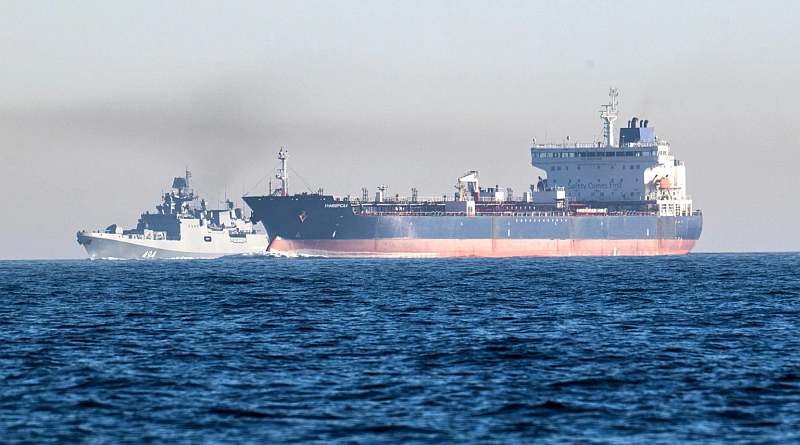
7. Russia has begun escorting “shadow fleet” tankers with military ships while passing through the English Channel.
– The frigate “Admiral Grigorovich” escorted the sanctioned tankers Universal and Enigma, which are carrying Russian oil, through the strait. The vessels were passing through British territorial waters, followed by a ship from the UK auxiliary fleet. Similar escorts have previously been used for other tankers.
– This is an attempt by Moscow to forcibly ensure the transit of its “shadow fleet,” which accounts for about 40% of oil exports. Overall, it consists of about 700 vessels, of which over 500 are under sanctions.
– Despite London’s tough rhetoric regarding the possible interception of such vessels, none have been detained so far, and over 300 tankers have passed through British waters since the beginning of the year.
– This is partly explained by the fact that routes also pass through the waters of other countries, complicating enforcement actions. At the same time, the presence of military escorts raises the stakes: any attempt at detention now carries the risk of a direct military incident. The Russian side has already warned of “response” in case of forceful actions.
– For Russia, this tactic also has a reverse effect—it increases the perceived risk among shipowners and insurers, leading to higher freight and logistics costs. Consequently, even without direct restrictions, this increases export costs and reduces the effectiveness of oil sales.
8. Clothing production in Russia is sharply declining, demonstrating the failure of the authorities’ expectations for a quick replacement of Western brands after their exit from the Russian market.
– The industry, which was relied upon as a symbol of “import substitution,” is entering its deepest crisis since the pandemic. According to official statistics, from January to February 2026, clothing production in Russia decreased by 17.2% year-on-year — the largest drop since April 2020, when factories were massively shut down due to pandemic restrictions.
– After a temporary growth of about 29% in 2023–2024, the industry quickly lost momentum: in 2025, there was a decline of 2.2%, and at the beginning of 2026, the fall sharply accelerated.
– The pressure on the industry is intensified by several factors simultaneously: sanction restrictions, labor shortages, increased tax burden, and weakened consumer demand amidst the cooling of the Russian economy.
– Under such conditions, production profitability is rapidly falling, and some enterprises are effectively operating on the brink of survival. According to industry representatives, about a quarter of sewing productions in the country are at risk of closure. This concerns not only small tailoring shops but also large factories that have been operating stably for years.
– As a result, another sector that the Russian authorities tried to present as an example of successful “import substitution” is showing deep structural problems and rapidly losing production capacity.
9. Hungarian Foreign Minister Péter Szijjártó coordinated actions with Moscow against Ukraine.
– Investigative journalists released material about Szijjártó’s contacts with Russian Foreign Minister Lavrov. According to records of conversations from 2023–2025, the Hungarian minister relayed information to Moscow about EU plans and discussed steps beneficial to Russia and directed against Ukraine. During the EU summit in December 2023, when the issue of Ukraine’s EU accession negotiations was being decided, Szijjártó reportedly informed Moscow about Hungary’s “blackmail strategy.” The authenticity of the records was confirmed by international investigative projects.
– In July 2024, after Orbán’s visit to Kyiv, Szijjártó conveyed details of the negotiations with Zelensky to Lavrov and discussed preparing Orbán’s trip to Moscow to meet with Putin.
– It also mentions transferring a document to Moscow with the EU’s demands to Ukraine regarding minority rights and coordination with Slovakia to block a new EU sanctions package.
10. The Trump administration is likely to continue easing sanctions on Russian oil in the coming days, despite criticism and limited effects from previous decisions.
– Last month, the US Treasury allowed the sale of previously sanctioned Russian and Iranian oil until April 11 and 19, respectively. These exceptions are expected to be extended, which effectively means further easing of the sanctions regime.
– This move did not yield the expected effect on the global market: prices did not significantly drop, and instead, Russia gained additional revenues—sometimes up to $150 million per day. Expanding the pool of buyers allowed Moscow to sell oil at higher prices despite formal restrictions.
– Against this backdrop, sanctions are increasingly losing their role as a leverage tool and are turning into a situational mechanism to influence the market. In Washington, it is effectively acknowledged that the decision is driven by internal economic risks: gasoline prices in the US have already reached about $4 per gallon—the highest since 2022.
– Critics warn that such a policy creates a dangerous precedent: countries under sanctions can receive relief if they can exert sufficient economic pressure on the US. This, in particular, allows Russia and Iran not only to adapt but also to partially benefit from the situation.
– At the same time, even if the situation with supply through the Hormuz Strait stabilizes, the White House does not rule out further extension of exceptions, indicating a lack of a clear long-term strategy and dependence of sanctions policy on short-term market fluctuations.
