

Information on current Russian losses due to sanctions as of 31.03.2026.
1. Ukrainian drones continue to systematically destroy Russian oil infrastructure: on the night of March 31, the Ust-Luga port was attacked again — for the fourth time in a week.
– According to Russian authorities, 38 drones were shot down over the Leningrad region, but damage in the port itself has been confirmed. Details are not disclosed.
– Previous strikes on Ust-Luga took place on March 25, 27, and 29, temporarily halting the port’s operations. Through its terminals, exports of oil, fuel oil, aviation kerosene, and gasoil occur — totaling about 700,000 barrels per day.
– Along with the Primorsk port, these facilities account for about 40% of Russia’s maritime oil exports, making them critically important for Russia’s energy revenues. Both ports have been repeatedly attacked in recent days.
– The concentration of strikes on port infrastructure indicates a shift in focus — from individual targets to a systematic disruption of export logistics.
2. The non-military sector of Russian industry shows accelerated decline at the beginning of 2026.
– According to the analytical center TsMAKP, closely linked to the Kremlin, excluding sectors with a military-industrial dominance, industrial production fell by 2% over the three winter months, and in February remained only 1.1% above the average monthly level of 2021. Civil industry figures were last lower in March 2023.
– The deepest decline is observed in industries dependent on investment demand. The production of structural materials is 10–25% lower than the average monthly level of 2024, while the production of building materials — cement, concrete, and bricks — decreased by 1.7–2.8% each month in January–February.
– Rapid contraction in the production of machinery and equipment continues. In February, output decreased by 2.2% following a 1.2% decline in January, while in the IV quarter of 2025, the decline averaged 3.5% per month, considering the calendar factor.
– It is estimated that in February, production in this segment was only about 75% of the average monthly level of 2024. Current figures indicate that the negative trend can no longer be explained by seasonal or calendar factors.
– A stable downward trend is forming in the civilian sectors of the Russian economy, increasingly evident due to the concentration of resources in the military-industrial sector.
3. One of Russia’s largest metallurgical plants — the Chelyabinsk Electrometallurgical Plant — is halting part of its production due to a collapse in demand.
– The halting of the smelting workshop is being discussed for at least three months starting April 1. The company has officially confirmed the reduction in ferrous alloy production, explaining it as a sharp drop in demand and the inability to sell the products.
– This is not the first sign of trouble: back in 2025, the plant had already moved to a four-day workweek. Now the situation has deteriorated to the level of actual conservation of part of the capacities. The reason is a systemic demand crisis in Russian metallurgy, suffering from high rates, a decline in business activity, and a reduction in domestic consumption.
– As a result, even key ferroalloy producers are forced to reduce production and switch to survival mode.
4. Russia temporarily suspends currency operations within the budget rule — at least until July 1.
– The decision was made by the government and the Ministry of Finance amid instability in oil revenues and changes in financial policy. Officially, this is explained by the revision of the base oil price parameter, which determines the distribution of income: part of the excess revenues is to be directed to reserves to cover the budget deficit.
– The authorities are trying to enhance the resilience of state finances and strengthen the financial system. In practice, the suspension means a pause in the purchase or sale of currency on the domestic market, which is one of the key instruments for regulating the ruble exchange rate and replenishing reserves.
– At the end of February, the Ministry of Finance planned to change the mechanics of the budget rule — to lower the threshold oil price and direct more revenues to the National Welfare Fund. It was for these changes that currency operations were suspended from March.
– However, the situation in the global market changed dramatically: after the start of the war around Iran, oil prices rose, forcing the Russian authorities to postpone the implementation of these plans. When operations resume, the Ministry of Finance plans to take into account the entire volume of unfulfilled currency interventions since March. This could mean sharp movements in the currency market in the future.
– In the end, the decision indicates the instability of the RF budget policy: the authorities are forced to quickly change the rules of the game depending on oil market fluctuations and external factors.
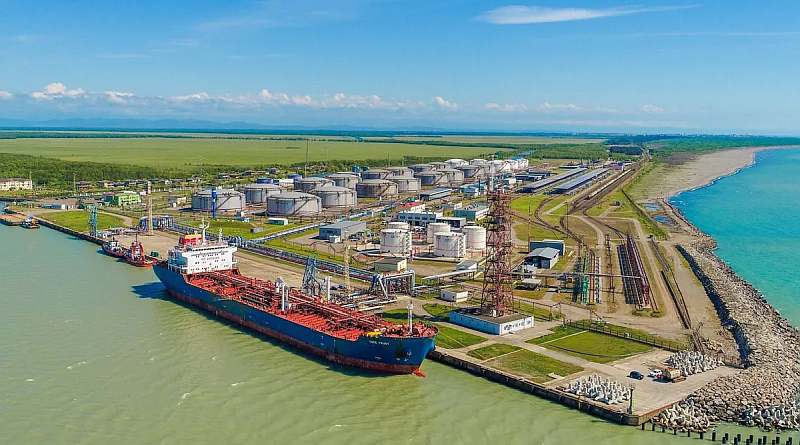
5. Georgia’s only oil refinery decides to abandon Russian oil.
– Due to the risk of sanctions and a desire to operate in the European market, Black Sea Petroleum, which manages the Kulevi Oil Refinery in the port, plans to completely replace Russian raw materials with supplies from Turkmenistan and Kazakhstan, as well as consider other alternative sources.
– The enterprise, with a capacity of about 1.2 million tons of petroleum products per year and the prospect of expansion to 4.5 million tons, is located in the Black Sea port of Kulevi.
– The plant currently produces mainly fuel oil and diesel, but the company plans to expand the range with Euro-5 standard gasoline, aviation fuel, and Euro diesel.
– Switching to alternative sources of oil should allow the Georgian refinery to export products to new destinations, primarily to European countries, which simultaneously means further displacement of Russian raw materials from regional supply chains.
6. Russia’s military rapprochement with Iran begins to undermine the Kremlin’s positions in Gulf countries.
– Moscow’s partnership with Tehran is increasingly seen in the region as a risk factor for security and political stability. According to British officials, Iranian drones, whose technologies were developed during the war against Ukraine, have been striking across the United Arab Emirates for almost a month.
– It is claimed that the drones are being guided using targeting information provided by the Russian side. This creates additional tension in the relations between the Gulf countries and Moscow.
– Against this backdrop, regional states are intensifying contacts with Kyiv. After Volodymyr Zelensky’s visit, a ten-year cooperation agreement in the field of air defense was signed with Saudi Arabia, and agreements were reached to deepen interactions with Qatar and the UAE.
– The strengthening of military partnership between Russia and Iran is gradually undermining Moscow’s diplomatic positions in the region. The Gulf countries, which previously tried to maintain a balance in relations with the Kremlin, are increasingly diversifying their security cooperation and seeking alternative partners.
– As a result, the alliance with Tehran, which Moscow sees as a way to counter Western pressure, is beginning to result in a loss of political influence and trust among key Middle Eastern states.
7. Sanctions continue to be bypassed through third countries: a scheme for supplying American ammunition to Russia has been uncovered in the US.
– An Italian citizen has pleaded guilty to conspiracy to violate export controls. According to the investigation, he organized the shipment of ammunition from the US worth over $540,000 through proxy companies to Kyrgyzstan, from where a significant portion of the products was transferred to Russia. The case involves military-grade ammunition that was ultimately used in the war against Ukraine.
– The investigation found that the organizer had access to international supply channels as a representative of a major weapons and ammunition distributor and consciously used intermediaries to bypass re-export bans.
– Separately, a figure involved in the scheme from Kyrgyzstan has already been sentenced to more than three years in prison for participation in this scheme.
– This case highlights a key weakness in sanctions policy: even strict restrictions can be bypassed through third countries and intermediaries, allowing Russia to obtain critically important resources despite formal bans.
8. Iran increased oil exports during the first month of the war, effectively limiting access to the Strait of Hormuz for other exporters and gaining significant economic benefits from the situation.
– According to ship tracking data, in March, the number of ships passing through the strait daily decreased by almost 23 times compared to the pre-war period. At the same time, about 80% of the tankers that managed to export oil from the Persian Gulf were Iranian or linked to countries supporting Tehran.
– Iran has effectively become one of the main beneficiaries of the conflict. Despite continuous strikes from the US and Israel since the beginning of March, Iranian oil exports have increased.
– According to Kpler estimates, average daily deliveries were about 1.8 million barrels, which is approximately 8% higher than the average level of the previous year.
– An additional factor was the partial easing of US sanctions, which allowed for the stabilization of deliveries, even though the main buyer of Iranian oil remains China.
– Meanwhile, other countries in the region faced a sharp drop in exports due to shipping restrictions in the Strait of Hormuz.
– This has exacerbated imbalances in the global energy market and contributed to rising oil prices.
– In fact, Iran has been able to use its control over a key maritime route as a tool of economic influence, allowing its own deliveries and limiting access to competitors, significantly altering the balance of power in energy markets even amid the active phase of hostilities.
