
Everyone who believes in painting has their own Picasso – just as they have their own Van Gogh or Renoir. Understanding an artist occurs when you find “your own” paintings – those that resonate with your perception of the world and light. As a child, when I could only see Soviet collections of Picasso, I genuinely did not understand why his work was so admired and assumed it was solely due to the Soviet reality, the tiresome “socialist realism,” whose masters could only dream of painting like Picasso. The question wasn’t even about him not needing to ask anyone what style to create in – it was about what we were allowed to see in his paintings.
I was mistaken. The essence of Picasso’s work was not the style but his genius perception of the world. Over the years, as I visited French museums of Picasso – from Paris to Antibes, I was increasingly convinced of the uniqueness and freshness of this perception. I finally understood the level of the artist I was fortunate to encounter, in New York at the Metropolitan Museum. The strength of America (at least the America we knew until recently) was precisely in its ability to appreciate masterpieces and gather geniuses. Therefore, in my opinion, the best collection of Picasso, as well as many other masters of European painting, is in the United States. Anyone who convinces themselves that they’ve understood everything about the artists of our continent just because they’ve visited the Prado or the Musée d’Orsay, but never visited North American museums, is mistaken. At least, my understanding of Picasso’s level, my intimate connection with him, originated in the halls of the Met.
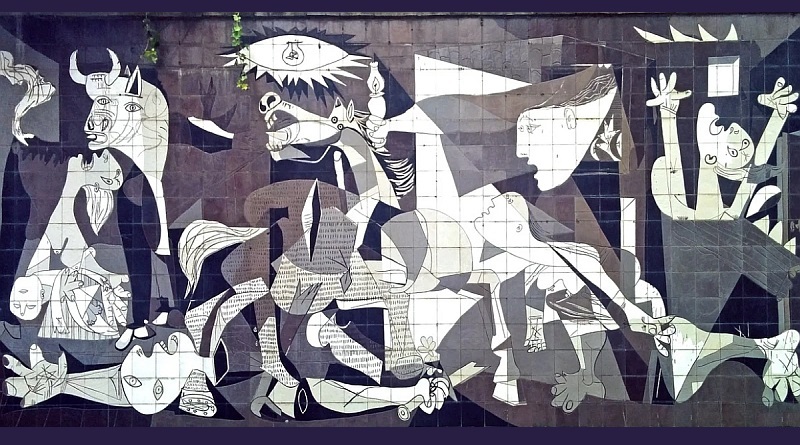
However, Picasso’s main painting is still in Europe, in Madrid, in the Master’s homeland. This is “Guernica,” which the Spanish saw at home only after the end of a long dictatorship period – because the artist did not want those involved in the destruction of the Basque town to manage the painting. I can confess that “Guernica” became Picasso’s main painting for me only after the great war began. Until then, my interest was more historical – I always visited the Queen Sofia Center when in Madrid to spend a few minutes near “Guernica,” I even traveled to Guernica itself to feel the atmosphere of horror that dissolved into the air of this possibly most important city for the Basques. Indeed, Guernica is like our Bucha: a small cozy town, reminiscent of the past, destroyed to intimidate and break. But only I visited Guernica when there was no Bucha yet.
And now, when I hear the sounds of explosions or see ruins in Ukrainian cities (and not only in Ukrainian, of course), I remember “Guernica.” And when I think of Bucha, I remember Guernica – so the experience of peaceful times intertwined with the war, and so I realized that Picasso painted a portrait of war. Not a universal portrait of war. My portrait of war.
The presence of this portrait, and Picasso himself with his view of the world in this new reality, feels almost physical. It’s not even a metaphor.
Now, as hopes for regime change in Iran dissipate, so does the hope that we will see the Tehran collection of his works. In pre-revolutionary Iran, Picasso’s work was admired and they assembled a marvelous collection – even the wife of the last Shah, Empress Farah Pahlavi, was among the main collectors. After the Islamic Revolution, the property of former rulers and their entourage was concentrated in a special fund, and the collection became inaccessible to the public. When the Tehran Museum of Contemporary Art (one of the few institutions that could afford to display such paintings) organized the “Picasso in Tehran” exhibition last year, its staff faced numerous refusals to participate. Private collectors feared their property would be confiscated, and other state museums did not want to be accused of promoting “incorrect” content. But when the exhibition opened, it gathered long lines of people who came from all over Iran, – just as a Picasso exhibition in post-Stalin Moscow gathered long lines of people from all over the Soviet Union. And yes, this willingness to meet always reminds us of how many unbroken people still exist in broken societies.
A replica of “Guernica” at this Tehran exhibition was also a quiet protest against the cult of war and violence that has always prevailed in the Islamic Republic and became one of the root causes of all the horrors that people in the Middle East are now experiencing. And I don’t even know if this museum – and Iranian Picasso paintings – will survive this war.
But what I do know for sure – “Guernica” will continue to remind us of all the horrors experienced under attack by people in Israel, the Gulf countries, or Iran, just as in Kharkiv, Kyiv, or Odesa.
