
Glory to Ukraine!
Glory to the defenders of Ukraine and the entire modern civilization!
Today in the release:
- How Trump’s second presidency differs from the first
- Anne Applebaum: Donald Trump does not think strategically. He does not think historically, geographically, or even rationally. He does not link actions taken today with events that occur weeks later. He does not consider how his behavior in one place will affect the behavior of others elsewhere.
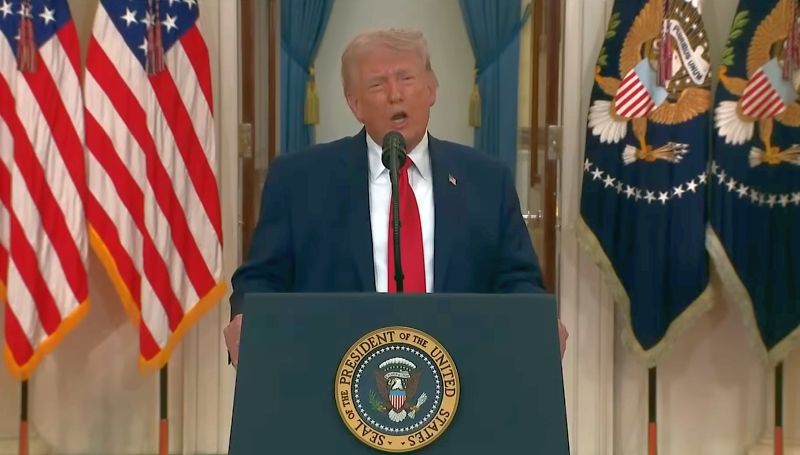
▶ One year, 2 months, and 15 days have passed since Donald Trump’s second presidency began.
The second presidency is very different from the first.
In his first term, Trump mainly sought external effects. He frequently traveled across the country before the COVID pandemic and spoke at massive rallies of his supporters. He emphasized his sympathy and love for dictators, meeting multiple times with Putin, Xi Jinping, and Kim Jong Un. He attempted impulsive actions, but his entourage mostly blocked or restrained him. This was the case with his desire to leave NATO in 2018 and to withdraw all American troops from South Korea in 2017. Even the details and backstage peripeties of decision-making were only revealed through books written about Trump’s first presidency.
The shadow of “Russiagate” loomed over him—the investigation into Russia’s interference in the 2016 elections to help him win. Although it irritated him, he mostly continued as before: speaking loudly and frequently, writing dozens of tweets a day, and giving endless interviews. During those four years, he made 30,573 false and misleading statements according to The Washington Post database.
When he crossed the line and decided to involve Ukraine to obstruct his main opponent in the 2020 election, Joe Biden, by stopping Congress-approved aid to Ukraine, his first impeachment followed.
When he crossed the line again by attempting a coup to stay in power after losing the election, the second impeachment followed.
Trump’s second presidency is fundamentally different. He speaks less frequently before his supporters but, as before, writes many tweets and gives interviews, mainly to Fox News. And, as before, he constantly makes false statements. He has started staging TV shows with himself in the lead role when hosting foreign guests at the White House and aboard the presidential plane, on which he flies almost every Friday from Washington to Florida, returning on Sunday.
But his actions, aside from this external, purely propagandistic, showman side, have another aspect that was absent in his first term or was largely blocked by his then-surroundings. He is attempting to establish an authoritarian regime in the US with the executive power concentrated under his leadership. He aims to reshape the world, dividing it into spheres of influence with himself, Putin, and Xi Jinping, openly showing his disdain for other countries and their leaders, believing their role, in his own words, is to kiss his *ss, obey him, and please him if they want to be in his sphere of influence or to do the same with Putin and Xi Jinping if the latter believe certain countries should be within their spheres of influence.
In his second term, unlike his first-term entourage, there is no one around him who can stop him from taking destructive, reckless, and erroneous actions, or who can block the execution of such decisions.
He openly and constantly demonstrates disdain and disregard for all the values of modern civilization – democracy, human rights and freedoms, equal rights for all, and the rule-based international order.
What he will achieve on this path by the end of his presidential term is unknown today. Everything in today’s world is extremely fragile and changing before our eyes.
It is likely that he will still not succeed in destroying the American political and legal system, although he will continue to push in this direction. The system is likely to withstand rather than be destroyed by him. However, it may take years, if not decades, to repair or rebuild what he breaks, and most importantly, to try to overcome the most significant divide in American society since the Civil War of 1861-1865.
What will happen to the world, increasingly chaotic as a result of his efforts, is unpredictable by anyone.
▶ On March 17, the online version of The Atlantic published an article by Anne Applebaum, an American journalist, Pulitzer Prize winner, and the wife of the Polish Foreign Minister Radosław Sikorski, titled “Everyone But Trump Understands What He Has Done.”
Trump has insulted and tariffed his European allies, persuaded Denmark to prepare for a US invasion and, by pressuring Ukraine and not Russia, encouraged Putin to keep fighting. All of which he has forgotten. https://t.co/GhDO27FyxK
— Anne Applebaum (@anneapplebaum) April 3, 2026
The article analyzes how Trump is destroying the established relationships between allies, between countries whose union is based on shared values of democracy, freedom, and human rights, and which aims to protect these values. Here is the translation of the article.
“Donald Trump does not think strategically. He thinks neither historically, nor geographically, nor even rationally. He does not connect actions taken today with events that happen weeks later. He does not consider how his behavior in one place will affect the behavior of others elsewhere.
He does not take into account the broader consequences of his decisions. He does not take responsibility when those decisions turn out to be wrong. Instead, he acts whimsically and impulsively, and when he changes his mind—when new whims and impulses arise—he simply lies about what he said or did before.
Over the last 14 months, few foreign leaders have been able to recognize that a person devoid of any strategy could indeed be the President of the United States. “Could it be,” whispered foreign policy analysts, “that Trump does not think beyond the current moment?” “Could it be,” whispered foreign statesmen, “that he adheres to no ideology, no pattern, no plan?” Various terms—”isolationism,” “imperialism”—were used in attempts to place Trump’s actions in a historical context. Pathetic articles were written about, for example, the supposed significance of Greenland—as if Trump’s interest in this Arctic island was not solely explained by the fact that on the Mercator projection, it looks very large.
This week, something broke. Perhaps Trump does not see the connection between past and present, but others do. They see that as a result of decisions Trump made, but cannot explain, the Strait of Hormuz is blocked by Iranian mines and drones. They see oil prices rising globally and understand: solving this problem by means of the US Navy is a difficult and dangerous task. And they also hear the president—once again—lashing out at those around him, trying to shift responsibility onto others and threatening those who refuse to take it on.”
NATO faces a “very bad” future if the alliance does not help unblock the strait, Trump told the Financial Times, seemingly forgetting that it was the United States that founded and has led this organization since its inception in 1949. He also stated that he is not asking but ordering seven countries to provide assistance. He did not specify which ones. “I demand that these countries intervene and protect their own territory because it’s their territory,” Trump told reporters aboard Air Force One en route from Florida to Washington. “This is the place where they get their energy resources.” In reality, it’s not their territory, and it is his fault that access to their energy resources has been blocked.
However, in Trump’s view, these threats are entirely justified: he now has a problem, and he wants other countries to solve it. He seems to forget or simply doesn’t care what he told the leaders of these countries a month or a year ago; he also doesn’t realize how his previous decisions have affected public opinion in these countries or harmed their interests. But they remember, they care, and they know everything.
In particular, they remember that for 14 months the American president imposed tariffs on their goods, mocked their security concerns, and repeatedly made offensive remarks toward them. Back in January 2020, Trump told a number of European leaders, “If Europe is attacked, we will never come to your aid or support you.” In February 2025, he told Ukrainian President Volodymyr Zelensky that he also couldn’t count on support because he “has no cards.” Trump mockingly called Canada “the 51st state” and referred to the current and former prime ministers of that country as “governors.” He falsely claimed that allied troops in Afghanistan “held back, a bit behind the front line,” which deeply insulted the families of soldiers who died in battles after NATO, for the first time in its history and at the request of the United States, invoked Article 5 of its Treaty. He called the UK “our once great ally” after the British refused to participate in the first phase of the attack on Iran. Earlier this month, when discussing the dispatch of aircraft carriers to the conflict zone in the Persian Gulf, he mocked the idea on social media: “We don’t need those who join the war after we’ve already won!”
At times, these harsh statements escalated into something worse. Even before his second inauguration, Trump began hinting that he might not rule out the use of force to annex Greenland, a territory of Denmark, a close NATO ally. Initially, it seemed either trolling or a joke; however, by January 2026, his public and private comments convinced the Danes to prepare for an American invasion. The Danish leadership had to seriously consider whether their military would shoot down American planes, kill American soldiers, and die at their hands; it was such an agonizing ordeal that some have yet to recover from it. A few weeks ago in Copenhagen, I was shown a Danish mobile app that advises users on which products are made in the USA, so they can avoid purchasing them. At that time, it was the most popular app in the country.
Economic damage is also by no means trolling. Throughout 2025, Trump imposed tariffs on Europe, the United Kingdom, Japan, and South Korea—often erratically, or rather, guided only by his whims, without considering the consequences at all. He raised tariffs for Switzerland because he didn’t like the Swiss president, and then lowered them after a Swiss business delegation presented him with gifts—including a gold bar and Rolex watches. He threatened to impose 100-percent tariffs against Canada if it dared to enter into a trade agreement with China. Not the least bit embarrassed by potential conflicts of interest, he conducted trade negotiations with Vietnam precisely when his son Eric Trump launched a project to build a $1.5 billion golf course in that country.
Europeans might have tolerated the harsh attacks and even damage to trade relations if it weren’t for the real threat that Trump now poses to their security. For 14 months, despite talking about peace, he encouraged Russian aggression. He stopped military and financial assistance to Ukraine, thereby giving Vladimir Putin new hope for victory. His envoy, Steve Witkoff, began openly negotiating business deals between the United States and Russia—even though the war was not over and the Russian side had not agreed to a ceasefire. To European leaders, Witkoff presents himself as a neutral figure, occupying some intermediate position between NATO and Russia—as if, once again, the United States were not the founder and leader of NATO, and as if Europe’s security were of no particular interest to Americans. Trump himself continues to attack Zelensky and lie about the extent of American support for Ukraine, repeatedly estimating it at $300 billion or more. In reality, this amount is closer to $50 billion over three years. (According to a Pentagon report published in January 2025, the Biden administration provided Ukraine with direct military aid in weapons, ammunition, and equipment over four years totaling $65.5 billion—a record in U.S. military aid history since World War II—IA). At the current rate, Trump will spend the same amount in just three months in the Middle East—waging war, not trying to stop it.
The result is this: Canadian Prime Minister Mark Carney stated that Canada will not participate in “Israel and the United States’ offensive operations—and never will in the future.” German Defense Minister Boris Pistorius says: “This is not our war, and we did not start it.” The Prime Minister of Spain refused to provide the United States access to bases to launch military actions. The United Kingdom and France may send a few ships to protect their own bases or allies in the Persian Gulf region, but neither will send their soldiers or sailors to participate in offensive operations initiated without their agreement.
This is not cowardice. It’s calculation: if the leaders of allied countries believed that their sacrifices could have any significance for Washington, they might act differently. But most of them have stopped trying to find hidden logic in Trump’s actions and understand that any contribution from them would be completely devalued. A few days or weeks later, Trump wouldn’t even remember that it happened at all.”
▶ This is the essence: a complete lack of any strategy, chaos, impulsive decisions with the confidence “I alone know what to do and can do whatever I want,” demonstrative disdain for countries that have been the closest allies of the USA for decades. Complete disregard for the values of liberal-democratic civilization.
This was the choice of 49.8% of American voters.
There are 1022 days left until the end of the story titled “Fear: Trump in the White House” © (the title of Bob Woodward’s book, published in 2018).
The next traditional big review of American news will be next Saturday, April 18. If there are any breaking news deserving attention, I will report them briefly before then.
Thank you to everyone who read this. Take care of yourselves and your loved ones. Take care of each other, help one another. Health to everyone.
In the end, what happens in the world depends on us. Whether we fight evil, do Good, remain mere observers, passively wait, and believe that someone somewhere will decide for us, or we fight evil and do everything possible for Good to prevail.
We must not allow evil to triumph. The victory of evil would mean the end of the world we live in. We cannot allow that. Especially now.
Ukrainian Friends, I embrace and love you all. Please take good care of each other, I ask you sincerely.
Ukraine exists and will always exist.
And evil will be defeated and punished. Definitely.
