
The largest war in Europe in the past 80 years has decisively reshaped the foundations of military science and changed practically everything — from the structure of firepower to logistics and psychological support for personnel. Both sides are trying to fill the emerging gaps by creating new means of destruction. This is clearly evident at the operational level of military command.

The enemy’s grouping has a practically classical Soviet structure of troops and their means of firepower. The firing range of the artillery within the organizational structure of each military unit corresponds to the depth of the combat mission of that unit, and the structure of the ammunition corresponds to its set of tactical tasks. If an army artillery brigade does not need to illuminate or create smoke, then such shells are not envisaged in the ammo of its guns — only high-explosive shells. Specialized shells like propaganda, incendiary, concrete-piercing, active-reactive, long-range, high-precision, with jamming devices (the Soviet genius created these too, yes) are considered special; their requirement for an operation is determined by the number and are provided to the troops exclusively for the implementation of a specific task before its execution.
Hence, the depth of the regiment’s combat mission is 10-15 km, the firing range of its artillery division is 15 km regardless of the distance of the firing positions from the line of combat engagement.
A division performs a task to a depth of up to 30 km, its artillery regiment on 2S19 fires at 24 km, if there are active-reactive shells — 30 km. If there is a “Tornado-G” MLRS division or 9M521 and 9M522 shells for BM-21 — 40 km. Without maneuvering divisions, the artillery regiment cannot support the forward regiments of the division to the full depth, as it does not reach, and the single “Tornado-G” division performs a limited circle of tasks, usually remains the reserve of the division commander and is clearly not the sun to warm everyone.

The army conducts operations at depths up to 150 km, although textbooks do not prohibit advancing 250–350 km. The artillery brigade with the same 2S19 fires at the same 24/30 km. The “Iskander” missile brigade hits targets at 480 km. But again, the weapon is expensive, the range of targets they attack is not that wide, and the need to fight against Ukraine’s infrastructure makes it even narrower. On the other hand, during the ATO times, our “Saint Barbara” brigade fired “Tochkas” at checkpoints. Don’t ask why and for what reason. Here it is clearly visible that in the zone from 30 km and throughout the operational area up to 350 km, there is simply nothing to reach the commander’s objects.
There is always a wizard, his name is senior commander, who has certain forces and resources, which are not enough for everyone, but he always gives something to the commander in the direction of the main strike: in the military district there is a reactive brigade of MLRS “Smerch” (or “Tornado-S”), which can fire at targets at 120 km. 2S5, 2S7, MLRS “Uragan” can also be used, but they also fire up to 40 km, while “Uragan-1M” with some new 220 mm shell (exact data not available, but NPO “Splav” reported it was created) — at 70 km.
And then the drones arrived. The artillery initially expanded, dispersed, began maneuvering, and eventually moved as far as possible from the front. Rocket divisions generally disappeared from the operational zones of armies, acting in some strange formations like a tactical missile group from their national territory and from occupied Crimea. The reach of artillery fire decreased, but the volume of tasks remained the same. Strike drones and loitering munitions took on part of the work. Hunting for individual logistics trucks more than 50 km from the front line introduced elements of a computer shooter into combat operations but did not radically change the views on planning strikes.

There is still aviation left, which in a classic operation until 2022 performed about 25% of the tasks of fire damage.
The enemy’s strike aviation is consolidated into the Air Force and Air Defense armies, which have dual subordination—to the commanders of military districts and the command of the Aerospace Forces. Two such armies trouble us—the 4th Army (in the south of Ukraine) and the 6th (in the east). Such an army includes three mixed air divisions, which have air regiments equipped with strike aircraft. Example: the 4th Air Force and Air Defense Army includes the 1st, 4th, and 27th mixed air divisions. The 1st includes the 368th Assault Aviation Regiment (Budyonovsk airfield, 24 Su-25) and the 559th Bomber Aviation Regiment (Morozovsk airfield, 36 Su-34). The 4th includes the 11th Mixed Aviation Regiment (Marinovka airfield, Su-34, recently visited by “Neptunes”) and the 960th Assault Aviation Regiment (Primorsko-Akhtarsk airfield, Su-25). The 27th has the 37th Mixed Aviation Regiment (Gvardeiskoye airfield in Crimea, 6 Su-24m, 14 Su-25).
These should have been working in the operational depth. But this hasn’t happened since early spring 2022. Plus, losses of planes and pilots, plus regular strikes on airfields closest to Ukraine, mean they have to operate from bases as far from the border as possible, which affects time, adds extra stress to aircraft frames and engines, and physically exhausts the pilots.
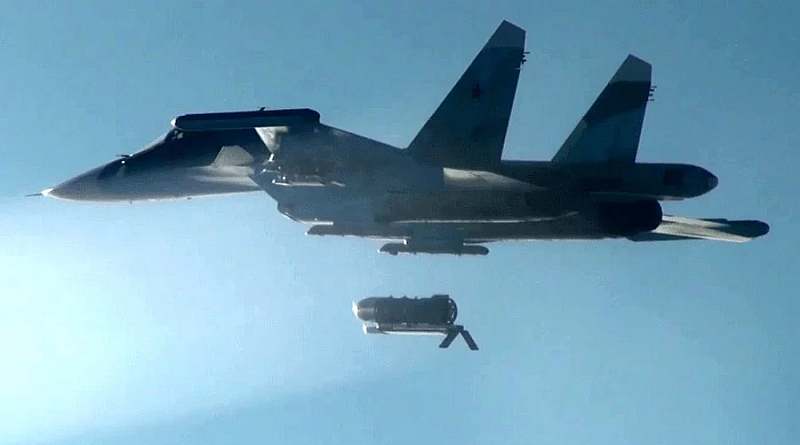
What about objects in the 30–350 km zone? And development began. Guided air bombs with UMPC kits (universal planning and correction module) appeared. If a jet engine is attached to UMPC, bombs can be thrown 150 km. Rumor has it that even 200. But from 150 to 350 km is still an unreachable zone. And the Air Defense Forces regularly remind them, so “Putin’s falcons” don’t risk approaching closer than 100 km for launches. Yet, in October alone, these criminals (there are lists, all will be found sooner or later) used 8,000 KABs. At the humanitarian aid distribution point in the Komyshuvakha school, the enemy used several KAB-500 bombs and one FAB-3000 with a warhead of 1400 kg—directly on the shelter where people were located.
There is also long-range aviation with air-to-surface cruise missiles, sea-based cruise missiles, what reforms do you lack? Enemy strategic bombers strike, operating in groups of 10-15 planes, usually Tu-160 and Tu-95. The Tu-95 carries six to eight Kh-101 cruise missiles with a range of up to 5500 km on an external suspension, but can also use Kh-55, Kh-555. The Tu-22m3 carries three anti-ship Kh-22 or three cruise Kh-32. The Tu-160 has up to 12 Kh-101, Kh-55, Kh-555 missiles in its internal bays. Sea platforms are now hiding and rarely shoot their ‘Kalibr’ missiles.
The economy has its own opinion:
• the enemy has 30-38 combat-ready Tu-95 (47-53 on paper), 13-17 Tu-160 (15-18 in total), and 9-15 Tu-22m3;
• the cost of a flight hour of a strategic bomber is $40-60 thousand, the flight duration from the Olenya airfield to the launch boundary is 2.5-4 hours, from the Engels airfield – 0.5-1.5 hours, from the Ukrainka airfield – 8-12 hours. Same on the way back. Il-78 air tankers are sitting at the Dyagilevo airfield near Ryazan. We calculate what and how much ourselves. Recently, we destroyed a tanker aircraft. And the Ryazan Oil Refinery earlier;
• the price tag for a Kh-101 missile is $1.2–2.5 million, although there were estimates of $13 million (I think they lied), Kh-555 / Kh-55 — approximately $2-4 million, Kh-22 / Kh-32 — around $1 million.
After practicing with a calculator, the commander should ask himself: “Why do I need a war for such money?!”, and his senior officer: “Why should I scatter my budget and reserves?!”. Overall, it makes sense.
So how to cover this zone, where it either can’t be reached or it’s reachable for big money? And then we heard about the small-sized cruise Missile S8000 “Banderole”: shooting range — up to 500 km, price — $50–150 thousand. The main carrier is the Mi-28 attack helicopter. There is only one squadron of such, operating from the Dzhankoy airfield, so “Banderoles” mostly fly over southern Ukraine. If launched from the ground, the range decreases by 100–200 km. This option is mainly used from the northern and eastern directions. Note that $16,000 in this price is for the Chinese turbojet engine Swiwin SW800Pro. It is freely available, made for aeromodelling sports. But it falls into the hands of not those modelers.

The next step is the same small-sized missile “Dan-T”: shooting range — up to 450 km, ground launch — up to 250 km, price lower than “Banderole” by 30%, around $65-100 thousand. They took a target missile for training air defense missile crew and made a cruise missile. The warhead, by the way, is 130 kg.
However, the Russians didn’t stop there, and by the end of the year, we heard about three new developments – the “Filin” cruise missiles, the S-71k “Kover,” and the S-71m “Monochrome.”
“Filin”: firing range of 600–1200 km, warhead – 50 or 100 kg. The airframe and fuselage are made from composite materials (carbon and fiberglass), and certain elements of the internal structural set are 3D-printed to reduce production costs. The wing is a simplified swept design without complex pivoting mechanisms. The engine is the Russian jet engine R500 (manufacturer – LLC “Reynolds”). The engine has independent rotor and stator parts, facilitating its maintenance and simplifying mass production. Price – $70-120,000.

“Kover”: sometimes referred to as “Rover,” but this is a transliteration error. This is an aviation cruise missile with a firing range of up to 300 km for the Su-57 (internal compartment) and potentially for the S-70 “Okhotnik” UAV. It has a warhead in the form of a standard OFAB-250 aerial bomb and uses the same R500 jet engine as the “Filin.” It attacks targets whose coordinates are pre-programmed in the onboard control apparatus. The price is currently unknown but lower than the “Filin.”
“Monochrome”: an aviation cruise missile with a firing range of 200-400 km. Carrier – Su-57. Warhead – 100-250 kg, likely the same OFAB-250. Smarter than the “Kover,” as it has elements of autonomous target searching (machine vision using Nvidia Jetson), and thus is more expensive than all mentioned, including the “Banderol,” but cheaper than a classic cruise missile.
Thus, the opponent has relatively quickly solved the problem of striking targets in operational depth with low-cost strike means and the potential for rapid production scaling. All this was achieved under conditions of sanctions, funding issues, but rather swiftly.

According to the chief designer of DCCB “Luch” Oleg Korostelev, the full development of the RK-360MC “Neptune” complex (missiles, launchers, communication tools, and mobility means) cost Ukraine approximately 40 million dollars. Only in October, up to eight Su-34 bombers were destroyed at the “Borisoglebsk” and “Marinovka” airfields by “Neptunes.”
According to Denys Shtilerman, co-owner of the company Fire Point, not a single hryvnia from the state budget went towards the development of the FP-5 “Flamingo” missile (excluding the launcher, communication tools, and mobility means); everything was funded by the company and private funds, the amounts of which are not disclosed.
On November 2, 2026, Shtilerman made quite an interesting statement, revealing that in 2024, UNITED24 allocated approximately 300 million UAH to support the Fire Point’s ballistic program. However, the company returned the entire amount to avoid claims that the missile development was financed by the state or charitable funds. Regarding Fire Point materials, they mentioned the support of Brave1 amounting to about 700 million UAH, which, according to Shtilerman’s statements, was also returned by the company. The co-owner of Fire Point also provided another interesting example: delivering 200 kg of a warhead over 300 km with the FP-7 missile costs approximately $600,000, but a similar task with the FP-2 attack drone, in his estimation, costs around $50,000. Therefore, there is no sense in producing the FP-7. Whether it was sensible to design it at all, he did not mention.
Somewhere in the country, engineers and designers from the “Yuzhnoye” Design Bureau, “Yuzhmash” plant, “Electroprylad” Scientific and Production Association (Kharton), who once designed and manufactured the R-36M2 “Voevoda” intercontinental ballistic missile, are nervously smoking. Why they found themselves out of the loop of missile program funding is unclear.
On the cover: Dropping of FAB-3000 on the territory of Ukraine. Photo: Ministry of Defense of the Russian Federation
