
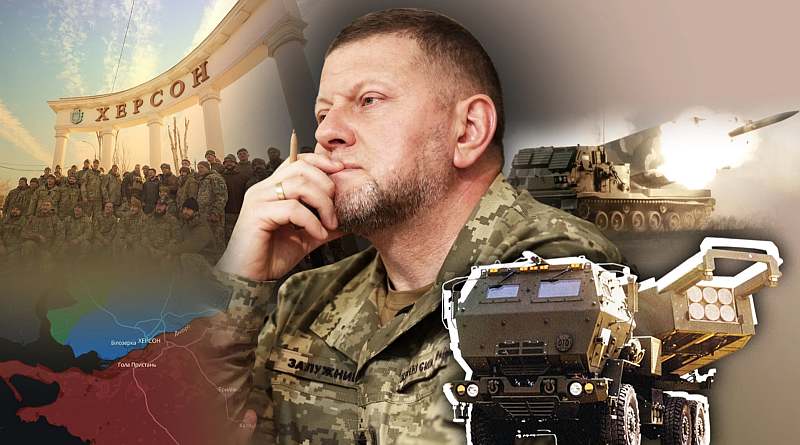
About the Last Operation of the War That Changed Everything
In the history of great wars, after the battles, verbal battles for “objectivity” and “their own truth” always begin. Our war has not been spared this fate. And although its end is not in sight even through optical sights, many materials and even books have already been published where participants of this tragedy portray themselves as victors and try to shift the blame onto someone else. Traditionally, our enemies set the pace, and we follow.
Already on November 10, 2022, a day before our troops entered Kherson, I wrote in an address:
“Behind every so-called “gesture of goodwill” from the enemy stand the colossal efforts of our troops. Just as the enemy retreated from Kyiv and Kharkiv region, left Snake Island, the possible exit from Kherson is the result of our active actions.
Directly on the Kherson direction, the Defense Forces of Ukraine destroyed logistical routes and the supply system, disrupted the enemy’s troop control system. Thus, leaving the enemy no other choice but to flee“.
Any war is blood, death, and the tragedies of fates caught in this whirlpool.
These are tragedies not only of those who faced death but also of those whose orders proved fatal for others. But all these people are already historical figures who fought for others’ right to live at the cost of their own lives.
Here, on the right bank of the Dnipro River, a true tragedy unfolded.
Since in February 2022 we were unable to defend ourselves fully, the Russians achieved a truly strategic success. However, it was eventually nullified: the enemy simply lacked the forces and means to continue the offensive, and local residents, our troops, and reserves from the Air Assault Forces offered genuine fierce resistance. However, this nullification was only temporary and just a chance for us and for those who came to kill.
Intellectual Battle for Strategic Initiative
A truly stalemate situation developed for the enemy, associated with the possibility of losing not only a strategic section of territory but also the inability to expand this operational success. A window of opportunity opened for us to localize and eventually eliminate the bulge on the right bank of the Dnipro.
The intellectual battle of the general staffs for strategic initiative began. At that time, the leadership of the Russian army probably made the only correct decision—to consolidate the success by conducting a defensive operation with the forces and means of the airborne troops and the marine infantry, rapidly redeployed there from all possible directions, and await reserves for the continuation of the offensive. This was still the living elite of the Russian army, which was digging deep into our land.
Therefore, the battle for the right bank began for me and the General Staff as early as July and far beyond the borders of the Kherson region.
The Russians needed forces to move further towards Kryvyi Rih, Pervomaisk, Mykolaiv, and Odesa.
We needed additional forces to drive this elite out of Ukrainian land, but we lacked them. We needed equipment, weapons, and ammunition. During the defense of the South, we, along with mayors, farmers, and all concerned citizens, gathered these in garages and farms, often taking them from the Russians themselves. However, we couldn’t conduct an offensive in the same way.
The occupiers were stubborn. Even when the enemy fled from the Kharkiv region, the elite stayed put. Time was honest, giving a chance both to us and to them. However, for us, that chance was singular.
Saying that preparing an offensive under such conditions was difficult would be unfair. Its success depended not only on the heroic acts of our soldiers but also on many other factors. The most crucial of these was the supply of weapons from our partners. While the staffing of units in the summer of 2022 differed significantly from today, we couldn’t equip ourselves with artillery, tanks, and infantry fighting vehicles. A classic case where the fate of a campaign depends on a partner means it’s no longer your campaign.
Every cloud has a silver lining. Even now, it’s clear that these delays allowed us to use time to our advantage, leading to the unexpected Kharkiv offensive operation on September 5 for our partners. It was truly a three-handed piano play that both the General Staff and commanders executed excellently.
There are no outstanding operations and genius heroes. There is only a front over 3000 kilometers long, and these three hands must play a single melody to create the illusion that three are playing. Back then, everyone was united. As were our partners who posthumously forgave me this surprise once again. Today, I deeply regret that exactly one year later, everything changed.
The Front Moves
Despite the enemy not reinforcing the Kharkiv direction, it soon became apparent that advancing on the elite of the Russian army across the open Ukrainian steppe was nearly impossible. Weapons and ammunition were delayed, and politics demanded results—not only ours.
That’s when the search for options, alternatives, the will to survive and win began to yield results. Just as at the beginning of 2022, military science came to aid, of which many later laughed. It demanded seeking concepts like parity, which gave a chance to enter the ring in the needed weight category. Then, heroism, cunning, and much of what history records as feats could be applied. Without them, it would be suicide.
This parity became represented by Western weapons and their effectiveness. We’re talking about HIMARS and M–270. The specific characteristics of these weapons define their strategic significance and determine their special deployment order, which unfortunately was changed in 2023.
The presence of HIMARS and M–270 systems and the correctly chosen application principle allowed us, starting from July-August 2022, to independently conduct selective missile-artillery strikes on sensitive communication lines and command posts, especially the logistics system of the Russian armed forces.
Analytics conducted at the General Staff at the end of August showed that the results of such strikes began to bring the expected outcome and required an immediate systematic approach to planning such actions, combining them with the actions of infantry and tanks. The enemy’s ability to defend, due to our reduction of their logistical capabilities, began to decline sharply.
Observers from the American publication The Wall Street Journal highlighted a feature of the Ukrainian strategy in the offensive in the southwestern operational zone:
“Instead of directly engaging in brutal artillery duels and tank battles favored by Russia, Ukraine tried to encircle Russian forces and cut off supply lines. It effectively integrated Soviet-era weaponry with long-range precision western artillery and missile systems to deprive the enemy of fuel, ammunition, and other reserves.
While Ukrainian troops advanced rapidly towards Kharkiv, the Kherson front progressed slowly. Faced with a larger and more effective force than in Kharkiv, Ukrainian troops suppressed Russian resistance by striking supply depots and routes across bridges over the Dnipro River, cutting off thousands of Russian troops in and around Kherson.”
Analyzing the Ukrainian offensive, Australian Major General Mick Ryan described the actions of the OSUV “Oleksandria” troops in the Kherson direction as a “strategy of corrosion.” In his opinion, Ukraine employed an “indirect approach,” first outlined by British military strategist Basil Liddell Hart in the 20th century, aiming to shift the balance of forces through unexpected and agile measures, “weakening the enemy with pricks rather than delivering risky blows.”
As a result, as early as the beginning of September, the front moved forward and, surprisingly, did not stagnate. It is worth noting that in September-October 2022, on the Kherson-Beryslav bridgehead, we faced an enemy grouping consisting of airborne forces from the 108th Airborne Regiment, the 7th Airborne Division, the 76th Airborne Division, the 98th Airborne Division, the 83rd Airborne Brigade, the 11th Separate Airborne Brigade, and the 45th Special Purpose Brigade. Also, the 810th Naval Infantry Brigade, parts and subunits of motorized rifle troops from the 49th, 58th armies and the 22nd Army Corps, the 90th Tank Division, the 10th Separate Special Purpose Brigade, and units of the Russian Guard.
The management of combat actions of the Russian troops on the bridgehead was carried out from the forward command post of the 49th army, personally headed by the commander of the airborne troops of the Armed Forces of Russia, Colonel General Mikhail Teplinsky, due to its importance and significance.
Incidentally, the command posts of the 49th army and the 22nd army corps were moved to the east bank of the Dnipro River after being repeatedly struck by our missile artillery units. Their location on the left bank also affected the decreased stability of the defense.
The personnel, especially the airborne units of the Russian group, had combat experience, showed resilience in defense, motivation, and actively resisted Ukrainian troops. Additionally, the Russians continuously replenished personnel and combat equipment.
The lack of natural camouflage factors in the Ukrainian steppe did not allow our troops to use large groups of armored vehicles during the offensive. The advance into the operational area was also hindered by a network of irrigation channels for irrigation farming and the Inhulets River.
This in no way could affect the decision to refrain from advancing. At the end of August, the front paused for a moment as if awaiting something to trigger a new process. This was anticipated not only in the trenches but also in high offices on both sides of the ocean, particularly in Kyiv.
Strangely enough, our offensive actions formally began with the enemy’s counterattacks, which started precisely on September 5.
Someone had to lose their nerves. After that, there was no turning back. It was their attempt to break us before we began to do the same. Thus, on September 5, 2022, the enemy counterattacked the troops west of Kherson in the direction of Shmidtove, Ternovi Pody, but was unsuccessful.
On September 10–12, the Russian armed forces made several attempts to counterattack. Fierce battles unfolded, and the enemy launched assault operations in the directions of Ternovi Pody, Lyubomyrivka, and Chkalove, Bezimenne. In both cases, they failed, suffered losses, and retreated.
Units of the OSUV “Oleksandriia” managed to expand the Inhulets bridgehead, and Bilozerka was liberated. Overall, with the beginning of the offensive, units of the OUW “Kakhovka” succeeded in pushing the front line back by 4 to 12 kilometers.
The total area of liberated territories exceeded 500 square kilometers. Thirteen settlements were liberated, including Vysokopillya, Novovoznesenske, Bilozirka, Sukhyi Stavok, and Myrolyubivka.
The situation predictably began to escalate on September 18–20. Russian troops unsuccessfully attacked our positions in the Pravdyne area (30 kilometers northwest of Kherson) and conducted assault operations towards the settlements of Davydiv Brid and Bilozirka.
Although the front was advancing, it was too slowly compared to the swift and relatively easy victories in the Kharkiv region. This fact caused tension in relationships with partners as well as with the higher military-political leadership. Meanwhile, the events on September 16 in Kyiv certainly did not add to our peace of mind.
Analyzing the results of the offensive operation carried out by our troops and assessing the situation at the end of September 2022, the General Staff updated the operational structure and reformed the operational-strategic grouping “Oleksandriia” into “Kherson,” consisting of two operational groupings “Mykolaiv” and “Kryvy Rih,” and clarified their operational zones. A regrouping was carried out within the troops, with supplies and reserves replenished, and tasks for further actions specified.
The heavy losses, difficult terrain, and slow advance along with the desire to maintain strategic initiative prompted us to completely change the tactics of the offensive in October compared to September 2022.
We switched to blocking the enemy in areas of their concentration and inflicted aviation and rocket-artillery strikes on them, periodically attacking identified weak points in the defense with the support of armored vehicles.
We realized that the enemy had already made a decision. A decision not to shoot at advancing units, but to save themselves. In this situation, creating the image of advancing speed and preserving lives seemed even more difficult to us.
Western experts noted: the initiative in the war has passed to Ukraine, Russia is weakened. Military experts attributed the successful advance to the morale of Ukrainians, Western weapons, and the obvious failures of the Russian command.
The mobilization announced by Putin was intended to strengthen Russia’s positions, but in the coming months, the initiative will remain with Ukraine.
“We must proceed from the fact that the material and numerous reinforcements that the Russian army currently relies on will arrive only in 2–3 months. This means that until then, Russia will have big problems, and the Ukrainians will try to take advantage of this,” said Wolfgang Richter, a military expert from the Berlin Foundation “Science and Politics”.
Eventually, the new tactics advocated by Major General Andriy Kovalchuk began to yield results. How fortunate that someone taught me to listen even to what I don’t like.
The development of the advance along the western bank of the Dnipro River and the eastern bank of the Inhulets River finally led to the loss of expected defense resilience of the enemy and its subsequent collapse in the northeastern sector. Suffering losses, Russian troops began withdrawing towards Beryslav and regrouped in the Myrove area.
A number of settlements were liberated. Later, the Russians made several last attempts to counterattack our forces, but these actions were no longer successful.
Entry into Kherson and Liberation of the City
Already in the second half of October, the “Kherson” operational and strategic command forces broke through the Russian defense in the Sukhanove area and continued the offensive towards Nova Kakhovka, Beryslav. As of the end of October 2022, the Ukrainian Defense Forces had liberated more than 90 settlements on the right bank part of the Kherson region since the beginning of the offensive operation.
But the main thing was that prerequisites were created for transitioning to a new phase of the offensive operation. Missile and artillery units reached new positions, allowing them to take under fire control Russian positions, command posts, depots, and communications on the territory limited by the line Skadovsk, Nyzhni Sirohozy, Mykhailivka, Tokmak, and thus further assist our troops in the Zaporizhzhia direction.
The enemy still continued to hold Kherson, parts of the Mykolaiv, Kherson, and Zaporizhzhia regions, but in the second half of October, the enemy began withdrawing airborne and artillery units from the bridgehead on the western bank of the Dnipro. They were replaced by servicemen drafted by Russia’s first and last mobilization, which no longer helped.
The front continued to move.
By November 10, the “Kherson” operational and strategic command forces liberated Kachkarivka, Kyselivka, Myrolyubivka, and Pravdyne in the western part of the Kherson region and advanced north of the city of Beryslav. Later, fighters of the 131st separate reconnaissance battalion liberated Snihurivka in the Mykolaiv region and the adjacent settlements of Vasylivka and Pavlivka. In just one day, our troops liberated almost 260 square kilometers and 12 settlements.
On November 11, 2022, our troops entered Kherson. The liberation of the city and the right-bank part of the Kherson region marked the result of a lengthy campaign that combined offensive actions, systematic targeting of the enemy’s logistics, and for the first time, creating conditions where holding the Russian foothold became increasingly difficult.
This success, of course, had military-strategic, socio-political, and international dimensions. It demonstrated Ukraine’s ability not only to contain full-scale aggression but also to conduct large-scale offensive operations against numerous adversaries. This was reported in almost all Ukrainian and international media.
Of course, how we would realize these opportunities, create and sustain them, no one wrote about then. However, this was not yet the end of the war. It was the beginning of the end of that war, in which we and, most importantly, our partners could fight. We were not alone and could theoretically count on something. But by the next summer, this war would end in another tragedy – a war of attrition would begin, in which we would be left alone. A war familiar only to us and our enemies.
The completion of the Kherson offensive operation and its consequences outlined obvious directions for further enemy actions and a gradual transition to a different war. A war in which the Russian leadership no longer announced mobilization but no longer had interruptions in replenishments. A war where Ukraine lost its best sons and daughters, while Russia erased mercenaries and useless elements that hindered it.
But most importantly, the Kherson operation forced Russia to fight for strategic goals as the only way to achieve political objectives. Russia decided not to splinter and to focus on strategy. And these strategic goals she intended to defend and realize.
That is why Russia needed the “Bakhmut fortress” to erase our last human resources. And we urgently needed to defend Zaporizhzhia, which for them also became a strategic defeat because of “Azovstal.”
However, the main thing was yet to come. Exactly one year later, robots entered the battlefield, which at first no one believed in, and then turned humans into robots. The Kherson operation was the last battle of that classical and honest war. Honest because its outcome was still decided on the battlefield and not under the rubble of a maternity hospital.
What did the Kherson operation show?
The material basis of war. It remains important and decisive in the formation of doctrines and strategies and is the basis for planning military operations.
At the end of April – beginning of May 2022, the Armed Forces of Ukraine fired their last shell remaining in our warehouses. May and June turned out to be tragic because we had none left, and help had not yet arrived. All possibilities of bringing into service everything stored in our warehouses were also exhausted. And the war was only intensifying.
Everything that came from our partners was immediately put into battle. This allowed survival but, of course, did not yet allow for victory. Tactics win battles, but logistics win wars.
The Kherson operation became the apex and development of yet another unknown but extremely important international logistics operation. An operation of the old world, where democracy existed, united, had power, and fought. Today it is impossible to repeat, because that old world and the unified democracy that could stand up for itself are gone.
This is an operation where equipment and ammunition were gathered from all over the world and immediately transferred to the troops. It was the beginning of the largest modern military supply operation since “Iraqi Freedom” in 2003. It had excellent results as a logistics operation, but most importantly, it was not part of our planning.
As a result, any of our plans and operational capabilities depended on the supply of weapons by partners.
The early arrival of more high-precision systems, artillery ammunition, armored vehicles could have created more favorable conditions for the development of our actions both at the end of 2022 and at the beginning of 2023. However, this depended on many factors, primarily political decisions and the work of our diplomats, given the challenges and threats that existed.
At that time, we had to show wisdom and cunning. Although it was difficult with the military, it was possible to negotiate faster – they did not play politics.
It was then that we came up with the scheme of asking for training for our military on the specific weapons we were interested in, long before receiving the political decision for supplies.
And in the summer of 2022, the British helped me create Wiesbaden, which for a long time remained not just a place of coordination, but a place of dialogue with dreams of an alliance. It was this coordination body, based on our decisive actions in the Kharkiv and Kherson operations, that opened another important page in our history. Our partners believed in our strength and opened an unprecedented phase of support, including launching mass training of our reserves on their own ranges.
But this is not about the partners now. We are grateful to them. Now about the fact that the main task of an economy transferred to martial law is its ability to meet the needs of operations, not to plan operations according to available or virtual capabilities. The calculation of production in drone wars must be an addition to the operational plan, not vice versa.
Then, summing up the results of this operation in mid-November at the General Staff, we realized one obvious thing – it is the dependence on and utilization of economic capabilities and their increasing involvement in the process of war as a whole.
Ultimately, we also realized that it is impossible to remain constantly dependent on the supply of weapons from Western partners. Not even because the planning of operations essentially involved political and partner audits for the feasibility of such operations. And not because sooner or later such weapons may run out of stock. But primarily because the weapons themselves will change over time and they will no longer be with our partners.
Four years have passed since that day. The range of weapons Ukraine still needs is reduced to a very limited list, mainly air defense systems.
Weapons needed today for parity are still not being produced by the partners.
Nothing fundamental in this approach could change even half a year later when planning for 2023, which became the last for me and the entire team that was seeking answers.
The Kherson operation strategically highlighted another critical aspect. The real pace and success of subsequent operations also depended on reserve preparation. Reserves and mobilization demonstrated their capabilities and operation capabilities at that time. The Kherson operation showed how it works and changed everything.
Speaking about this operation, a whole book could be written about the defense of the Kherson region and southern Ukraine. This book will be written with tears and pride. It will talk about how farmers, businessmen, teachers, officials, and even criminals united to kill the enemy, defend and liberate every meter of their native land.
A book where the core of combat capability was precisely those who are today called TCC. It was they who built defense nodes and conducted raids. Because there were simply no other forces available.
When assigning a task to one of the TCC leaders in the Mykolaiv region in March 2022, I heard the legendary phrase: “General, the tanks don’t matter, we’re from Bashtanka“. It is an unreal feeling when you understand that the main thing is not to interfere.
It was they who sent the elderly home and organized the partisan movement. And it was they who formed the units that later liberated Kherson. Of course, there were exceptions. However, the unity and that spirit of resilience that united farmers, soldiers, officials, and law enforcement agents, unfortunately, remain in history.
Changes in Russia
Hypothetically, any possibilities are always time-limited. The decree of the Russian president about partial mobilization on 09/21/2022 already signaled victory for us. These were real obstacles set for Ukraine on the eve of the invasion, breaking the strategic success of the Russians.
At that moment, neither the decree, nor the decision to mobilize the population of temporarily occupied Ukrainian territories, nor the appointment of General Surovikin as the commander of the Joint Group of Russian Forces could save the situation.
The battle for mobilization and reserves was won by the state of Ukraine. However, only then, because the Kherson operation changed everything for us and for Russia. Here’s what it brought to the Russians.
In September 2022, under the influence of our actions in the south, the Kremlin tried for the first and, as later became apparent, the last time to create military realities in the country by announcing “partial mobilization.”
The result was impressive and pleasant for us: amidst the forced conscription of just over 300,000 people, at least 700,000 men immediately fled the country.
To attract free “cannon fodder,” the Russian authorities had to offer mobilized soldiers a salary that was, at the time, on average 4 times higher than the national average.
Notably, this happened only once, despite the fact that over the last 4 years, new mobilization was discussed at least 10 times.
Recently, this topic was revisited, especially in connection with parliamentary elections – it was evident that the Kremlin would not dare to repeat the autumn experiment of 2022 imposed by us.
Returning to Ukraine. Shouldn’t we consider the deadly idea imposed on us? It is very strange to me that the heads of law enforcement agencies supported the initiative to reform the mobilization system in August 2023.
By 2024, the Russian authorities not only created a system of commercial recruitment for the army but also started paying servicemen considering “sign-on bonuses” and “so-called death benefits” — sums that the average 35-year-old Russian would not be able to earn before retirement age.
A well-known Russian economist and publicist aptly noted: “I call it a system where it is more profitable to die than to live in mortal danger.”
This clearly shows that the authorities are not “forcing society to bear the costs of the war,” but rather negotiating terms under which they are ready to fertilize Ukrainian soil. And even if someone ends up in the army due to coercion or intimidation, they or their family receive all that is due to them, and society calmly accepts what is happening, realizing that there will be no mass mobilization.
It is the events of November 2022 that should today provide a clue as to why creating tension in Russian society is not so easy. Because of this, the entire Russian society does not bear the burden of war. And it was the Kherson operation that made the Russian authorities afraid of mobilization. Therefore, today the Russians do not protest against the war because they do not view their situation through the lens of true grief.
In Kyiv or Kharkiv today, as in Leningrad or Moscow in 1941, during attacks, people run to shelters. But in Russia, on the contrary, crowds of spectators watch fires with interest, take photos and shoot reels, and share their impressions on social media. Sometimes it is so intense that the authorities demand not to photograph affected sites and try to fine especially zealous bloggers.
Thus, today Russians are dissatisfied with many things: queues at gas stations, hours of waiting for flights at airports, mobile internet restrictions, deteriorating quality of goods in online stores – but most of them do not observe any attempts by the state to prohibit personal freedoms and life itself after the fall of 2022.
The Kherson operation changed the state’s attitude towards mobilization according to the set political goal. After it, the state faced a choice of which path to take. Russia chose internal stability as a guarantee of victory in a prolonged war of attrition.
Therefore, while we used all available opportunities to deprive the Russians of strategic initiative, after an unsuccessful attempt at mobilization, the Russian leadership decided to sharply increase the number of the PMC “Wagner”. Very soon, this structure began to become a parallel army by recruiting prisoners in prisons. According to our information, the number of this PMC by January 2023 reached no less than 50,000 people.
Changes in the operational art of preparation and conducting operations
The operation to liberate the Kherson region in the 21st century also brought changes to the operational art of preparing and conducting operations. These changes concern the formation of new ways to solve operational tasks in conditions where they cannot be achieved by classical methods of conducting offensive actions.
The discussion revolves around one of the solutions to the so-called “impasse” that emerged in 2023. The Kherson operation specifically showcased and developed such a method of operations as blocking through fire control of logistics and evacuation routes. This approach later proved to be the most effective method for shaking and shifting the front line, even in the conditions of drone warfare. This method allowed the Russians to conduct successful actions in the Kursk region, and our forces in the Dnipropetrovsk region.
Of course, the development of such a theory, sooner or later, particularly through technological progress, creates an “impasse”; however, it allows for the broad use of these possibilities, especially for impacting the economy and the normal functioning of the state by destroying logistical routes.
At the time, one of the decisive factors of the Kherson operation, as well as resolving issues with parity before the war, was the strengthening of our capabilities through the supply of Western artillery systems and precision weapons.
Particularly significant was the arrival of HIMARS and M270 systems, which not only allowed for more effective strikes but also the destruction of ammunition depots, command posts, and logistical hubs, which is crucial in the operational depth of the enemy.
Logically, such work required massive volumes of accurate and timely intelligence, which the Armed Forces, even today, could not acquire and process independently. However, this necessity forced us to seek and exploit opportunities in civilian space, which proved to be extremely beneficial in this operation.
This allowed us not only to receive real-time satellite images but, thanks to network-centric communication tools such as STARLINK, we gained fire superiority and precise long-range strike capabilities.
As it was later revealed, the most painful aspect was not so much the destruction of headquarters and ammunition depots, but the strikes on the locations of military units and reserves. The Russian side was forced to pull reserves deep into controlled territory and partially even into the territory of the Russian Federation.
The Russian group on the right bank of the Dnieper depended on a limited number of crossings. Strikes on the Antonivsky road and railway bridges, as well as on transport connections in the Novaya Kakhovka area, complicated the supply of fuel, ammunition, equipment, and manpower. The enemy was forced to use alternative crossings more actively, which did not fully compensate for the limitations of the main routes.
The significance of HIMARS and M270 was that we gained the ability to systematically influence the enemy’s ability to maintain combat operations, combining intelligence, precision strikes, and maneuvers of ground forces. This allowed us to consistently not only worsen the operational situation of the enemy group but also to preserve our personnel.
But the main idea was to create such conditions for the enemy where holding certain territories becomes an unbearable task due to constant strikes and the absence of stable logistical support.
Tactics win battles, but logistics win wars. This must be remembered.
I am proud that today this is the main card in the hands of our state when the amount of occupied territory no longer matters because it entirely depends on our willingness to allow or not for these territories to become habitable.
The number of decrees concerning the annexation of these territories to anyone has no significance. The combat order of the commander of the area of responsibility of the grouping determines whose land it is, both factually and legally.
Indeed, it’s fortunate that the creators of the current peace deal are unaware of this. This means there is time and opportunity. Just like back then. A time for radical changes.
New War Strategy – Strategy of Attrition
The last battle of the old war was, of course, supposed to lay the foundation for the next one. Because nothing appears or disappears by itself. Yes, it was the Kherson operation, its fatalism for the Russians, and our tenacity that formed the basis of the new war strategy. The strategy of attrition.
The basis of this strategy for the Russians consists of the terror applied to the civilian population and infrastructure that affects people. It was precisely the desperation and the attempt to use all possibilities to their advantage during the Kherson operation that initiated this strategy, which became the foundation of Russia’s war against Ukraine.
The enemy for the first time systematically used operational-tactical missiles not on military but civilian targets with the aim of moral and psychological pressure on the civilian population. It was for the first time then in September that Mykolaiv, Voznesensk, Kryvyi Rih, Dnipro, Zaporizhzhia, Yuzhnoukrainsk, Odesa, Pervomaisk systematically suffered missile strikes on the city.
But most importantly, it was in September 2022 that the enemy began actively using Iranian-made UAVs “Shahed-136” on civilian targets.
On September 14, the dam of the Karachunivske Reservoir near Kryvyi Rih was hit for the first time, leading to the flooding of the city’s residential areas. This was the beginning of a new danger and a new war. A war we had not yet seen.
Already in December, due to the success and effectiveness of the drones, Russia began assembling and later launching “Shaheds” on its own territory.
Yet it was the Kherson operation, through the Russians’ failure to achieve strategic goals, that marked the start of virtually a new war, with the final transition occurring a year later.
War for a New World Order
Today marks exactly 4 years since that significant date. Much has changed, yet one thing remains constant: the war continues, and Ukrainians are still fighting to survive.
It’s quite strange, on the one hand, that entire governments have changed, coalitions have dissolved, and new ones have formed. New wars and new crises have begun. The weapons used in the war have changed, and Ukraine’s entire military leadership has changed twice, yet our war has not ended, despite the hopes given by the Kherson operation.
These are the realities the whole world has found itself in. They no longer define the end of war as the beginning of a tribunal over war criminals. These realities offer advantageous deals and mutual trade instead of a tribunal. They try to replicate what happened on September 30, 1938, in Munich.
These realities force Ukraine to hand over not war criminals for trial, but territories that supposedly are so needed by those who do not want this tribunal and who claim this is the only path to peace. This is impossible, as it is a real path to gas chambers and concentration camps, which will be organized on those very territories. And unfortunately, as long as this reality exists, we are forced to fight.
In the modern war, there is another aspect that marketing experts do not want to know about. In 2026, this war involves not only Russian interests but also geopolitical ones.
Every missile, bomb, and drone landing on the heads of Ukrainians is 90% made up of parts not manufactured in Russia. Why would anyone in the Middle East or East Asia want to bomb Ukraine?
Today, this is truly a war for a new world order. It is a war whose outcome should not be peace in Ukraine, but a new world order where the economic growth achieved by some countries logically translates into political influence and new spheres of influence. No territories in the Donetsk region will satisfy these appetites, including the quest for historical justice.
So if values earned by the blood of their ancestors are important to someone, they must be fought for. If the values of freedom, dignity, and democracy are no longer important, then decisions must be made to abandon these values, as well as the political influence that comes with them. This is the answer to why everything is changing and the war in Ukraine continues.
It will only end when the new division of the world into spheres of influence is completed. Such a division and global solution historically emerge after global wars. Whether the powerful of this world have the wisdom to reach this global solution without a global war is unknown. I can only present arguments as to why this search for a global solution can already be considered global.
And, surprisingly, two countries are definitely ready for this global war—one of them in the center of Europe. The rest haven’t even thought about preparing, which means they will place their bets on Munich, which does not suit us at all.
And then we will have to fight until we at least see our place in the new world, and at most, until we want to live.
By the way, one country has been living this way since 1947. That country is Israel. Immediately after declaring independence on the night of May 14-15, 1948, a war began against it, which continues to this day. They have learned not only to survive but also to live in this war—meaning they have already defeated those who wanted their death.
On this day, remembering the events of November 2022, we bow our heads to the Heroes, thanks to whom the liberation of Kherson became possible, and thanks to whom we live in our country and are still not fighting for someone else’s.
Thank you for your service!
Kherson is Ukraine. It will still be hard for us, but it will never be shameful again.
Collage: Andrii Kalistratienko/UP
