

Glory to Ukraine!
Glory to the defenders of Ukraine and all of modern civilization!
Today in the issue:
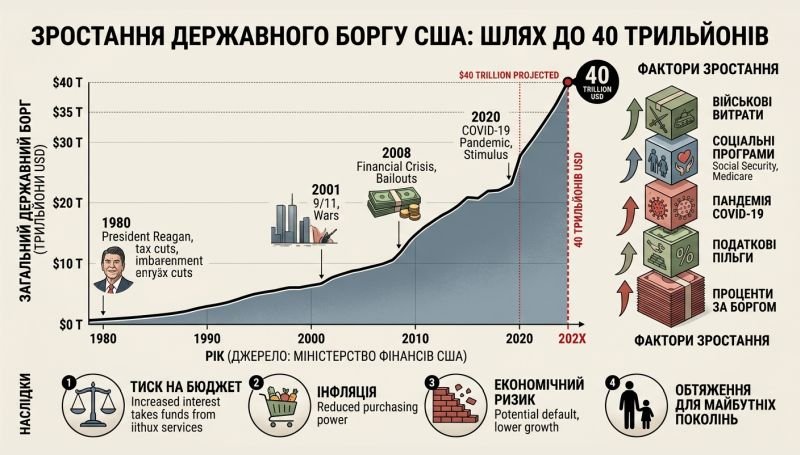
- The US sovereign debt has exceeded $40 trillion. What is the reason for the long-term budget deficit and debt growth?
▶ In the past week, the US sovereign debt exceeded $40 trillion. A psychological “round” barrier that necessitates an analysis of what is happening with the American budget, economy, and financial system.
Firstly, where does the debt come from, why, and how does the government allow itself to have such a huge debt.
The debt is indeed enormous. It exceeds the US GDP, which is $32.4 trillion. That is, the sovereign debt is 23.4% higher than the product that the entire US economy produces in a year. And this ratio is only getting worse, as the debt grows faster than GDP.
Where does the debt come from? The answer is very simple. It forms because the government borrows money to cover the budget deficit. And the deficit arises because federal budget expenditures exceed revenues. That is, the state collects less in taxes and duties (which constitutes budget revenues) than it needs for expenditures.
This problem has become chronic.
Where did it come from and why?
The standard answer of the Republican Party to this is: reduce budget expenditures. The standard (and correct) answer of real economists, supported by the Democratic Party, is that budget revenues need to be increased by optimizing expenditures where possible.
Where possible, because reducing budget expenditures without harming the vital functions of the state is extremely difficult, practically impossible.
To understand this, one needs to understand the structure of the US federal budget expenditures.
Unlike the budgets of most countries in the world, the structure of the US federal budget is very simple. This is because there is no state sector in the economy in the US, and therefore, the budget does not finance the economy but those functions that the state is simply obliged to perform.
Budget expenditures consist of two large and approximately equal parts today – defense expenditures and expenditures on other mandatory functions that the state must perform and cannot refuse. These functions include:
✓ Social insurance – pensions for old age and pensions for people who have lost the ability to work;
✓ Financing of the Medicare health insurance program for retirees;
✓ Financing of the Medicaid medical insurance program for low-income people (this program is used by at least 40% of the country’s population) and the children’s health insurance program;
✓ Funding the National Institutes of Health (including funding for medical research), the Centers for Disease Control and Prevention;
✓ Funding pensions, healthcare, and various benefits for army veterans;
✓ Funding national parks, conservation of natural resources, and environmental protection programs;
✓ Funding the federal law enforcement system and the federal justice system, including courts;
✓ Funding transportation infrastructure – air traffic control, railroads, maintenance and construction of federal infrastructure, transportation security services;
✓ Funding federal government activities – ministries, executive branch agencies, Congress and its structures;
✓ Servicing the US sovereign debt.
The budget’s expenditure also includes other items (such as foreign aid), but all other budget expenditure items are very small compared to the costs of maintaining the functions listed above.
Is there any way to significantly cut expenses on the main budget items? Practically, this is impossible. Can pensions not be paid? Can pensioners and low-income individuals be deprived of medical insurance (over a million people lost access to Medicaid insurance under “one big beautiful law” passed by the Republican majority in Congress fulfilling Trump’s desires, yet this did not solve the budget deficit problem)? Can air traffic control or emergency agencies not be funded? Can army veterans be deprived of benefits? These are all rhetorical questions, the answers to which are obvious: no.
When President Bill Clinton completed his second term in the White House in January 2001, he left a budget surplus for President George W. Bush. In the 2001 fiscal year, which began on October 1, 2000, the budget surplus was $128 billion. A budget surplus eliminated the need to borrow money. Budget revenues exceeded expenditures. But the 2001 fiscal year was the last year in recent US history with a budget surplus. Since 2002, the budget has suffered from a chronic deficit, resulting in the need to borrow money to cover the deficit, which has meant a continuous growth of the sovereign debt for 25 years.

The two main American political parties have diametrically opposed views on budget revenue.
Democrats believe that a flexible tax system with progressive taxation is needed, where those with higher incomes pay higher taxes, and where there are no legal “loopholes” allowing those with super incomes to evade taxes. According to Democrats, reducing business income taxes should be targeted—when the state is interested in the growth of a specific economic sector, it can lower taxes for businesses in that sector to stimulate growth.
Republicans believe that taxes on the income of all large corporations and the wealthiest Americans should be reduced. They promise that the freed-up money will be invested by corporations and billionaires in the economy, supposedly increasing budget revenues. The past 40 years show that the Republican theory does not work. Tax cuts for large corporations and billionaires increase their own wealth but do not lead to economic growth beyond the natural level, and consequently, do not increase budget revenues. On the contrary, the budget loses money, the deficit grows, and the state is forced to borrow more money to finance the deficit.
This is clearly illustrated during the first and second Trump presidencies, when the Republican majority in Congress passed, at the initiative and demand of the president, two significant tax cuts for corporations and billionaires in 2017 and then in 2025.
Compare: Democrat Obama inherited a federal budget deficit of $1.42 trillion in 2009 from Republican George W. Bush (remember, Bush inherited a surplus budget from Clinton!)
Trump inherited a budget deficit of $670 billion from Obama in 2017 (meaning the deficit was more than halved under Obama!)
In 2021, Biden inherited a budget deficit of $3.13 trillion from Trump. This means the deficit increased nearly fivefold during Trump’s four years! Even considering the unplanned funding related to the pandemic, this is excessively high. This is confirmed by subsequent developments.
Trump inherited a budget deficit of $1.78 trillion from Biden in 2025 (meaning the deficit decreased 1.75 times under Biden). According to the Congressional Budget Office’s forecast, the final budget deficit for 2026, ending on September 30, will be $1.9 trillion, meaning a Republican president is in the White House again, and the budget deficit is growing.

Out of the $40 trillion U.S. sovereign debt, $11.9 trillion, or 29.75%, is attributed to Trump’s 5 years and 7 months in the White House.
What happens next? A rhetorical question. The 47th president won’t change. It’s worth recalling that his business strategy has previously led him to six business bankruptcies. It seems he is conducting a historical experiment to see how such a “strategy” works on a national scale.
Additionally, the servicing of this debt already requires spending an amount annually equal to the U.S. defense budget. And the interest on the debt continues to grow along with the debt.
Another issue hits American financial stability hard. The rise in sovereign debt and payments to its holders has led to a crisis situation in the sovereign bond market. Key foreign bondholders are losing trust and abandoning them.
The U.S. Treasury is forced to continuously increase the issuance of new bonds to sell them to cover the budget deficit. Meanwhile, traditional major buyers such as China and Japan are reducing their portfolios of American bonds. The development of artificial intelligence infrastructure and the creation of new data centers compel companies in this field to massively borrow money through the issuance of their corporate bonds. They directly compete with the U.S. Treasury for available capital. Additionally, instability in the Middle East spurs inflationary expectations, leading investors to dispose of a significant portion of the government bonds they hold. As a result, 30-year U.S. bonds plummeted in price in August 2026, with yields soaring above 5.2% — the highest in the past two decades. The situation demanded urgent intervention from the U.S. Treasury, which doubled its program of repurchasing long-term securities to stabilize the market.
The rise in U.S. Treasury bond yields directly impacts the real economy sector, as bonds are the base benchmark for the cost of all other credit funds.
High yields on risk-free government bonds cause capital to flow from real business to government debt. The cost of attracting investment capital for American companies has sharply increased.
Rates on 30-year mortgage loans have reached 6.8%, making home purchases unattainable for a third of American families with average incomes. At the same time, rates on all other loans (car purchases, education, etc.) have risen.
On the balance sheets of American banks are massive volumes of government bonds purchased during periods of low interest rates (2020-2021). The decline in the market value of these bonds creates giant unrealized losses, making financial institutions vulnerable to a panicked withdrawal of depositors.
Judging by the growth rate of sovereign debt, by the early months of 2027, the Treasury Department will have exhausted the borrowing limit set by Congress in the “big beautiful law” ($41.1 trillion).
There are 882 days left until the end of the story called “Fear: Trump in the White House” © (the title of Bob Woodward’s book published in 2018).
Thank you to everyone who read. Take care of yourself and your loved ones. Take care of each other, help each other. Health to all.
Ultimately, what happens in the world depends on us. On whether we fight against evil, do Good, remain mere spectators, passively wait and believe that someone somewhere will decide something for us, or fight against evil and do everything possible for Good to prevail.
We must not allow evil to prevail. The victory of evil would mean the end of the world we live in. We cannot allow this. Especially now.
Ukrainian Friends, I embrace and love you all. Please take care of each other, I urge you very much.
Ukraine is and always will be.
And evil will be defeated and punished. And this will certainly happen.
