
Today – the Kostiantynivka direction.
1. In this direction, the enemy (Russian forces) continues to implement plans to capture and eliminate the Kostiantynivka defense area of the Armed Forces of Ukraine (AFU). Currently, they are quite close to successfully completing this.
To achieve this goal, the enemy command used the left flank of its grouping of forces (GF) “Yug” — most of the forces (troops) of the 8th Combined Arms Army (CAA), almost the entire 3rd Army Corps (AC), and a whole “set” of forces and means of their reinforcement, from other armies and GFs (and even fleets), which are operating their main forces in other directions.
To optimize combat management of these forces and means, intended specifically for the assault and capture of the Kostiantynivka defense area of the AFU, and to enhance the level of interaction between them, the enemy command organized them into two tactical groups (TGr) of forces — “Dzerzhinsk” and “Bakhmut”. These operate, respectively, in the areas of the 8th CAA and the 3rd AC:
TGr “Dzerzhinsk” (area of the 8th CAA):
– The 4th Separate Motor Rifle Brigade (omrsb) of the 3rd ZVA is likely operating only part of its forces;
– The 103rd Motor Rifle Regiment (mrs) of the 150th Motor Rifle Division (mrd) of the 8th ZVA;
– The 10th Tank Regiment (tr) of the 20th mrd of the same army. It apparently operates mainly with its assault infantry units and groups. Tanks are used only sporadically in small groups (2-3 vehicles) or individually;
– Possible presence of separate units of the 78th Motorized Special Purpose Regiment (mtr SP) “Sever-Akhmat” of the 42nd mrd of the 58th ZVA (UV “Dnieper”). Although they have not been recorded in this direction for some time;
– The 54th mrs of the 6th mrd of the 3rd Army Corps (AC). Its units are used to “qualitatively” reinforce the units of the 103rd mrs and the 10th tr of the 8th ZVA;
– The 1194th mrs “Territorial Troops” (TrT) of the 3rd ZVA;
– The 1219th, 1436th, and 1465th mrs TrT from the 51st ZVA. Together with the previous regiment, they serve as the main source of accumulation and supply of assault infantry in this direction;
– The 20th and 155th mrs (in fact, rifle regiments \ sp) “Vmf vs rf”. Consolidated units from the Russian fleets. They are quite actively used in offensive/assault actions in this direction;
– The 77th mrs (or better “regimental tactical group”) from the 49th ZVA, formed on the basis of the 7th military base (VB) “vs rf”, which is deployed in the occupied part of Georgia (Gudauta, Abkhazia).
TGr “Bakhmut” (actually the 3rd AC, without part of its forces):
– The 72nd omrsb (engaged almost in its entirety);
– The 1008th, 1307th, and 1442nd mrs TrT from the 6th mrd of the 3rd AC. Their units make up the main part of the assault infantry of this corps;
– The 89th Tank Regiment of the 6th Motor Rifle Division of the 3rd Army Corps. Like the 10th tr of the 20th Motor Rifle Division from TGr “Dzerzhinsk”, it operates in the first echelon in this direction, mainly with its infantry units. Tanks are used rarely and mainly dispersed with 1-2 vehicles.
It is also worth mentioning the flanking sectors of the Kostiantynivka direction, where the enemy’s following units and formations are operating:
– The 70th mrd from the 18th ZVA UV “Dnieper” (24th, 26th, 28th mrs and 17th tr), operating in the general direction Chasiv Yar — Druzhkivka;
– Units of the 20th and 150th mrd of the 8th ZVA (central and left flanks of this army’s sector), operating in the directions Sofiivka — Raiske and Rusin Yar — Druzhkivka.
In the reporting period, there was probably no significant build-up or other changes in the combat and numerical composition (CBN) of these (aforementioned) forces and means.
2. The current situation in this direction is characterized by significant enemy activity in the framework of completing the stage of a large-scale breakthrough of its forward infantry (assault) groups into the boundaries of Kostiantynivka simultaneously in several sections and directions, followed by their consolidation there.
It is apparent that the hostile command plans to immediately after this, without significant “operational pause,” proceed to the stage of mass “infiltration” (penetration) of the main bulk of its forward units and detachments into the entire Kostiantynivka defense district of the Armed Forces of Ukraine (with quite likely simultaneous pulling up of most of its UAV groups and units directly to the forward echelon).
Currently, there are directions and areas where the enemy has already managed to advance within the boundaries of Kostyantynivka with their assault groups and entrenched there:
– In the 3rd Army Corps sector (Task Group “Bakhmut”), the enemy managed, advancing in the direction of Stupochky-Kostyantynivka, along Chekhova Street and through Novodmytrivka, to penetrate the eastern part of the city (approximately up to Minsk and Radishcheva streets). Simultaneously, they managed to occupy at least the southern part of Novodmytrivka.
– Advancing from the line of Stupochky-Predtechyne along the Pokrovsk-Bakhmut road and on both sides of the Shanghai reservoir, the forward infantry groups of the 3rd Army Corps also managed to break into the southeast part of the city (up to Bakhmutska Street) and advance to the area of the “Kostyantynivka” railway station (between the T-0504 road and Ostrovskoho Street).
However, despite repeated attempts to occupy the station area itself, the enemy has not yet managed to achieve this (at least I do not currently have reliable information on this).
– On the right flank of the 8th Guards Army sector (Task Group “Dzerzhinsk”, where the enemy’s “main strike” is apparently delivered) they have achieved even greater success — breaking through simultaneously in several sectors to the western (central) part of Kostyantynivka and entrenching there.
In particular, in the direction of Illinivka-Kostyantynivka, the assault groups of Task Group “Dzerzhinsk” broke through the area of the “7 Winds” shopping center and Jubilee Park to Yemelyanova Street, and also advanced northeast of Lomonosov Avenue to the Kryvyi Torets River, reaching the area northwest of the “Kostyantynivka” railway station.
This means the enemy managed to make a tactical breakthrough from the Illinivka-Berestok line to the western (Central) part of Kostyantynivka, the preparation for which I wrote about a few weeks ago.
– However, in the directions of Yablunivka-Stepanivka and Illinivka-Dovha Balka, the enemy cannot yet boast similar results. They still have not fully taken control of Stepanivka, and several small infantry groups that infiltrated the Dovha Balka area were apparently eliminated.
Thus, it can currently be stated that the battles for the Kostyantynivka defense area of the AFU have entered the final phase, as the enemy has apparently managed to break through (simultaneously in several sectors) to the western (central) part of the city. This, in turn, has sharply destabilized the resilience of the entire AFU defense system in this area.
3. Regarding the further tactical prospects for the defense of Kostyantynivka, they obviously appear “not very favorable” for the AFU. In the event of further advancement of the enemy’s assault groups of Task Group “Dzerzhinsk” and Task Group “Bakhmut” towards each other (the approximate line of their “hypothetical” meeting — the Museum of Local Lore — Central City Market), the situation throughout Kostyantynivka for the AFU will worsen even more, resembling an avalanche.
Currently, the approximate distance between the forward assault groups of the 8th Guards Army (area of Yemelyanova Street, “Motto” gas station) and the forward infantry groups of the 3rd Army Corps (area of Minsk Street) is less than 2 km.
In this sense, the enemy can only be delayed by the presence of the Kryvyi Torets River, which Russian assault groups will evidently have to cross to move towards each other. So far, they have not crossed it with significant forces (fighting is ongoing in the area of Promyslova Street, near the “Motto” gas station, and the “Svinets” enterprise).
However, if they succeed, the position of ALL Ukrainian units defending south of the highway junction at the intersection of Yemelyanova and Oleksa Tykhoho streets will sharply deteriorate.
In fact, to capture the Kostyantynivka defense area of the Ukrainian Armed Forces, the enemy used the same “methodology” (though with slight modifications regarding this specific defense area) that it developed and applies in other directions to capture more or less significant settlements with dense development and the presence of numerous “industrial zones” (Pokrovsk, Kupyansk, and is preparing to use for Lyman). Flanking encirclement, breakthrough into the villages by separate assault groups and units (preferably in several areas and directions), and then mass “infiltration” and penetration of the main part of its assault infantry precisely through these areas and zones.
In a broader (operational-tactical) sense, the further actions of the enemy in the Kostyantynivka (Kramatorsk) direction also appear quite clear and obvious.
After ousting the Ukrainian Armed Forces from the Kostyantynivka area, the Russian command will clearly try to achieve at least two more tactical goals:
– “Cut off” the Ukrainian tactical bulge in the Chasiv Yar area (Mykolayivka — Chervone — Stinky — Podilske). Two facts evidently motivate them to do so — the advance of their 70th Motorized Rifle Division to the eastern edge of Virolubivka and the rather successful battles of their 3rd Army Corps in the Novodmytrivka area. These factors themselves create favorable tactical prerequisites for the Russian command in this sense.
– Also, they will undoubtedly try to break through to the approaches to Druzhkivka both along the Kazennyi Torets River and on the Volodymyrivka — Druzhkivka road, as well as from the Chasiv Yar side. This, in turn, will allow them, with the SIMULTANEOUS advancement of Russian troops towards the Sloviansk direction (3rd Combined Arms Army “Yug” section), to achieve the basic precondition for launching the entire Sloviansk-Kramatorsk offensive operation — advancing the main forces of “Yug” to the approaches (from the south and east) of both Kramatorsk and Sloviansk.
In an even broader (operational) sense, it is worth noting that within the framework of the entire summer-autumn campaign of the Russian troops in the coming months, one should expect their further sharp activation (or at least attempts to do so) along the entire “defense arc” of the Ukrainian Armed Forces in the Sloviansk-Kramatorsk agglomeration area (namely in the Lyman, Sloviansk, Kostyantynivka, and Dobropillia directions).
These attempts will evidently involve three Russian military groupings simultaneously — “Zapad,” “Yug,” and “Tsentr” (up to 5 combined-arms armies and up to 2 army corps), not considering possible reinforcements with units and formations from the strategic reserves of the Russian Armed Forces General Staff, as well as from the airborne troops and naval infantry.
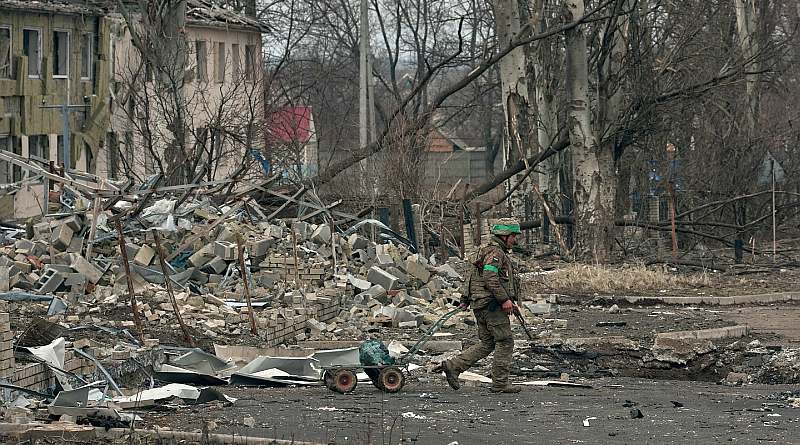
Thumbnail: Kostyantynivka, March 2026. Photo: Kostyantyn Liberov
