
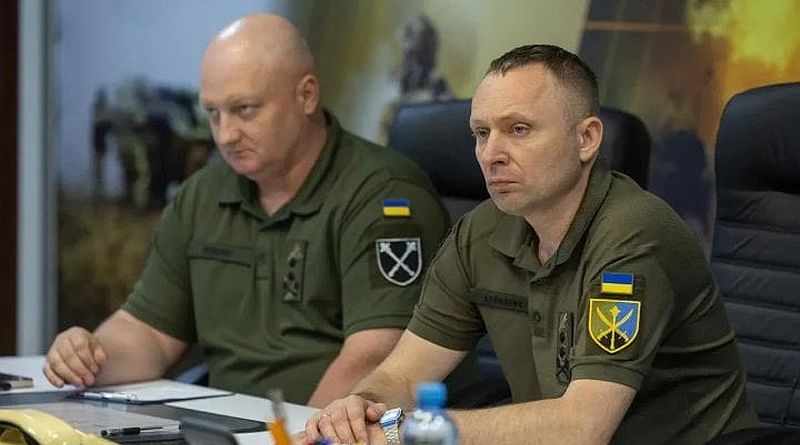
The new Commander-in-Chief has inherited a considerable set of obvious challenges. None can be solved by appointing a specific person to a high position. Mobilization, management system crisis, personnel shortage, a zoo of equipment without unified technical requirements…

The discussion about changing approaches to the Defense Forces has been ongoing for a long time. But “forums of peace” and “coalitions of the resolute” are on one shore, while soldiers on the front lines are on the opposite.
Our reality, according to the former Commander-in-Chief of the Armed Forces of Ukraine General Muzhenko:
• The Defense Forces today are unable to conduct offensive or counter-offensive operations;
• the aggressor state is also unable to conduct a broad offensive, therefore it will focus on several directions. The enemy lacks the capacity to achieve an operational breakthrough;
• the most likely task of the enemy is to seize the Sloviansk-Kramatorsk-Druzhkivka-Kostiantynivka agglomeration. Alternatively, to blockade the Sloviansk-Kramatorsk and Druzhkivka-Kostiantynivka agglomerations to achieve a political decision to withdraw Ukrainian troops under the threat of encirclement and defeat, and to seize at least the left-bank part of the Zaporizhzhia region and blockade Zaporizhzhia from the east;
• the aggressor’s further strategic task may be to create bridgeheads on the right bank of the Dnipro to advance aggression north of Mykolaiv and Odesa, aiming to reach the Transnistria area and further north, depriving Ukraine of economic sovereignty, as the so-called “industrial rhombus” Kremenchuk-Dnipro-Zaporizhzhia-Kryvyi Rih would be lost;
• the entire territory of Ukraine is a strategic rear;
• the strategic rear (the entire state not on the front line) must organize not only the logistic support of the front’s needs, but also the functioning of state authorities, defense, including air defense, protection of critical facilities, conducting counterintelligence operations, combating saboteurs, and preventing terrorist acts;

• Ukraine needs societal mobilization to achieve a defined political goal (the general doesn’t specify which. It seems the Supreme Commander doesn’t specify either);
• the continuation of mobilization in the current format blocks the formation of effective reserves, which in turn deprives the Defense Forces of the ability to conduct even local operations;
• insufficient level of training of operational staff of management bodies that plan operations, competencies of commanders as military leaders and managers of such operations; lack of personnel in the troops, primarily – the first operational echelon;
• in modern warfare, one person cannot cover the entire spectrum of problems, but there is an “integral commander” (a term introduced 100 years ago by General Svechin in his book “Strategy”), meaning the combination of activities of the state’s political leadership, high command, General Staff, logistics, etc.;
• the Chief of the General Staff must ensure concentrated analysis of all factors and preparation of forecasts and proposals for the Commander-in-Chief and the Supreme Commander, based on calculations and models, generation of forces and resources, and strategic planning;
• formation of corps is a step in the right direction, but the number of formed corps has reduced their level from operational-tactical to tactical, the operational level is once again unfilled. Management bodies of the corps have not acquired defined capabilities, the problem is staffing (General Svechin: preparing an officer of the operational-strategic level requires 20-25 years of service practice);
• the Ground Forces are overloaded with tasks, the functionality of their commander is diluted to such an extent that it is beyond their grasp;

• inflated states (Muzhenko: incompetent commanders compensate for their incompetence by expanding their staff);
• fragmentation of the army, creation of “name-based commands,” dictated by the political expediency of appointing higher military command, resulting in a decline in the quality of operational management;
• within the Defense Forces, there are units that operate by their own rules, having their own bases and training schools, and their preparation methods differ from those adopted in the Armed Forces. The main law for everyone should be the general military statute;
• creating assault troops as a separate branch – a mistake;
• disassembly of the moral and psychological support system, and the full-scale deployment of the new personnel psychological support system has not been carried out, particularly due to a lack of specialists, which is one of the reasons for CCH;
• a chase for indicators and attempts to impress Ukraine and the world with large numbers;
• statements by the former Defense Minister about the “creation of centers of competence for military technologies” – loud PR, a misunderstanding of the principles and laws on which the Armed Forces are built. Such approaches can lead to defeat in the war.
These thoughts were expressed by General Muzhenko in his interview with “Texty” in March of this year.
The new commander-in-chief will have to deal with all this, with his very appointment being noted on social networks as a “kick in the back to the entire Soviet general school”. Let’s deal with the school:

We see that, according to open sources, all commanders (about whom this data is available) received operational and strategic education in Ukraine during independence. The question arises: where is the “entire Soviet general school”? Who got kicked? To clarify further, we add:

Currently, the Land Forces have 13 corps (3rd, 9th, 10th, 11th, 12th, 13th, 14th, 15th, 16th, 17th, 18th, 19th, 20th, 21st), two corps in the Air Assault Forces (7th, 8th), and a Marine Corps (30th): out of 16 corps commanders, 15 received military education in Ukraine during the times of independence, while Brigadier General Andriy Biletsky has no military education at all.
It is evident that the search for the “Soviet general school” is a fight with shadows.
In the mentioned interview with “Texts,” General Muzhenko outlined urgent tasks facing the Commander-in-Chief:
• Reforming the entire state’s security sector and its management system, eliminating dual subordination of formations transferred from the Ministry of Internal Affairs of Ukraine to the Defense Forces;
• Eliminating political influence on certain structures of the Armed Forces through material aid and additional funding;
• Bringing the management structure in line with the laws by which all the armies of the world operate today;
• Creating a command for strategic deterrence forces. The Security Service, Intelligence Directorate, Special Operations Forces, State Border Service, etc., should be relieved of this functionality;
• Harmonious development of all branches and arms of the Armed Forces, not just the Unmanned Systems Forces;
• Changing the functionality of the National Guard or transferring both corps to the Armed Forces, creating border troops within the State Border Service for state border defense;
• Accelerating the creation of military police and military justice;
• Solving the problem of academic education of the military;
• Introducing a BZVP course for the entire population.
The challenge of “mobilization” is one of the main ones today, as it affects everyone: politicians, who shy away from unpopular decisions, concerned about ratings and elections; Defense Forces, struggling with a lack of personnel, especially in brigades defending the front line; the population, some of whom hide from the call to mobilization, due to personal fear; service members and veterans, for their sense of justice. Naturally, the universal evil, i.e., the TCC and SP, and the riders of the mobilizational apocalypse—the minibuses—are to blame for everything.

This challenge, despite loud calls to “stop busyfikatsia,” cannot be overcome by the Commander-in-Chief. It is impossible to fight for both the brief and the cross at the same time: to continue the war, troops need to be staffed at least at an acceptable level. Maintaining the level of staffing can only be achieved through the conscription of citizens by mobilization, as the current staffing system is based on a constitutional duty, not a voluntary desire.
The only leverage for the Commander-in-Chief is to demand from the General Staff to replenish the troops, for the General Staff to pressure the TCC, issuing appropriate orders, and for the TCC, there is no choice but to catch those who are hiding, not meant for war, didn’t manage to get a deferral, etc. The state can demand citizens fulfill their constitutional duty, but the Commander-in-Chief cannot. Therefore, this challenge is insurmountable. Busyky forever.
This does not mean that nothing can be done. Let us recall the words of General Muzhenko: “insufficient level of training of the operational staff of the management bodies that plan operations, the competencies of commanders as military leaders and managers of such operations.” Thus, addressing this challenge can significantly improve the image of the Armed Forces since without restoring trust in commanders, staffs, dismantling the image of “butchers” and “idiots with stars,” nothing can radically improve within the corporation “Armed Forces of Ukraine.”
It is important not to forget that in an information war, each side sets a threefold task – to destroy trust in the political leadership of the opposing country, to destroy trust in the military leadership of the opposing army, and to sow panic among the population. And here our opponent is a well-known master, so let us be prepared to read all sorts of nonsense that will be directed precisely in these three directions. The example of General Syrskyi only confirms this. There is also a nuance: there are plenty of people willing to stand with signs “for Fedorov” across the country, but nobody at all to sign a contract with Fedorov. How is that?

Since we’ve already figured out that the commander-in-chief can search for the branch, egg, hare, duck, and everyone else on the list only in the depths of the corporation, let’s highlight these facts (media, social networks, and cards are not places where officials should look for solutions, advice, answers, or inspiration):
• Handle the staffing of military management bodies: battalions and brigade commanders who have demonstrated the ability to fight with minimal losses, act decisively, and with initiative must move up the career ladder. They all need to undergo proper training courses;
• If the first step moves forward, a domino effect should be triggered: the promotion of commanders trusted by their subordinates will change motivation, improve the image of specific military units, which recruitment structures should take advantage of. Recruitment, in turn, is a chance for a citizen who is afraid and hesitant to find themselves in a place where they feel relatively stable and will not have to choose between death and deserted service;
Lyrical digression: in the summer of 2014, in the report on the tasks of conscription during partial mobilization, a column “volunteers” appeared. And those volunteers were only 5% of the conscription plan. I don’t think the country has cleansed itself so much that the 5:95 ratio has changed. Why is it important not to forget about this? Without coercion, the commander-in-chief won’t be able to form strategic reserves, and without them, conduct even one small counter-offensive operation, as the recruitment of a brigade forming from scratch has nothing to tell a candidate other than promising “rivers of milk – shores of jelly.” Remember the “Anna Kyivska” brigade? Exactly!

• General Muzhenko recalled many strategic-level tasks that can be combined into one point – “changing the philosophy of war”. This includes reformatting the Deep Strike forces into a strategic deterrence command (or something similar in functionality), developing all components of the Ukrainian Armed Forces for their adaptation to modern war requirements, and to some extent, to the demands of future warfare, as well as reforming the military command system.
The commander-in-chief cannot solve these tasks alone, a team is needed. Who are these people? Do the commanders of the different branches and separate forces support the commander-in-chief? Or will they just pretend? Will everything fall back to “personalized commands” again?
How to overcome internal resistance in the offices of the General Staff, the command of branches, and operational commands? Bureaucratic sabotage will occur, as it always has. The atmosphere in any management body is created by mid-level managers. Will it be possible to engage them in favor of change?
Meanwhile, corps have up to eight thousand vacant officer positions, many of which should have the appropriate level of academic education. There are many questions about the education level of already appointed officers. The rapid advancement of officers at the tactical level has created a management vacuum in tactical-level staff.
“Reality always turns out to be much more complex, harsh, and multidimensional,” noted Mykola Bielieskov, a senior analyst at the “Come Back Alive” fund. And this reality is complicated by the absence of a defense minister.
It is no secret that the war has long been a war of technologies – FPV, HLK, BECs, automated EW complexes, the same “Delta”. Diverse combat equipment that General Zaluzhny described as a “zoo”. Is sufficient work being done in the Ministry of Defense to form operational-technical requirements for all this, to standardize, to establish rhythmic supplies precisely where needed? Remember, there is no minister, only an acting one. Many defense Hi-Tech products rely on the volunteer movement, and the non-traditional nomenclature of ammunition production (primarily for UAVs) is the activity of military workshops. Can the commander-in-chief handle all this? Without a minister – unlikely. Statements like “centers of military technology competencies” won’t suffice.

Analysts from the Frontelligence Insight group have analyzed this appointment and note the following:
• General Drapaty is not a supporter of the traditional vertical-hierarchical culture, advocates for expert assessment methods in decision-making (like General Syrskyi, by the way), encourages honest feedback, ready to adjust action plans based on operational data directly from the battlefield;
• a people-centric leader;
• consistent, though rapid, career progression, experience in all management levels.
Among the priorities of the commander-in-chief is the improvement of the training and adaptation system of personnel to reduce the NZC level, the refusal to form new brigades in favor of completing existing ones, eradication of dogmatic management methods, and overcoming inefficient troops management, including the practice of bolstering some units with parts of others.
“The appointment is undoubtedly positive, but many who react accordingly do not realize the scale of the tasks and do not understand that being the commander-in-chief of the Armed Forces of Ukraine is currently one of the toughest missions. The transition from media expectations to cold military machine management will be extremely tough,” stated Mr. Bieleckov.
In the cover photo: Chief of the General Staff Ihor Skybyuk and Commander-in-Chief of the Armed Forces of Ukraine Mykhailo Drapaty. Photo: Ministry of Defense of Ukraine
