

Dear citizens,
I would like to clarify the position on the topic of the Armed Forces of Ukraine striking Russian targets.
For some reason, in the comments, I encounter opinions like: Yes, we hit them, but they hit us here… This creates the impression that Russia is retaliating, and if we stop striking them, they won’t hit us back.
But we do not have that option.
There are two options:
1) Russia strikes our targets (as it has done for years), and we endure.
2) They hit us, and the Armed Forces of Ukraine retaliate more painfully, and if this continues, and Russia receives substantially more damage than it inflicts, it will serve as a push to stop this.
So choose from these two.
The only thing you, dear ones, need to monitor is whether our economic strikes were more painful than what we received during the latest drone-missile raid. So far, the Armed Forces of Ukraine are handling this task and scaling it.
Not dear Russians, uninterested in politics and tired with your “For what?”
Let me explain simply.
For years you ignored the fact that your country was killing Ukrainians and supported strikes on our civilian targets. Now the situation will change.
Now, after the next strike on a Ukrainian dairy plant or civilian infrastructure, you won’t be particularly pleased, as you will now understand that in response, an object that significantly affects your quality of life will burn. And when Russia starts a campaign against Ukrainian energy, you will receive the same response.
As far as I know, the number of strikes on your territory will increase by one and a half times by autumn. And there will already be hits on thermal power plants, gas distribution stations, and other objects important for medium and big businesses after your small businesses are finished by our strikes on marketplaces and your tax reforms. This will be a nice addition to your mobilization this winter. Russia loves conducting offensive actions in winter when the forests are bare, and you can’t hide from drones, and filled with bodies of sanitary stormtroopers, as there is neither the appropriate winter equipment nor protected logistics for ensuring assault operations – none of this is available. The fuel crisis affecting the army this winter will not disappear. So you’ll be storming on foot, like the grandfathers.
Both of these factors will make you, bastards, interested in politics, believe me. We will do our utmost for that. There’s simply no other way with you; you just don’t understand otherwise.

On the last day before August, we see this.
In the Kharkiv region, Russians dropped a KAB on Izyum, killing a person. In Kharkiv itself, three districts were hit in a day, injuring a woman.
In Kozacha Lopan (north of Kharkiv, near the LBS), a man (81 years old), who was killed by a Russian FPV drone on July 26, was buried in the yard of a house. The body could not be evacuated.
The postal terminal was attacked again.
In Sumy, four KABs were dropped in the morning. In the Krolevets community, 7 people were injured as a result of a Russian drone strike.
In the Chernihiv region, 9 settlements in 4 border communities were attacked in a day. Among other things, Russians attacked a farm with drones in the Kulikiv community, killing 9 cows.
In the Zaporizhzhia region (Novoselene) an FPV drone killed a person by attacking a vehicle. In a day, 45 settlements were hit, including the regional center.
In the Kherson region, 48 settlements were hit by Russians in a day, killing 5 people and injuring 5.
What’s happening in Russia?
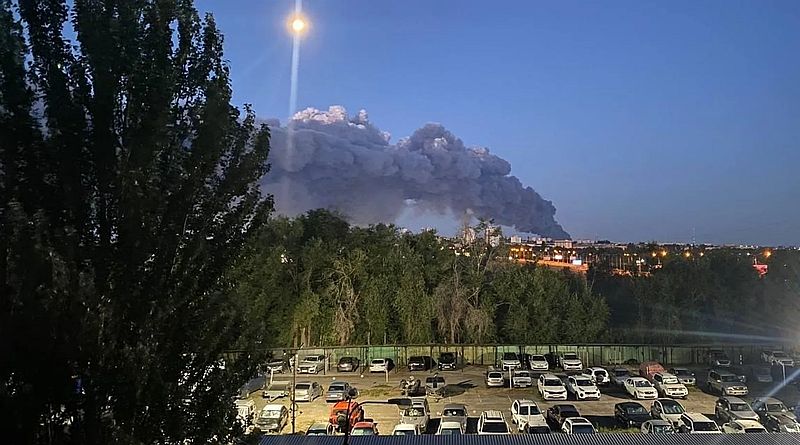
The Ukrainian defense forces comprehensively covered Volgograd. Another Wildberries warehouse caught fire and burned.
There was also a noticeable fire at the Lukoil-Volgogradneftepererabotka refinery. This plant has been visited repeatedly, and resumption of visits was inevitable due to its significance. It is one of the largest refineries in Russia overall and the largest in the south. It processes more than 14 million tons of oil, with 80%+ of products being light oil products. It produces up to 6.5 million tons of diesel, up to 3.5 tons of gasoline, up to 1.3 million tons of aviation kerosene, etc.
The peculiarity also lies in the fact that as part of Transneft’s “South” project, a main oil products pipeline was constructed to supply diesel from this refinery via pipeline to the port of Novorossiysk for export. Technically, this fuel can be used for the needs of Russia’s southern regions.
Pipeline supply capabilities are now extremely important for Russians. For example, grain terminals in Novorossiysk and nearby areas suspended truck deliveries for several days due to abundant rail shipments. They simply cannot handle the flow of goods due to problems with sea traffic in the Azov region. This means that both the railway in the south is overloaded and the highways.
The diesel pipeline partly alleviates these problems. As a result, the flow through the pipeline needs to be reduced. We will soon find out how today’s visit worked out in this regard.
Russian occupiers in Crimea are traditionally given attention. Among other things, a workshop at the aircraft plant and two hangars with aviation equipment were hit in Yevpatoria. Perhaps later, they will talk about the education of the Russian fleet (4 units) and energy facilities.
There were also attempts to study the situation at several logistics facilities in other regions, in particular in Tatarstan.
In the background: On July 31, drones attacked a Wildberries warehouse in Russian Volgograd. Photo: Exilenova+
