
Political competitions are probably impossible without a dash of populism, simple solutions, and emotional statements. However, there is a limit to everything. When the leader of one of the oldest factions in parliament begins to use phrases that almost verbatim resonate with the enemy’s propaganda, it ceases to be merely “oppositional struggle.”
“Texts” analyzed the transcripts of Yulia Tymoshenko’s speeches in the Verkhovna Rada over the last three years. We examine in more detail the accusations of Ukraine’s colonization, grant repayment, and the “last 10 years,” which the deputy calls “humiliating.”
It Doesn’t Matter, East or West
One of Tymoshenko’s key messages is the thesis that Ukraine has lost subjectivity. Her rhetoric is filled with words about “international advisory boards” and “foreign supervisory boards” as tools of colonization.
“This is a humiliation of Ukraine and a humiliation of our sovereignty,” said Yulia Tymoshenko, equating the presence of foreign experts in the supervisory boards of state corporations to occupation.
The problem is not in criticizing the efficiency of supervisory boards (which may be justified), but in the focus of the criticism. Russian propaganda has been promoting the narrative of “external governance” for years, trying to prove that Ukraine is not an independent state but a “puppet” of the West.
Tymoshenko plays into this by calling specialists who help reform the transparency of state enterprises “supervisors” (these changes, of course, are necessary because state enterprises have historically been and sometimes remain significantly corrupt). This creates the illusion that Ukraine is trapped between two enemies. Even more dangerous is another manipulation by the deputy: “I don’t care who devours our sovereignty — the east or the west of the world.”
This statement ignores the objective perception of reality. The “East,” represented by Russia, is physically killing Ukrainians, destroying cities, and striving to eliminate statehood. The “West,” on the other hand, helps us survive by providing weapons and financial support. Comparing these influences is more like blurring society’s orientation in choosing a civilizational path rather than Ukrainocentrism.
Humiliating 10 Years
The rhetoric of the leader of “Batkivshchyna” sounds especially harsh regarding the “last 10 years.” She calls this time “the worst” and “humiliating.”
“Everything that has been adopted in the last 10 years will be canceled as unconstitutional, as humiliating,” said Tymoshenko. At the same time, these 10 years have become a period of the greatest activation of civil society, departure from all things Russian, and obtaining candidate status for EU membership.
By denying the achievements of this decade, Tymoshenko essentially suggests a rollback to the model that existed before the Revolution of Dignity. This resonates with the TikTok campaign about the “stability of Yanukovych’s times,” where through AI-chanson and manipulative videos, nostalgia for a “strong hand” and a “dollar at eight” is promoted (explained in more detail in our text here).
When Tymoshenko says that reforms are the “destruction of Ukraine,” she strikes at the foundation of European integration. After all, most of these reforms (judicial, anti-corruption, banking) are direct requirements for our accession to the European Union. Moreover, they are necessary for Ukraine itself, as they make our state fairer, more resilient, and richer. By calling them “colonization,” she questions the choice of millions of Ukrainians, won during the revolutions and consolidated by voting results.
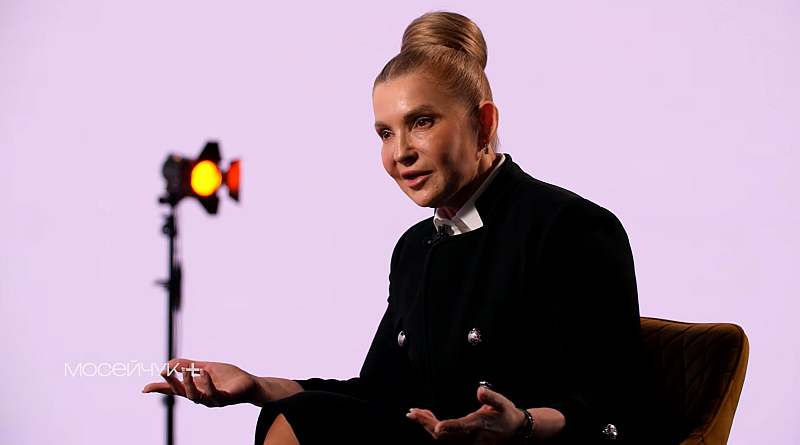
In a recent interview with Nataliya Moseychuk, Tymoshenko again brought up the topic of “experimenting on Ukraine,” claiming that the governance model after 2014 was aimed at “minimizing sovereign states.” That is, Ukraine’s European choice is once again presented as a “global redistribution of influence,” where the national government allegedly lost the right to make decisions.
And what besides “impoverishment”?
If we remove words like “death,” “genocide,” “liquidation,” and “looting” from Tymoshenko’s speeches, her speeches would be significantly shorter. Using radical rhetoric during the war is a dangerous tool for demoralizing society.
“One of the issues that looks like a planned genocide is the people who are already retired… Do you understand that you are killing these people? You are just consciously liquidating them. If you have adopted such a policy of eliminating the elderly, then say it honestly,” Tymoshenko states, proposing budget changes that would help raise the minimum pension to over 7,000 UAH. Apparently, such fatal words are meant to intensify what is said. However, by using the word “killing” as an exaggeration, Tymoshenko somewhat distorts its meaning given that Russia physically without any hyperbole kills Ukrainians every day.
It’s important to note the lack of constructiveness here. A quality opposition in a democratic country should offer an alternative model for solving urgent problems. With figures, calculations, sources of funding. Instead, we hear demands to “cancel everything” and “give out money,” which often lack substantiated explanations.
Destructive rhetoric works to divide. It makes vulnerable segments of the population see their own state as an enemy “worse than the invader.” This way, Tymoshenko’s supporters may lose their understanding of reality. And people who lose clear orientation are more likely to become prey for Russian recruiters and, for example, agree to commit a terrorist act, believing that life in Russia is fairer than in Ukraine (read more about recruitment methods here).
Journalists from Texty.org.ua also discovered a strange coincidence by analyzing the anonymous “Mykola Vidlyha” account on Facebook, which systematically spreads pro-Russian narratives under the guise of pseudo-patriotism. The malicious actors, whose videos are regularly published by Vidlyha, attacked most active politicians and volunteers, but Yulia Tymoshenko was virtually untouched. This observation raises questions, although it may indeed be a coincidence.
From “punitive organs” to suspicion
A separate case is Yulia Tymoshenko’s attacks on the anti-corruption structures NABU and SAP. She called them “organs of political influence” and accused them of “covering up” corruption.
“NABU and SAP are bodies of political influence on Ukrainian authorities. When needed, they cover up corruption, and when not, they fight against it… Please tell me, in 1991, were people fighting for Ukraine to give up its sovereignty, independence, and remain a country controlled by, you know, an electric collar?” Tymoshenko said about the draft law that was already returning the subjectivity of NABU and SAP, which was demanded by Ukrainians who took to the so-called cardboard Maidan in July 2025.
Such statements undermine trust in institutions that are important safeguards in the fight against corruption. Russia is interested in convincing the world of Ukraine’s “total corruption” to stop the supply of weapons. Tymoshenko’s claims that NABU is just a tool of pressure can play into enemy propaganda.
When at the beginning of 2026, Tymoshenko herself was accused by NABU, her vehement rhetoric against anti-corruption bodies or the western vector of Ukraine as a whole became even more ambiguous.
According to the investigation, the tapes recorded Tymoshenko negotiating payments to deputies for destructive voting: “We vote for removal, we don’t vote for appointment.” It concerned dismissals of officials from the government and state bodies and blocking appointments of others in their places.
This seems more like a desire to preserve an existing corrupt system where political decisions were commodities rather than countering “colonization.” But the personnel chaos during the war, when a minister is dismissed and no one is appointed in their place, benefits Russia. It is logical when the opposition does not vote for the personnel appointments of the ruling coalition. However, when such decisions involve offering money to deputies from other factions, it may exceed the bounds of internal political struggle.
Dismantling Three Trusts
An analysis of transcripts suggests that in Yulia Tymoshenko’s rhetoric, there are several key narratives. These could be called a consistent dismantling of three trusts.
- Trust in the West is undermined by narratives about “colonization” and “overseers.”
- Trust in state institutions is destroyed through emotional claims about “genocide” and the “deliberate murder” of citizens.
- Trust in change is nullified through destructiveness toward reforms.
It is quite likely that the sharp statements of the “Batkivshchyna” leader are just attempts to hold on to the electorate. However, in conditions of hybrid warfare, the line between radical populism and playing into the enemy’s hands becomes thin.
Destabilizing Ukraine, discrediting partners, and stopping reforms are things Russia cannot achieve on the battlefield. It tries to fight for this in the information space, using “useful idiots” or seasoned politicians whose words create the perfect backdrop for enhancing malicious information campaigns. Even if this process occurs unconsciously, its result remains equally dangerous.
On the cover: Yulia Tymoshenko during an interview with Natalia Moseychuk. Photo: video screenshot
