
Ukraine’s efforts to counter Russian ballistic attacks have several directions: the development of the international anti-ballistic program “Freya,” sourcing missiles abroad for Patriot systems, developing its own ballistic capabilities—such as FP7 rockets, and testing the “Sapsan” (“Hrim-2”) operational-tactical missile complex. Among these is work on enemy launchers.
We spoke with experts to find out how effective the targeting of Russian launchers is compared to other methods, what means can be used for this, and why precise intelligence is indispensable.

What to strike with
The means to strike Russian launchers can be either a kamikaze drone, flying at a speed of 100-200 km/h, or a ballistic missile, which has a speed of 4 Mach, explains Ivan Kyrychevskyi, serviceman of the 413th SBS “Raid” regiment and an expert on armaments for Defense Express in a comment for LB.ua. In the past six months, several such strikes have already occurred, he says.
“At least six publicly known successful episodes with the use of long-range kamikaze drones or middle strikes. One of them was when our ‘Raid’ regiment destroyed an S-400 setup in Bryansk,” says Kyrychevskyi.

At least five were strikes on Crimea, the soldier says. There, positional areas of “Iskanders” and “Tsirkons” as well as S-400 were targeted.
With the availability of operational-tactical missiles FP7 or “Sapsan,” they could also be used, the expert believes.
“I have encountered many different interesting options: one American general suggests using subsonic missiles Rusty Dagger, which have theoretically been transferred to us (as reported by Defense Express in June this year, fragments found by the Russians indicate that Ukraine is already using the latest AGM-188A Rusty Dagger cruise missiles with a range of over 930 km, developed by the American company Zone 5 Technologies specifically for the Armed Forces of Ukraine under the ERAM program. — Ed.),” says Kyrychevskyi.
If reliable intelligence data is available, subsonic cruise missiles can also be used.
“But the question remains whether we have enough missiles to switch solely to hunting launchers and to have enough for planned combat operations to destroy Russian targets,” the expert notes.
Major Vitaliy (Chez) Ivanov, commander of the anti-aircraft missile and artillery battalion “Strazh” of the 1st Corps of the National Guard “Azov,” believes that the most effective way to hit ballistic missile launchers is reciprocally, with their own ballistics: “Fast reaction time, large impact area, low interception probability during approach to the target.”
In his opinion, the reaction and approach time of a drone to the target does not allow it to strike the installation along with the crew in the launch area.
“As an option, domestically produced cruise missiles can be considered. But this also requires detailed planning and placing our launchers closer to the LOA to reduce approach time,” says Chez.
As aviation expert Anatoliy Khrapchynskyi mentioned in the podcast “Damned Questions,” missiles like ATACMS, AGM-88 HARM can be used for strikes on launchers. They fly at a speed that meets the conditions of this task.

“The decision-making time, loading of coordinates, and execution—approximately six minutes. We can also add time for the march—this is another approximately 14 minutes. The average distance for a conditionally safe missile launch at a launcher from Ukrainian territory is about 185 km,” says the expert.
In a comment for LB.ua, Khrapchynskyi noted that it is critically necessary to use long-range drones instead of expensive missiles for launchers. However, there are strict requirements for the technical characteristics of such drones. To operate against a dynamic target deep within enemy territory, mostly at night, the drone must have high flight speed and the ability to maneuver in conditions of dense enemy air defense.
“The most important element of this system is a reliable and secure connection that needs to synchronize the reconnaissance and strike units. Currently, the only practical solution capable of ensuring the necessary speed and quality of real-time data transmission despite enemy electronic warfare is satellite communication — specifically integrated Starlink terminals,” notes Khrapchynskiy.
Thanks to an uninterrupted digital channel, a long-range drone transforms from a regular loitering munition into a precise instant response tool, says the expert.
What’s the situation with intelligence data
According to Serhiy (Flesh) Beskrestnov, Advisor to the President of Ukraine on the development of defense technology, the Russians fire from a distance unreachable for HIMARS, so other types of weaponry are needed against ballistic launchers. And for this, aerial reconnaissance and satellite images are essential.

Everything is complicated by the fact that the launcher is not a stationary target.
“Catching an ‘Iskander’ on the move or at the deployment position is difficult,” notes Flesh in a comment to the channel “We — Ukraine.”
It is similarly challenging to hit ballistic missile production sites — they are mostly located deep underground.
In the hunt for launchers, the issue lies in intelligence data rather than means, believes Ivan Kyrychevskyi.
“There was this trendy concept of an ‘intelligence-strike circuit.’ It’s not enough to have strike means; you also need reconnaissance that will transmit data in real-time, with a processing cycle of several minutes,” he explains.
In Kyrychevskyi’s opinion, the problems with intelligence data are “already a matter of political factors.” Perhaps the data is not being provided by the U.S., or maybe the Americans don’t have it themselves, the serviceman speculates. Whether the recent resumption of intelligence sharing with the United States will address this, he does not know.
Anatolii Khrapchynskiy notes that with the satellite data provided by foreign partners, Ukrainian military knows when a missile has already launched. Launch areas are approximately known, but knowing in advance from exactly where the threat will come is necessary: “A satellite alone won’t suffice here — we need to discuss our reconnaissance drones that will be in the airspace.”

The key technological gap between the temporarily occupied territories and the territory of the Russian Federation lies precisely in the field of communication, noted Khrapchynskyi in a comment for LB.ua. In the occupied lands, our operators can rely on Starlink, while in the territory of Russia, the operation of this service is limited. To target dynamic or well-hidden objects deep within the Russian Federation, constant space and radio-technical monitoring is needed, where the role of intelligence information from partners is crucial.
“Unfortunately, Western allies still take a cautious stance regarding the provision of operational data for active actions in Russian territory, fearing a hypothetical ‘escalation.’ Hence, we face a complex of restrictions: from purely ‘technical gaps’ in communication to geopolitical framework constraints that we have to compensate for by developing our own autonomous solutions,” Khrapchynskyi says.
It should be noted that according to The Atlantic, Ukrainian President Volodymyr Zelensky requested help from Elon Musk during a meeting with Donald Trump to use the Starlink satellite system for targeting ballistic installations. However, as is known, Musk did not grant such permission. In a comment for the publication, a representative from the team of former Defense Minister Mykhailo Fedorov noted that Musk argues with Fedorov about the risk of further escalation by Russia and believes it is time to make peace.
Why they sometimes don’t strike even when data is available
According to Anatoliy Khrapchynskyi, there have indeed been cases where, even with information about the location of launchers, they were not targeted. One reason is the restrictions imposed by foreign partners: “Intelligence repeatedly detected launchers, enemy air defense systems, and aviation on its border territory, but the use of provided high-precision weapons (such as ATACMS or HIMARS) was strictly prohibited.”
According to him, while diplomatic agreements were being negotiated or political limitations were in place, enemy machines calmly executed launches and retreated to cover.
The second reason is the critical time gap in the detection-decision-strike chain (Kill Chain), whereas with mobile complexes like “Iskander” or S-300/400, the window of opportunity is a matter of minutes, says Khrapchynskyi.
“If operational data from partners’ satellites is delayed due to bureaucratic verification procedures, the information loses relevance and the target manages to change position,” he explains.
Moreover, even with accurate real-time coordinates, there is often no available weapon in the desired zone with the necessary range and speed of approach.
Alternatives in Countering Russian Ballistic Missiles

According to Vitaliy (Chezet) Ivanov, the most effective way is to destroy launchers along with their crews: “It’s better to kill the archer than try to destroy his arrows. That is, if there are no launchers, the ballistic missiles won’t fly.”
However, missile defense, such as with Patriot system missiles, is also important while Russian launchers are not destroyed and operational.
“It’s necessary to focus on our own means of striking enemy ballistic missile launchers, while at least maintaining the number of means to intercept these aerial targets,” notes Ivanov.
According to Anatoliy Khrapchynskyi, it’s possible to strike stationary bases from which launchers depart and return after strikes on Ukraine. But this is challenging: “Such bases are located deep within Russian territory and have exceptional levels of passive protection. Typically, these are fortified reinforced concrete hangars, underground bunkers, or specially equipped protected shelters in forested areas, additionally covered by a dense umbrella of electronic warfare and air defense.”
Traditional long-range drones with relatively small warheads are ineffective here—their charge can’t penetrate thick concrete or earth. Heavy long-range systems with penetrating or anti-bunker warheads of high power are needed here, or combined operations to exhaust local air defenses and block entry and exit points from these shelters, notes Khrapchynskyi.

Exclusively targeting launcher crews won’t be the silver bullet capable of instantaneously paralyzing the enemy’s missile potential, says the aviation expert.
“With approximately 160 launchers, Russia also has a sufficient reserve of trained personnel. Professional training of crews indeed takes time, but the Russian military education system still ensures the stable rotation of personnel,” Khrapchynsky notes.
However, the elimination of operators of this equipment can be an additional method to combat Russian attacks. The destruction of a coordinated crew reduces the unit’s effectiveness, forces the enemy to use less experienced personnel, and increases the time between deploying to position and launch, the expert clarifies.
Ivan Kirychevskyi believes there is no panacea: “I think no one will say now that even 50% effectiveness can be achieved by switching to hunting these launchers.”
According to Chezet, several projects for domestic ballistic missiles are being developed, and the development of such means is extremely important.

“However, in my opinion, the main limitations in development and production are related to the presence of mostly foreign components and materials or the localization and reverse engineering of these components to create a product independent of external factors,” says the commander of the “Guard” anti-aircraft missile-artillery battalion of the 1st Corps of the National Guard “Azov.”
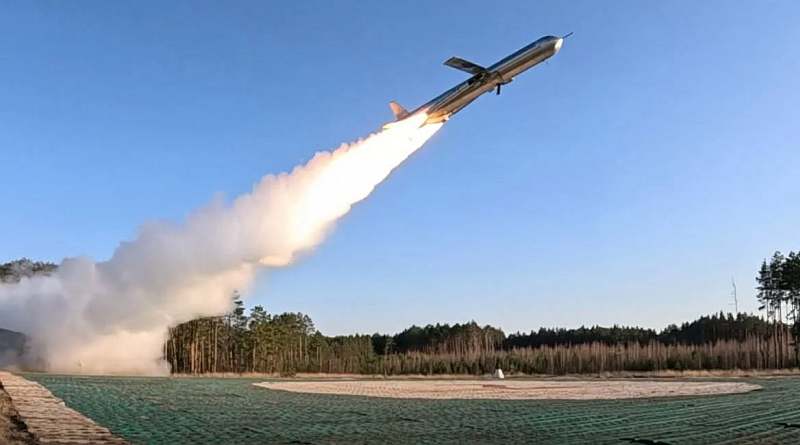
On the cover: Launch of the Ukrainian missile Ruta Block 2. Photo: facebook/Ivan Kirychevskyi
