
In July 2026, Russian aviation dropped over 8,300 guided aerial bombs (GAB) on Ukraine. This is the highest monthly figure for the entire major war, surpassing the June result of 8,266 units. The General Staff presented this figure alongside nearly 97,000 shellings and 7,922 combat clashes, in a general stream of statistics where the reader’s eye quickly tires from the numbers. But the first number describes the main physical reality of this war more precisely than any other. More than two and a half hundred bombs per day — the backdrop against which everything else occurs: from the defense of Kostiantynivka to discussions on security guarantees.
The British Telegraph in early June described this situation with a formula worth remembering. For three years, guided bombs remained one of the most destructive systems on the front, and Ukraine had no response to them. Now a response is at least announced, and it has its own name.
Three years without a response
The guided aerial bomb is not an invention of this war. Laser-guided Paveway bombs in Vietnam and American JDAMs during the Gulf War made ordinary munitions highly accurate using inertial navigation and satellite guidance. The fundamental novelty of the Russian solution lay not in the technology, but in the scale and price. In 2023, the Russians started fitting a universal planning and correction module to old Soviet explosive bombs of the FAB series weighing from 250 to 3,000 kilograms and dropping them from Su-34 frontline bombers.
The consequences of this decision were severe for the Ukrainian army and for civilians. In the spring of 2024, bombs in Kharkiv reached the northern and eastern districts, while the southern part of the city remained outside the impact zone. Residents quickly figured out where the approximately safe boundary lay and built their lives around it. Then this boundary moved further south, and then to the outskirts. It moved similarly in Zaporizhzhia, Sumy, Sloviansk, Kramatorsk, Mykolaiv. And although these bombs are not very accurate, their destructive power compensates. A FAB-1500 leaves a crater up to six meters deep and up to 25 meters in diameter, and one can get a concussion even 300 meters from the point of impact. For urban construction, this means a destroyed entryway or an entire building. As for the front, it means a ruined stronghold along with the garrison, which can range from a squad to a platoon.
The technical essence of the UMPK module is as primitive as possible for a precision weapon. Folding wings, inertial measurement unit, satellite guidance. Dropping is done from an altitude of 6,000 to 7,600 meters in Russian airspace, after which the bomb glides over distances from 60 to 95 kilometers. The deviation from the target with satellite and inertial guidance is from 5 to 15 meters, which is quite sufficient for a stationary object.
Then began the usual evolution of the “device” typical for this war. Russians started installing rocket boosters on the standard UMPC body, which increased the flight range to almost 150 km when released from a sufficient altitude. To counter Ukrainian electronic warfare means, new versions of the module were equipped with eight or more satellite antennas. In the fall of 2025, the reactive KABs reached Mykolaiv, Lozova, Poltava, and Odesa for the first time, targeting cities that were previously considered deep in the rear regarding aviation threats. According to Ukrainian intelligence, Russians have moved to serial production of modular guidance systems with a range of up to 200 kilometers, and the Kremlin’s production plans for this year are measured in six-figure numbers.
The Arithmetic of KAB
Estimates of the cost of the Russian KAB vary depending on the caliber and type of module, but the order of magnitude is known. As early as 2024, Ukrainian experts estimated the average price of a FAB with UMPC or with the universal interspecies ammunition D-30 in the range of 30 to 50 thousand US dollars. Later estimates for heavier and longer-range modifications reach 100 thousand US dollars, and Russians often spend two or three bombs on a single target. The Ukrainian equivalent of the module, which the “Medeoid” design bureau tested in the summer of 2025, cost 1.2 million hryvnias, or about 25 thousand dollars, per kit for a 500-kilogram bomb. It’s the same price range, as it involves the same aluminum body, wings with spring deployment, inertial block, steering servos, and satellite antenna. Essentially, it’s a product with the technological level of household electronics with Western civilian components inside.
The second part of the equation looks different. The PAC-3 MSE missile costs the US army approximately 4.2 to 5 million US dollars per unit, and in export contracts, along with a logistics package, the price reaches 6–7 million US dollars. The cost of missiles for NASAMS is in the range of 900 thousand to 1.1 million US dollars, about the same as a missile for the IRIS-T. In the spring of 2026, the US army began seeking contractors capable of making an interceptor for the Patriot cheaper than a million US dollars, precisely because the current cost ratio was deemed unacceptable even for the American budget.
Now plug in the July numbers. Over 8,300 bombs per month cost Russia at least several hundred million dollars, a sum quite bearable for a country with its current military budget. Attempting to intercept even a tenth of this stream with AMRAAM-class missiles would cost about the same amount. And operations against such targets with Patriot means would cost several times more than the attack itself. No economy, including the American one, can sustain such an exchange over the years. This is where the real advantage of this weapon lies, not in the kilometers of range.
Why Are They Almost Impossible to Shoot Down?
Yuriy Ignat, who is the voice of the Ukrainian Air Force, articulated the problem with a rare directness for official comments, saying: there are not enough missiles in the world to deal with these bombs. The main thing that can be done to counter guided aerial bombs, according to him, is to chase the carrier far away.
The same conclusion is reached by Justin Bronk of the Royal United Services Institute, independent of the Ukrainian military. Russia has a greater capability to produce guidance kits for the old FAB series bombs than Ukraine does to replenish the ammunition stock for its anti-aircraft missile systems, so direct interception is not a sustainable strategy. This is not pessimistic analysis but arithmetic that cannot be bypassed by purchases.
This does not mean that interception is impossible. In February 2025, near Zaporizhzhia, a bomb was likely taken down using an old Soviet ZU-23-2 combined with a detection and targeting station, and over three autumn months of the same year, the anti-aircraft missile forces destroyed about a hundred aerial bombs. Together with NATO, under JATEC, solutions combining radar, recognition algorithms, and interceptor drones are being developed. Ukraine has also tested the German Titan and the French “drone wall” concept. A cost-effective interceptor is the only direction capable of eventually balancing the value ratio, but so far, none of these solutions work on the required scale.
Allied Bombs on Ukrainian Wings
Ukraine has been trying to build a symmetrical response from the beginning, relying on partner supplies. The Air Force acquired American JDAM-ER adapted for MiG-29 and Su-27, French AASM Hammer with a range of about 70 kilometers and a deviation of about ten meters, and small-sized GBU-39 weighing 110 kilograms with a deviation of one meter. In May 2026, the US agreed on a potential sale to Ukraine of over fifteen hundred JDAM-ER kits, valued up to 373.6 million US dollars. The problem is that a western bomb on a Ukrainian aircraft performs worse than the same bomb on an American one.
Russians drop their KABs from a high altitude in protected airspace, while Ukrainian aviation, due to the threat of Russian air defense and fighters, is forced to operate at extremely low altitudes with a lofting mode, where the aircraft lifts its nose and gains altitude before launch. Due to this, the effective range of the JDAM-ER decreases from approximately 70 to 40 kilometers. Add to this Russian jamming of satellite signals, which led the Americans to separately procure sensors capable of targeting jamming sources.
In other words, for three years, Ukraine has been engaged in this duel with allied tools, at the pace of foreign deliveries and with characteristics halved by the conditions of their use.
Leveler
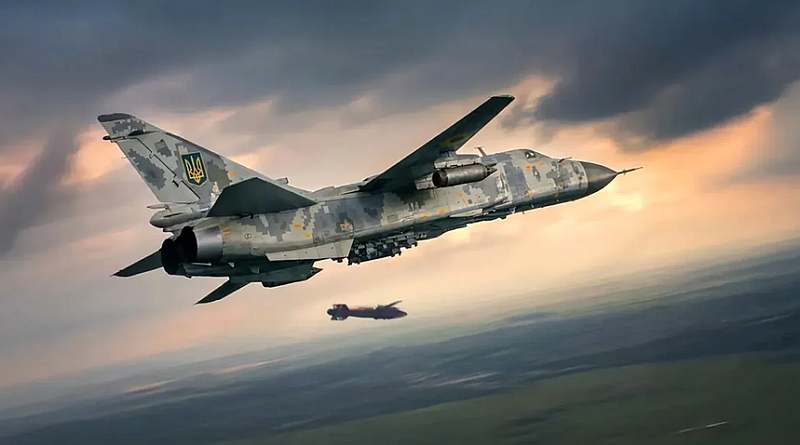
On May 18, 2026, Defense Minister Mykhailo Fedorov announced the creation of the first Ukrainian guided aerial bomb. The development was carried out by DG Industry, a member of the Brave1 cluster, which supported the project with a grant at an early stage. The project took 17 months to complete. The chosen name is indicative. Known characteristics of the “Leveler” are as follows: the warhead weighs 250 kilograms. The construction is claimed to be original rather than copied from Soviet or Western models, though the experience of using foreign analogs, including Russian ones, was analyzed during development. The bomb is compatible with Su-27, Su-24, and MiG-29, and is also adapted for Western platforms, including the F-16 and Mirage, but this requires separate certification. The claimed range is up to 140 kilometers, though this figure should be read with the same caution as in the case of the JDAM-ER, as it is achievable only when dropped from a high altitude.
The most important characteristic, again, is economic. According to the manufacturer, the cost of the product is approximately three times lower than that of the JDAM-ER, allowing the Defense Forces to be supplied with a greater quantity of ammunition. If this is translated into money, the picture becomes clearer. In a May American agreement, over one and a half thousand JDAM-ER kits were valued at up to $373.6 million, which is roughly a quarter of a million per kit along with the associated service package. The claimed price, three times lower, places the “Balancer” in the range of several tens of thousands of dollars, roughly similar to the Russian UMPC. For the first time in the war, Ukraine enters the same price category that the enemy uses for its air campaign. In June, at the Eurosatory exhibition in Paris, company representatives reported that the product was already in serial production, with the first batches delivered to the military and used in combat.
Limits of Symmetry
Keir Giles of Chatham House says that for a long time there was practically no protection against Russian planning bombs, which significantly increased Ukrainian losses on the front line. Now that Ukraine is creating comparable capabilities, this could potentially accelerate the pace of pushing out Russian troops. Giles also adds a much more interesting point, suggesting that Ukraine is essentially doing on its own what it was not allowed to do in Washington, building strike capabilities that partners were unwilling to supply or sanction.
Kristof Bergs from RUSI explains the tactical niche of this weapon. Practically any forward artillery positions of the Ukrainians are threatened with destruction, and small FPV quadcopters and tactical drones, while they hit targets, do not have the explosive power of a 250 or 500-kilogram bomb. According to him, the Ukrainian bomb adds a tool for striking fortified areas, defensive positions, and command posts where a large explosive effect is required.
And finally, the main limitation that no successful design can remove. Robert Tollast from the same RUSI puts it bluntly, noting that the fundamental problem of the Ukrainian Air Force is that they are not very large.
Ukrainian aircraft are forced to drop bombs from afar to stay clear of Russian aviation with its long-range air-to-air missiles. The number of strikes depends not on the availability of ammunition, but on the number of operational carriers, trained pilots, and technicians.
Where is the Issue of FABs Actually Resolved?
Ignat’s formula for moving the carrier away has a very concrete realization, which is unrelated to Ukrainian bombs. Throughout 2026, the Defense Forces systematically worked on the basing airfields and the ammunition depots themselves. On the night of July 5, a strike on the “Borisoglebsk” airfield in the Voronezh region hit a warehouse with guided bombs and a training-combat aircraft. Three days later, a repeat strike destroyed a tank park of fuel and lubricants built back in the winter of 2023, as satellite images recorded. On this airfield, units of the 105th mixed aviation division with Su-34, Su-35, and Su-30SM aircraft are based, which are precisely the carriers that daily drop FABs on Kharkiv and Donetsk regions.
Even more indicative are the results of a forty-day SBU operation released at the beginning of August. Strikes were carried out on the “Saky,” “Gvardeiskoe,” “Belbek,” “Bagerove,” “Engels,” and “Khanska” airfields, as well as the Yevpatoria aviation plant.
Hit:
- strategic bomber Tu-95MS,
- two Su-35 fighters,
- two L-39 trainer-combat aircraft,
- hangars with Su-24, Su-30, and Su-30SM,
- airfield fuel infrastructure.
This is the real counteraction to planning bombs in the current conditions, as it works on that side of the equation where the cost is not hopeless. A carrier destroyed on the ground costs tens of millions of dollars and cannot be replaced in a few weeks of production, whereas each attempt to shoot down the bombs with missiles remains knowingly unprofitable. Symmetrical logic also applies to the Ukrainian side. The “Equalizer” will not change the arithmetic, and no Ukrainian bomb in the near future will match eight thousand Russian ones per month because these magnitudes have different natures. Russian KABs are a means of massive fire destruction, while Ukrainian guided bombs remain a targeted tool for objectives that neither artillery nor drones can handle. The number of Ukrainian air strikes depends not on the availability of ammunition but on the number of operational carriers, trained crews, and the pace of certifying the new bomb for the F-16 and Mirage, which is still ongoing.
Therefore, the practical agenda appears quite narrow. Certification of the product for Western platforms, replenishment of the fleet of carriers, early launch detection means for frontline communities, and further increasing strikes on airfields and KAB depots. The rest are matters of industrial pace, not technological breakthrough. The importance of having one’s own bomb lies precisely in removing a critical class of weapons from the logic of waiting, in which the country has been for three years, where the intensity of strikes was determined by the political calendar of allies rather than the needs of the front.
The mass appearance of the “Equalizer” on the front together with the announced Ukrainian ballistics will drastically change the situation on the battlefield in favor of the Ukrainian side. It is announced already for this fall and will finally eliminate the question of whether Ukraine has a response, reducing it to a single one: “How many strikes and with what intensity can we deliver monthly to force Russia into peace on the eve of the harsh winter of 2026–2027?”
Pictured: Dropping the “Equalizer” from the front-line bomber Su-24. Photo: Ministry of Defense of Ukraine
