
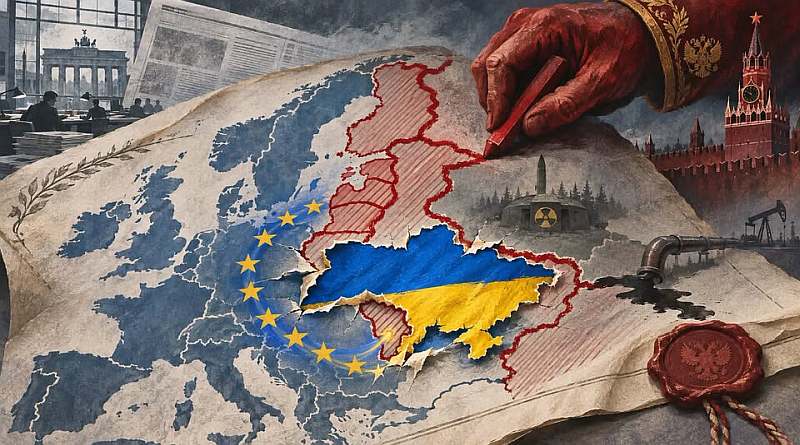

On the eve of the full-scale invasion, the German Bild published a map of how Russia would advance on Ukraine. At the time, many thought it was an exaggeration.
Now the same editorial team has published the terms that Moscow calls peaceful, and they should be read just as carefully.
Bild honestly warns: this is just one of the packages circulating in unofficial negotiations, and whether Putin supports it is unknown. Our Telegram channels usually skip over this caveat. Yet even as one of the options, the document is very telling. It was shown to European representatives in Abu Dhabi, and most of it concerns countries other than Ukraine.
In this plan, Ukraine is assigned a familiar role. It must give up the rest of the Donbas, demilitarize the ports of Odesa and Mykolaiv, and permanently forget about NATO.
The following points are addressed to other capitals. Remove military bases from Estonia, Latvia, and Lithuania. Return Finland to the status it had before joining the Alliance. Transform Moldova into a federation with Transnistria and Gagauzia, and in case of its EU membership, immediately lay the groundwork for referendums on the “independence” of these regions. When an aggressor dictates the structure of a neighboring country it has not yet invaded, it is essentially indicating where it will look next.
The true nature of this document is best seen in what Moscow offers in return. It is ready to remove nuclear weapons from Belarus, which it placed there, and not to deploy medium-range missiles there. It is ready to withdraw troops from Transnistria, where they are stationed without Moldova’s consent, but only if Moldova remains non-aligned. Regarding Kaliningrad, there is no mention in the points known to Bild. Thus, Russia’s “concessions” boil down to removing threats it created itself.
There is nothing new here. Putin has never hidden his desire to return the continent to the logic of spheres of influence that emerged after World War II. For many years, he has portrayed NATO expansion as a “threat” and references a promise of non-expansion that no one legally made. But Finland joined the Alliance not under Washington’s pressure. It joined because it saw February 24. Now the Kremlin demands to undo the consequences of its aggression and behaves as if someone else is to blame.
Behind the words about a “new European security order” lies no strategy. There is a post-imperial resentment of a former KGB man who once called the collapse of the USSR the greatest geopolitical catastrophe of the century and still cannot come to terms with it.
Therefore, this text is useful. It destroys the illusion that the war is about Donbas, language, or “security guarantees.” It is about who will set the rules on the European continent. In the Kremlin’s design, Ukraine was one of the items on a list, a desired object. Unexpectedly for Putin, it became a subject, and that’s why this list remains on paper.
For Europe and the world, this implies one thing. Talks with Russia can only be from a position of strength, and here strength means weakening Russia. Without this, any negotiations are doomed.
Sanctions must finally strike, not simulate a blow. Russian oil refining must be dismantled, and revenues from outside must reach zero.
China cannot be ignored either. Maximum diplomatic efforts are needed for Beijing to see its own interest in a weakened Russia. Washington has long feared the opposite: that Russia’s collapse would strengthen China, which would seize its territories and resources. But today, a nuclear Russia constantly blackmailing the world poses a more real threat than a hypothetical China. Beijing has publicly called nuclear threats unacceptable, and that argument is worth taking there.
Finally, speaking from a position of strength means pursuing policies contrary to Putin. He wants to see Ukraine and Moldova non-aligned, fragmented, and dependent. The best response to this plan: membership of both countries in the European Union.
