
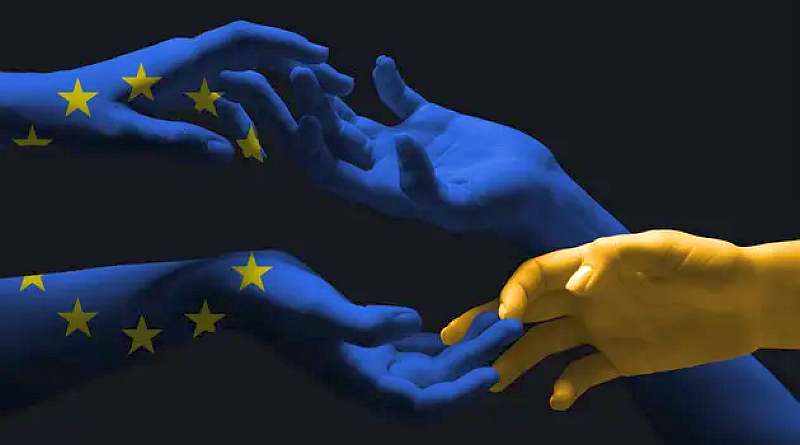
Marc Champion, Bloomberg / Translation iPress
Bloomberg Opinion columnist Marc Champion, who writes about Europe, Russia, and the Middle East, emphasizes that Europe is entering a new stage of the war, where its role in supporting Ukraine and future negotiations becomes crucial. He believes that current negotiations do not mean imminent peace: Putin aims to break Ukraine with strikes on infrastructure and the economy, exploiting a shortage of air defense systems. Moscow uses talks to avoid further sanctions and restrictions while continuing to bomb Ukraine with impunity. Therefore, Europe, in his view, needs to quickly provide funding, use frozen Russian assets, strengthen Ukraine’s defense, and appoint a single political representative. The speed of these decisions affects not only Ukraine’s position but also Europe’s future security.
There are reasons to believe that an opportunity has emerged to reach a peace agreement on Ukraine. This is indicated by Russia’s agreement to participate in a new round of trilateral talks in Abu Dhabi this week, the upcoming new U.S. Congress less favorable to Moscow, the rapid increase in losses among Putin’s troops, and the unbearable cost Ukrainian cities and the economy are paying. It might seem logical to conclude that we stand on the brink of an agreement to end the war. But this is, unfortunately, an illusion.
However, something has indeed changed. As Volodymyr Zelensky said in Dublin on Wednesday before the European Political Community summit, which was to gather about 50 world leaders, the continent must decide “in November” who will speak on its behalf at this new stage of the conflict. Donald Trump and his team seem to have finally realized that Europe must be involved, as any agreement and any security guarantees that Putin accepts must take into account the broader ambitions and concerns that led him to start the war. It was not only about Ukraine but also about Russia’s aspirations for control and influence in Europe. As acknowledged by Jared Kushner, one of Trump’s representatives in the talks, this will be a lengthy process — and the Kremlin is quite content with it.
Putin has a plan for victory, and he is sticking to it because it seems to work better than anything he tried from the first hours of the war. Only the invasion tactics have changed. This shift can be traced back to when the U.S. entered the war with Iran in February and began rapidly depleting stocks of scarce and expensive Patriot interceptor missiles, on which Kyiv relies to shoot down ballistic missiles. Russia is now reportedly producing missiles to strike Ukraine at record rates — up to 200 per month, creating a deadly advantage for her. Kyiv’s inability to fully defend against this powerful weaponry means that Russia’s strategy no longer necessarily depends on the successes of its troops on the ground. Putin’s goal, as he has publicly stated, is to turn Ukraine’s infrastructure and economy into ruins. He has a reasonable expectation that a deal will be made on his terms after this.
From Moscow’s perspective, the negotiations in Abu Dhabi, where parallel discussions on prisoner exchanges, de-escalation measures, and security architecture were held, are advantageous because they allow it to continue its destructive war without facing additional international pressure and sanctions.
Ukraine is doing what it must under these circumstances, but at this stage, its fate is in Europe’s hands. So far, the continent has demonstrated more resolve than Putin or almost anyone else, including myself, expected in February 2022. However, a common understanding of the goal is not enough. Europe now needs to act and take leadership in a way it never has before.
First of all – money. Next year, Ukraine’s total funding deficit will amount to 70 billion euros (77.7 billion dollars), according to European Commission President Ursula von der Leyen, and most of the funds to cover it must come from Europe. EU leaders are considering providing 45 billion euros in loans to cover a large part of the deficit, but domestic political difficulties surrounding this are only growing – another reason why Putin believes time is on his side. The threat by German Chancellor Friedrich Merz to block the EU budget, along with tens of billions of funding on which politicians like Slovakia’s pro-Russian Prime Minister Robert Fico rely, sounds tough. But that is exactly what’s needed.
Secondly, Germany and other countries must unite to reclaim frozen Russian assets from Belgium, which is blocking their use due to fear of reprisals from Moscow. These assets should be used as a basis for new loans to Ukraine. This is the moral and political correct step, especially if the alternative is forcing European taxpayers to pay for the destruction caused by Putin.
Next – air defense. Europe and Kyiv are trying to develop their capabilities, and additional Patriot systems are expected later. Until then, the only way to save Ukrainian cities is to destroy missile launchers and factories in Russia. Ukraine is attacking reachable targets with swarms of long-range drones, but it needs both covert and overt assistance to overcome the complex defense system around these objects. This is not an “eye for an eye” principle in response to Russian strikes on civilians and livelihoods. This is not Europe entering the war with Russia. This is helping Ukraine exercise its right to self-defense.
Finally, Europe needs a consistent and convincing voice. Several leaders, including Italian Prime Minister Giorgia Meloni, have noted that the constant change and rivalry of leaders, who take turns claiming the right to speak on behalf of the Old World regarding Ukraine, look simply unserious. There will be a temptation to create a “troika” or another collective format of European representation – the EU loves this. However, when dealing with individuals like Putin and Trump, who perceive this as a weakness, such an approach is almost guaranteed to fail.
Similarly, the idea of entrusting this task to EU institutions created for this purpose but rarely given the opportunity to execute it or failing to manage it is questionable. With all due respect to von der Leyen and European Council President António Costa, neither they nor their institutions should handle this. Firstly, they are not respected by either the US President or the Russian leader. Secondly, they speak on behalf of the EU, but not on behalf of some key players in European security, including the United Kingdom.
This important role must be assumed by one of the current European leaders. None of the big three are suitable for this role. France is likely to soon be led by Marine Le Pen, whose party once received millions of euros in funding from Russia. Neither is Merz suitable: he could perform well in this role, but his domestic political position is too weak. UK Prime Minister Andy Burnham lacks experience in foreign policy.
Fortunately, there are good candidates. Among them is Meloni, who has proven her capability in office and possesses the necessary resoluteness. There is also the equally tough and pragmatic Danish Prime Minister Mette Frederiksen, who has been among the leaders in seeking innovative solutions for Ukraine – from rebuilding the port of Mykolaiv during the war to creating the Danish Ukraine Fund, through which weapons are purchased from Ukrainian manufacturers and sent directly to the front; other donor countries have joined this mechanism. However, the most likely candidate is Finnish President Alexander Stubb, given his country’s lengthy experience in relations with Russia, the shared border, and sufficient military strength to protect it. It doesn’t hurt that he is Trump’s golf partner.
It is less important which of these competent candidates takes on this role; what is more important is that the choice is made quickly. All these decisions need to be made within the next few weeks, as Ukraine’s situation is critical, endangering European security prospects.
