
Olesya Zhigalyuk, BBC News Ukraine
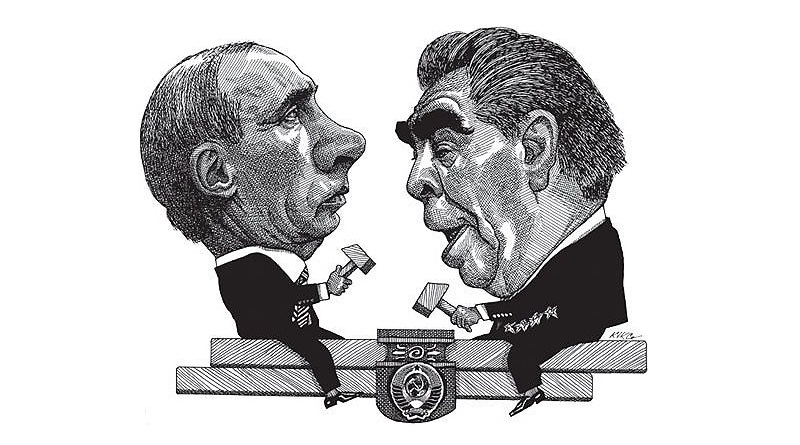
Vladimir Putin is repeating one of the main mistakes of the Soviet leadership during the era of General Secretary Leonid Brezhnev – pouring more and more money into the war, which the Russian economy simply may not withstand, believes Telegraph analyst Kon Coughlin.
He draws a parallel between the current Kremlin policy and the last decades of the USSR’s existence. At that time, the rapid increase in military spending and the war in Afghanistan were some of the factors that ultimately led to the collapse of the Soviet Union. Now the author sees a similar risk for Putin’s Russia.
According to data cited by Coughlin, in 2027 Russian military expenditures may increase by 27%.
About $204 billion is planned to be directed to defense. This is over 7% of Russia’s GDP and about 35% of all federal budget expenditures.
For comparison, Russian defense spending already more than doubles the defense budget of the United Kingdom. Meanwhile, the war that the Kremlin intended to conclude quickly in February 2022 has been ongoing for its fifth year.
Coughlin notes not only the scale of these expenditures but also the cost at which Russia covers them.
According to him, household incomes in Russia are declining, and the state is reducing spending on important areas such as healthcare and education.
In some regions of Russia, healthcare expenditures have been cut by more than a third just this year. In the summer, different parts of the country experienced fuel shortages.
Western sanctions continue to limit Moscow’s capabilities, and Ukrainian strikes on Russian energy further complicate the situation.
Coughlin believes that the Kremlin’s decision to continue increasing military spending under these conditions is a desperate gamble that could eventually threaten the regime’s stability itself.
Afghanistan as a Warning
Here, the Telegraph draws a parallel with Soviet history.
Under Leonid Brezhnev, Moscow increased military spending for years. In 1979, the USSR began the war in Afghanistan, which lasted until 1989.
According to Coughlin, the combination of enormous defense spending and a protracted war became one of the factors that later contributed to the collapse of the Soviet bloc.
The consequences were not only financial. Rising military expenditures led to serious economic distortions, consumer goods shortages, and enormous inefficiency in the military-industrial complex.
Now, the Telegraph author believes, Russia is moving down a similar path. The more resources the Kremlin spends on the war, the less remains for other sectors of the economy.
Another factor in this scenario is the losses of the Russian army.
According to the General Staff of the Armed Forces of Ukraine, as of September 27, Russian troops lost about 2,090 servicemen. The Ukrainian Ministry of Defense called this the largest daily losses of Russian troops for that period.
The record level of losses was also mentioned in the assessment of British intelligence cited by the British Ministry of Defense.
The Telegraph provides an even larger estimate: since the beginning of the full-scale war, the Russian army may have lost about 1.5 million people, including 500,000 dead.
Meanwhile, Moscow continues to show a willingness for a protracted conflict, despite its price.
In an interview with CBC News, President of Ukraine Volodymyr Zelensky explained how Kyiv sees the ultimate goal of the Russian leadership: “Putin doesn’t need additional kilometers, he needs Ukraine. He wants Ukraine to become part of Russia.”
“Russia is losing the war”
In this context, it is worth recalling the recent trip to Moscow by CIA Director John Ratcliffe.
As reported by Telegraph, he directly told the Russian side: “Russia is losing the war.”
The American assessment concerned not only the situation on the battlefield.
A senior diplomat, familiar with the information the CIA conveyed to Western partners after Ratcliffe’s visit, told the German publication F.A.Z that American intelligence believes the Russian economy could eventually collapse “just as the Soviet Union did at the end of the Cold War.”
The U.S. also believes that maintaining sanctions could be one of the factors accelerating this process.
Moscow raises the stakes
At the same time, Western countries are also warning about potential further escalation.
German Foreign Minister Johann Wadephul met with his Russian counterpart Sergey Lavrov for the first time since the start of the full-scale invasion.
As F.A.Z. writes, their conversation in New York lasted about 20 minutes. Wadephul urged Moscow “to abandon the dangerous path of escalation towards Germany, Europe, and NATO.” He also stated that Russian hybrid attacks would not alter the allies’ determination to continue supporting Ukraine.
Kaflin also writes about a potential threat to NATO. Alliance Secretary-General Mark Rutte warned last year that Russia could attack NATO countries within five years.
Now some European intelligence leaders believe Moscow could attempt to test the Alliance’s defense in “months, not years.”
At the UN General Assembly, Polish Foreign Minister Radosław Sikorski also stated that Moscow is “preparing something big this year.”
In conclusion, the Western press draws attention to several interrelated risks: Russia continues to increase military spending, suffers significant losses on the front lines, faces growing economic strain, and simultaneously does not shy away from confronting the West.
The Telegraph sees a historical parallel: the Soviet Union also increased military spending for years until the cost of its foreign policy became too high for the system itself.
