
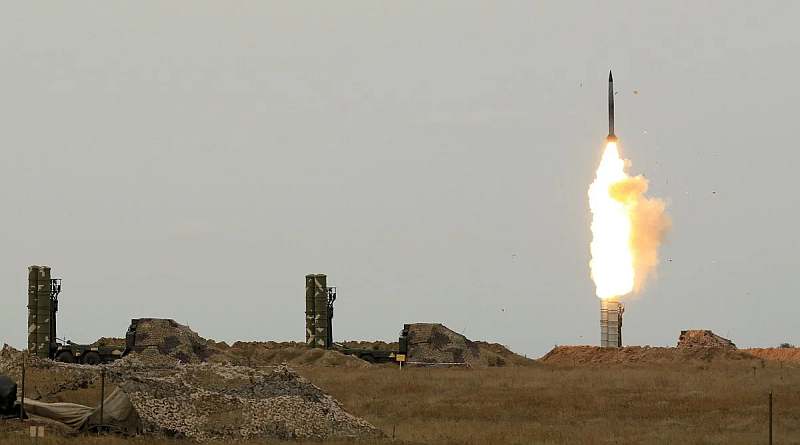
The USA approved the sale of a package of air defense systems to Ukraine for $2.68 billion. It will include extended-range air defense systems, mobile launchers, anti-drone radars, spare parts, software, and technical support.
The West decided to revive our post-Soviet complexes. This is a purely pragmatic set of tools, aimed at massively neutralizing drones and reviving Soviet hardware with European and partly American funds.

The package is a powerful mix from the FrankenSAM project (hybrid air defense) and modern anti-drone solutions:
S-300 clone missiles. Yes, it’s written exactly like that in the documents. No new divisions are being transferred – the allies simply funded the production of analog missiles so that old Soviet launchers don’t remain idle. This fills the gap in long-range air defense. I think they used decommissioned bodies because global supplies are exhausted;
Improvised Transporter Erector Launchers 1.5 and modification kits. This is the core of the “Frankensteins”. They take Soviet chassis, install Western guides, and integrate American anti-aircraft missiles, digitize, and perform current repairs. They return well-known equipment to the operators and support services;
Laser long-range missile systems. This is definitely about VAMPIRE type complexes. It integrates APKWS missiles with laser guidance, which can be mounted even on pickups. It’s cheap, effective, and ideally takes down “Shaheds”, avoiding the use of Patriot missiles costing several million dollars. Plus, it’s a great self-defense and object-based air defense for long-range if the connectivity is broken and they advance to close distances;

Radars RPS 202. Modern anti-drone radar stations. The evolution of Israeli-American radars (type RPS-42) designed to spot any small object in the sky against the ground. They come with towers with telescopic masts — to lift radars above obstacles and quickly change positions before being detected by the next wave of drone missions.
The key feature of RPS 202 is micro-Doppler analysis. The plastic or foam body of a “Shahed” barely reflects radio waves. But the radar looks for not the body, but the micro-Doppler shift from the spinning propeller and metal parts of a two-stroke engine. It doesn’t matter what the fuselage is made of — if the propeller is cutting through the air, the target is illuminated. These are the eyes of the local anti-drone network. It solves the main problem of mobile fire groups — blindness in darkness and not knowing from which ravine a drone might appear. One radar on a mast covers a 30 km radius, replacing a dozen visual posts with thermal imagers and guiding machine gunners and MANPADS or drone intercept teams to the target long before they can hear the motor noise. It operates in LPI (Low Probability of Intercept) mode — emitting narrow low-power pulses that are hard to detect;
Missiles GAM-67. A very unusual item. Historically, GAM-67 Crossbow were anti-radar missiles from the 1950s. However, this particular version didn’t go into production, so it is most likely that they are naval anti-aircraft RIM-67 missiles, of which around 3,000 were produced. There will be issues with targeting, so there will be some tweaking needed. In the 2026 context, this is either a code name for some new hybrid interceptors, or they unearthed and modernized old stock for launches against ground-based radars, such as EW, as they emit significant signals. Or, logically, with an air detonation to destroy jet-powered UAVs. We’ll see.
By early 2025, the global stock of available missiles for the S-300 had been depleted. Greece, Bulgaria, Slovakia, and a couple of African countries gave up everything that was still functional. There’s nothing more to buy, and the remaining missiles have exceeded all conceivable expiration dates (they are 30–35 years old). Therefore, $2.68 billion was spent not on buying old junk, but on funding Western defense companies to convert old Soviet blanks into clones.

The process is divided into three stages:
1. Disposal of bodies and TPK (transport-launch containers). There are indeed thousands of decommissioned missiles and fired “tubes” (TPK) in warehouses in Ukraine and Eastern Europe. The metal, aerodynamic rudders, body geometry — all are in perfect condition. There is no sense in manufacturing a new body to fit the dimensions of the Soviet S-300 launcher. The old body is taken, gutted, the old Soviet electronics are removed, and the movement compartment is cleaned;
2. Refilling solid fuel. This is the most expensive part of the process. The solid rocket fuel in Soviet missiles dries out, cracks, and turns into a gamble in 30 years: the missile may either fail to launch or explode right in the launch tube. Western contractors (utilizing capacities in Eastern Europe) have developed the technology to melt old propellants and refill with modern mixed solid fuel. Western chemistry provides a better specific impulse, thus the old heavy missile on new fuel even flies slightly farther than the original;
3. New brain (GOS and electronics). The original S-300 missile (5V55R) operates on the principle of semi-active guidance — the illuminator radar (30N6) must continuously light up the target until the missile reaches it.
No fantasies of attaching expensive active heads from Patriot PAC-3 or AMRAAM are entertained — it’s economic suicide. Western engineers go for a simpler and more elegant solution: they install a digital replica of the old Soviet head inside, assembled using modern SDR (software-defined radio) technology and modern microelectronics.
As a result, the logic of the system’s operation does not change, but the missile receives a new brain that is considerably more compact, lighter, and, most importantly, almost impossible to jam with old Russian EW systems. The old Soviet radar mathematics is translated into modern Western code.

Essentially, only the metal tube and steering of the old missile remain to fit into the launcher’s dimensions. The entire interior, engine, and brains are products of the Western defense industry, paid for with European checks through American funds.
The funding scheme here is maximally cynical. The whole package of $2.68 billion is paid jointly: the lion’s share is provided by Europeans, and part of it is the remnants of the American FMF (Foreign Military Financing) fund, created back during Biden’s time.
The formula is brilliantly simple: Europeans provide cash to protect their eastern flank, but every cent of the $2.68 billion ends up in the coffers of the American defense industry. Trump sells this to his MAGA electorate as “not a cent of American taxpayers’ money for foreign wars,” while simultaneously forcing Brussels and Berlin to buy security with their own euros.
And to cleverly utilize the remaining resources of the FMF fund without triggering the current Republican Congress, sleight of hand was applied. The American share is recorded as a “US investment in the Ukraine Reconstruction Fund” — but only on the condition that Europe contributes equally in a 1:1 ratio.
Bottom line: American factories are overloaded with orders for years ahead, Europe pays for the feast, and we receive a functional air defense against “Shaheds” and cruise missiles. Nothing extraordinary, just capitalism on the ruins of Soviet legacy.
In fact, this is not the transfer of elite SAM systems, but the creation of a cheap, massive, and resilient air defense contour. They merge the old Soviet base with Western missiles and the latest radars to minimize the cost of intercepting a target.
Can this work? Yes, quite. S-300 divisions are formidable weapons, and the fact that they have survived many months of war is proof of this. We have personnel experienced through many months of repelling waves of cruise missiles and UAVs. More channels, more eyes, more survivability: while some leap to backup positions, others activate the radars. A good package that will infuse fresh blood into our air defense.
On the cover: Launch of an S-300PS/PT missile during exercises at a range in the Kherson region. 2021. Photo: Militarnyi
