
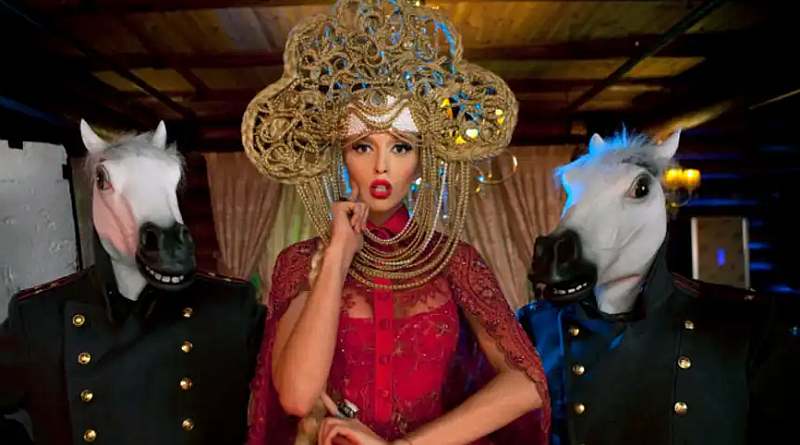
The outburst of emotions from singer Olya Polyakova and the unexpected public reaction to the artist’s accusations against her own country, which now Polyakova and her supporters perceive as a real concentration camp, could be written off as an offense or just a reminder of democracy and freedom of speech. After all, it might not be so bad that in our country people can calmly talk about a concentration camp and prepare for tours, rather than being sent on tours to the Far North, like in the country that attacked us.
But in this situation, I am interested in the country that attacked us. Because it is precisely about this country that Olya Polyakova tried not to mention – as if the main issues of today are not connected with this attack.
About what happened with Ukrainian society, with state governance, with personnel policy, with freedom of speech, I have been speaking since 2019, not from 2026. And why from 2019? From 2010. And why from 2010? From 1994. On Ukrainian television, my shows were shut down, not Polyakova’s. Cameras were installed in my apartment in Kyiv before the last Maidan, not in Polyakova’s bedroom. A listening device was found at the very beginning of the war in my apartment in Lviv, not in Polyakova’s apartment. It was my TV channel that was taken off the air in the first days of the war – yes, my face disappeared from television screens across the country, not Polyakova’s face. I know about government pressure, harassment, and threats much better than all the representatives of our show business combined.
But unlike many of these characters, I see the elephant in the room. I see Russia. I know for sure that if there were no Russian aggression, there would be no questions about the artist’s behavior at a festival involving people with controversial reputations. I know for sure that if there were no Russian aggression, there would be no issue of mobilization, and there would be no abuses in the military corps. And there would be no corruption in the war if there were no war itself. And I perfectly understand that increasing the efficiency of governance (for four and a half years in a row I have been literally describing textbook recipes on how to do this) will help reduce the negative impact of many decisions but will not be able to solve all the problems. Because our main problem, in fact, is not the efficiency of governance, the heightened public reaction, or even corruption.
Our main problem is the war. Because it is from the outcome of the war that it depends whether Ukraine will remain on the political map of the world, and whether Ukrainians will remain on their land. Despite all the optimistic assumptions and statements like “Russia has definitely already lost,” these remain open questions. And this should be realized by everyone who looks to the future – both of the country and their own. Good always defeats evil only in fairy tales. In life, efficiency and realism prevail.
When people begin to ignore the elephant in the room, they travel back in time – to 2019. Then, let me remind you, they also tried not to mention the war, the future president ended it simply in his own head, and his supporters were sincerely convinced that the conflict in Donbas continued only because the authorities who profited from the war were interested. If you revisit the famous debates at the stadium, you will see that their main content from the candidate’s side was precisely the unwillingness to notice the elephant.
It would seem that the first four and a half years of the great war should have demonstrated how mistaken the Ukrainian society’s understanding of war and peace was – but no! The return to 2019 has already begun, only now Zelensky himself is in Poroshenko’s role. And why?
Because living this way is much more comfortable. “War fatigue” is primarily the desire to live as if there is no war. It’s also a great opportunity not just to replace justice with injustice, but to tell yourself that this injustice is indeed justice.
Because when you see the elephant, you at least understand that the situation where your classmate is at war and you’re in the shade is an injustice not even to the state, but to that very classmate. No, you probably won’t make any new decisions because of this, but you give your choice an adequate moral evaluation.
And when you don’t see the elephant, then your classmate is the victim, and you’re the moral hero challenging the tyranny of power: “What about Ukraine, what about the war? The government must stop the war – as soon as all deputies go to the front, everything will stop immediately.”
This is what I want to say in conclusion about the elephant. You might not see it, but it is there. It exists and won’t leave our room until we overcome it. And no, the president of Ukraine does not have any opportunity to negotiate an end to the war – and never had. And no, the president of the United States does not have the opportunities to negotiate an end to the war – and didn’t with Iran, and especially not now. And yes, it’s necessary to improve government efficiency, fight corruption and abuse – because this will help us stop the war faster. But it seems everyone might mean different things by efficiency. For instance, effective mobilization without corruption and abuse, where the government considers citizens as warriors, not voters, is simply a much larger scale mobilization with rotations and movements of not millions, but millions of soldiers of different ages and, pardon, genders, not stopping mobilization (at least until the start of robot wars, which we too will have to see and endure in possibly ruined European cities). So the expectation of correcting mistakes may not coincide with the actual result for everyone. Just like it did in 2019.
Our country has had many problems over the last 35 years. The Ukrainian people over the centuries of its existence – even more. But never before has the question been so acute and obvious: to be or to disappear, remaining just a few pages in ethnography textbooks. As a person whose ancestors lived without a state for millennia and found themselves only on the pages of the Book, I wish no people such a fate. And at the same time, I will always know that a people who cease to notice the root causes of their troubles may be doomed to defeat and oblivion.
In the cover photo: Olya Polyakova. Photo: shot from the clip Russian Style
