
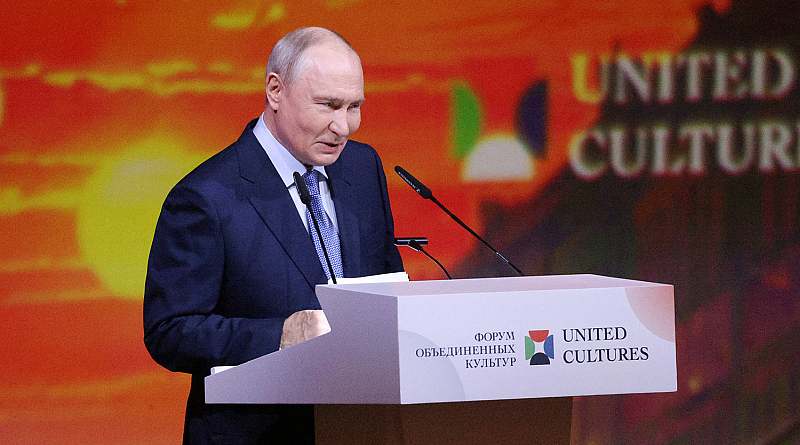

From September 24-26, the main propaganda event of the Kremlin in the humanitarian sphere – the Forum of United Cultures – was held in St. Petersburg. Putin personally spoke, along with a number of other war criminals and sanctioned individuals.
I will analyze the forum itself later. For now, I want to draw attention to a document discussed at the forum that significantly represents a collective confession.
This concerns the draft Concept for the Development of Museums in the Russian Federation until 2030, developed by the Federal State Budgetary Scientific Institution “Russian Research Institute of Cultural and Natural Heritage named after D.S. Likhachev” and the Ministry of Culture of the Russian Federation based on Putin’s directive. So, it’s all official.
Some positions will be adjusted. But the essence will not change: the museum system of Russia is entirely integrated into supporting the aggressive war. This activity has been ongoing since 2014. Since February 2022, it has simply been expanded.
And Russian museum workers intend to continue working as loyal soldiers of the Putin regime. Contributing to the theft of Ukrainian cultural heritage, the destruction of everything connected with Ukraine in the occupied territories, pro-war indoctrination of people, especially children.
It’s important for everyone dealing with Russian museum workers in any form to understand this.
Even if you are dealing with a pleasant, competent person, he/she is fulfilling a criminal task.
The best way to help Russian museum workers avoid performing criminal assignments is to sever all ties with them until the end of the war. At the very least, the number of tasks related to the public legalization of items stolen from Ukrainian museums will decrease.
Personal international sanctions also greatly help Russians. Because a sanctioned person becomes toxic and is easier left alone. Only the most dedicated regime accomplices remain active. Well, that’s a separate discussion.
Below are quotes from the mentioned concept with brief comments.
“… II. Current State, Main Trends, and Problems of Museum Development in the Russian Federation
Since 2014, a museum network in Crimea has been developing in the Russian cultural space. An expansion of cooperation between Crimean museums and leading Russian institutions is observed, the creation of innovative projects related to enhancing the status of culture and state cultural policy. In particular, from 2024, the large-scale museum-temple complex ‘New Chersonesus’ receives visitors, within which the State Museum of Antiquity and Byzantium is established. In 2026, a new building of the Russian State Art Gallery (Russian Art Gallery) opens at the Art Center on Cape Crystal in Sevastopol…”
As we can see, the origin of the Crimean museum network is not explained. It suddenly appeared and is developing! The statistics of Crimean museums are integrated into the overall Russian data. Since the starting point for analysis is 2008, this accelerates the dynamics.
“… One of the current tasks for museum collections is documenting the events of the special military operation (hereafter – SMO). In April 2022, the Ministry of Culture of the Russian Federation, together with the Russian Historical Society, created an inter-museum working group to collect funds related to the history of the SMO (the order to create the group was personally given by the head of the SVR RF, Sergey Naryshkin – AK). The group included the State Museum-Reserve “Stalingrad Battle,” the State Central Museum of Contemporary Russian History, the Victory Museum, the State Historical Museum, and others. More than 15,000 items have been collected, some of which have been displayed at temporary exhibitions and permanent expositions. In 2025, more than 3,000 exhibitions and expositions dedicated to the history of the special military operation were held at federal, regional, and municipal museums, attended by more than 7.5 million people. A large-scale permanent exhibition “SMO. Defenders of the Fatherland” was opened in 2025 at the Victory Museum.
Collection to replenish their funds and collections documenting the SMO is carried out by museums at all levels with the participation of the public and requires methodological support. High professionalism in the work of collecting and publishing cultural values, telling about the SMO and its heroes, has been achieved at the State Museum-Reserve “Prokhorovskoye Field…”
This group created the first deceitful expositions, including using exhibits from Mariupol, where the bodies killed by a Russian air bomb in the theater building had not yet been covered.
“… In 2023, Russian museums established benefits for SMO veterans and their families and determined priorities for working with this group of museum audiences. Hundreds of special projects and events were implemented during 2023–2025. Museums conduct thematic activities in exhibition spaces and creative workshops in hospitals, create art therapy groups for military families. Many museums have established systematic interaction with governmental and non-profit organizations that assist participants in the special military operation and their families, including the State Fund “Defenders of the Fatherland.” The basis for systematic work was the “Roadmaps for integrating SMO participants into museum activities,” developed taking into account recommendations from the State Russian Museum…”
So remember: the integration of war criminals into museum activities is centrally accompanied not by some red corner but by the Russian Museum, which in 2022 had a physical branch in Malaga (Spain), a network of virtual branches, and friends in Europe.
Moreover, Russian museums are equally focused on working with active servicemen of the occupying army who have killed some Ukrainians, returned for a break, and then will go back to kill again. Direct complicity.
This is if someone starts saying that museum advocates and keepers of high art have nothing to do with the aggressive war.
«… The task of integrating into a single cultural space 77 museums of the new subjects of the Russian Federation – the Donetsk People’s Republic (DPR), the Luhansk People’s Republic (LPR), Kherson and Zaporizhzhia regions – is being successfully resolved. Museum institutions were included in the patronage program of the Ministry of Culture of Russia. Federal and regional museums provide support in the processes of restoring museum buildings, organizing exhibitions, and museum branches…»
Since 2023, I have constantly emphasized: it is not about Russia stealing some individual exhibits. Russia has centrally, as part of state policy, stolen dozens of Ukrainian museums ENTIRELY, in the literal legal sense of the word, taking possession and formally registering Ukrainian property.
The museum system technically supports this theft.
«… In 2023, 116 million rubles were allocated for equipping museums with exhibition equipment, video surveillance, fire alarms, and other technical means. Personal workstations necessary for entering objects and collections into the State Catalog of the Museum Fund of Russia (!!!) were purchased. More than 80 exhibition projects accompanied by ongoing event programs were implemented throughout the year. Professional development courses for museum staff were conducted. Support for museums in the new subjects of Russia continues under the state program of the Russian Federation “Development of Culture…”
«… In 2023-2025, the Presidential Fund for Cultural Initiatives (head – Sergei Kiriyenko) provided support to 59 institutions in the LPR, DPR, Zaporizhzhia, and Kherson regions for a total amount exceeding 178 million rubles. In particular, modern interactive equipment was purchased for the Military-Historical Museum “White Lily” (DPR), interactive panels, furniture, and computer equipment for the “Young Guard” museum (LPR). Support was also provided to five branches of the Berdyansk Museum Complex (Zaporizhzhia region) and the Kherson Regional Museum of Local Lore (interesting, how???)
The fund’s program continues in 2026.
«… Since 2023, a program for organizing cultural and educational routes “Cultural Map 4+85” for schoolchildren from the new subjects of the Russian Federation has been implemented, allowing them to visit iconic places in different cities of the country. More than 9,000 children participated in this program in 2025…»
In other words, Ukrainian children are taken to Russia and influenced.
“… From 2024, children’s centers are being established at the museums of the DPR, LPR, Zaporizhzhia region, and Kherson region. By now, federal museums have organized 45 modern spaces for children’s development, where creative workshops, exhibitions, film screenings, lectures-discussions, master classes, and other cultural and educational events are held. For example, the children’s center of the Museum of the History of the city of Rovenky (LPR), opened with the support of the State Historical Museum-Reserve ‘Gorki Leninskiye’, hosts a popular master class on preserving family heritage ‘My Family – My History’. Another illustrative example is the children’s center of the Cosmonaut G. T. Beregovoy Museum in the city of Yenakiieve (DPR), organized with the participation of the State Exhibition and Museum Center ‘ROSIZO’ and the Agency for the Management and Use of Historical and Cultural Monuments. The center has a stage for theatrical and dance activities, a projector for showing films and cartoons, and a play area. The center’s decor introduces children to the traditions of Russian folk arts and crafts, as well as various natural materials and methods of decoration. Currently, the successful experience of organizing children’s centers in the museums of the new subjects of the Russian Federation is being applied throughout the country…”
No comments here at all.
“… Starting from 2024, as part of the methodological events for museum workers in the DPR and LPR, Kherson, and Zaporizhzhia regions, the Russian Ministry of Culture is implementing the ‘History of the Motherland’ program, addressing the development of the Russian state from ancient times to modern history. To form this educational course, all federal museums (71 institutions) were involved, developing lectures based on their collections’ specifics and cultural-educational activities. Additionally, note that from 2025, this program covers the entire country, ensuring access to training for municipal museum employees.
With the support of the Ministry of Culture of Russia, federal and regional museums in the new subjects of the Russian Federation, museum objects are being created and updated. On the basis of the Historical and Archaeological Museum-Reserve ‘Stone Grave’ in the Zaporizhzhia region, the branch of the Museum-Reserve ‘Chersonesus Taurica’ has been organized (settlement of Myrne, 2023). The State Historical Museum, with the support of Promsvyazbank PJSC, updated the exposition of the Stanitsa Luhanska Museum of Don Cossacks in the LPR (settlement of Stanitsa Luhanska, 2023). With the participation of ROSIZO, the Cinema Museum was created in the DPR (city of Shakhtarsk, 2023). Also, a Memorial House-Museum of A.A. Zhdanov – a branch of the State Memorial Museum of Defense and Blockade of Leningrad – was opened in the DPR (city of Mariupol, 2025), and the Museum of Heroes of the Donetsk Underground was created with the assistance of the State Central Museum of Contemporary History of Russia (city of Donetsk, 2026).”
I quote to make it clear: ALL (!!!) federal museums of the Russian Federation are implicated in direct participation in armed aggression and are actively engaged in the ‘normalization of occupation’. The degree of involvement varies. There are individuals who have personally spent a lot of time in the occupied territories, ingratiating themselves with the authorities. But, in principle, not a single federal museum has refused.
Therefore, when it comes to “innocence,” well, here the Russian museum professionals themselves have defined their role on an institutional level. This means a shift to a presumption of guilt: when it comes to normalization, they will have to prove their innocence.
“… III. Goals and tasks for the development of museums in the Russian Federation at the current stage
The tasks for the development of the museum field are defined by the role of museums in achieving the priorities of cultural development in Russia and include:
… the creation of special programs and projects aimed at support, social and cultural adaptation of participants in the special military operation and their families; …”
“… IV. Main principles, directions, and priorities for the development of museums in the Russian Federation
4. Priorities in the development of the museum network and modernization of the material and technical base of museums:
… providing conditions for the modernization of museums located in priority territories, including the regions of the Far Eastern Federal District, the North Caucasus Federal District, regions within the Arctic zone of the Russian Federation, the Republic of Crimea, the city of Sevastopol, the Kaliningrad region, the Donetsk People’s Republic, the Luhansk People’s Republic, the Zaporizhzhia region, and the Kherson region; …”
I particularly liked this point in the priorities:
“…restoration of museums and cultural heritage sites damaged due to the ARMED AGGRESSION OF UKRAINE; …”
Understand?
Formally intelligent and educated, demanding to be treated as people, sometimes dreadfully pompous characters, speaking with disdain and a raised finger, in all seriousness embed in a conceptual document the thesis of “armed aggression of Ukraine.”
Conscience, self-respect, some professional pride? No?
I’m even curious if there will be any disagreement at all? After all, museums are a sufficiently influential professional corporation to disagree with such disgrace. Or perhaps they collectively assigned themselves this role. This is how we will treat them unless proven otherwise.
Everyone who talks to European colleagues should pay special attention to this point. So that colleagues do not get involved or have to stop.
“… 5. Priorities in improving the practice of acquisition, accounting, storage, and restoration (conservation) of museum items, as well as the museumification of cultural heritage sites:
… ensuring conditions for the inclusion of information about the main fund items of museums in the Donetsk People’s Republic, the Luhansk People’s Republic, the Kherson region, and the Zaporizhzhia region in the State Catalog of the Museum Fund of the Russian Federation in accordance with the deadlines set by Federal Law No. 63-FZ dated 18.03.2023 “On the features of legal regulation of relations in the field of culture in connection with the incorporation of the Donetsk People’s Republic, the Luhansk People’s Republic, the Zaporizhzhia region, and the Kherson region into the Russian Federation and the formation of new subjects within the Russian Federation – Donetsk People’s Republic, Luhansk People’s Republic, Zaporizhzhia region, and Kherson region”; …”
This is a straightforward task—to fully legalize what was stolen by 2030 (it is present in measurable outcomes of the concept’s implementation). Exactly what was done in Crimea. They write it in black and white.
“… completing the collections of regional and municipal museums to document the events of the Special Military Operation with the involvement of the local population in this activity; …”
“… 6. Priorities in creating conditions for comfortable museum visits and access for Russian citizens and tourists to cultural values:
… developing measures for additional support of museums actively participating in the civic-patriotic education of youth (if the share of visitors under 18 accounts for more than 50% of the audience);
… ensuring conditions for the social adaptation of participants in the Special Military Operation when visiting museums, involving them in organizing educational activities of museums on military-historical topics; …”
So that “participants of the Special Military Operation” can tell children about “Ukraine’s aggression.”
“… 7. Priorities in improving the methodology of exhibition and cultural-educational activities:
… preparing exhibition and cultural-educational projects of museums dedicated to Russian military history, events, and heroes of the Special Military Operation, avoiding typical and clichéd solutions, striving to display authentic evidence related to local heroes or battle participants; …”
There are plenty of “non-standard” and genuine testimonies—in Bucha, Yagodne, Izyum, and practically across all of Ukraine.
“… 9. Priorities in developing the human resource potential of museums and professional connections of museum workers:
… development and implementation of educational programs for specialists in the museum field based on the creative industries academy “Meganon” art cluster “Tavrida,” within the educational programs “Captains of Culture,” “Higher School of Management in Culture”; participation of museums in the implementation of a cycle of educational programs #SpecialMilitaryOperation (#SpecialMilitaryOperationAndMUSEUMS); …”
“… VI. Expected outcomes of the Concept’s implementation
… restoration of museums and cultural heritage sites damaged by the ARMED AGGRESSION OF UKRAINE (!!!!);
… integration into a single cultural space of museums from new subjects of the Russian Federation;
… collection completion and museification of objects related to Russian military history, including events of the Special Military Operation; …”
In summary, servicing the goals of the “Special Military Operation” runs through the entire concept like a red thread. I didn’t even cite various statements regarding patriotic education, traditional values, and the harmonious development of the Russian personality.
The important fact: Russian museums are tools of Russian propaganda. This is institutionally structured. It is not a mistake. Not an anomaly. They apply their extensive toolkit in cognitive warfare. They themselves serve as a means of cognitive warfare. Specifically, they not only disseminate false information but also change the mindset of Ukrainian children and other Ukrainian citizens.
All these figures will inevitably rush to “restore connections” in decent countries. They will all be mobilized to justify aggression and whitewash criminals.
Therefore, it is important not to focus on individual episodes but to perceive this picture as a whole.
