

An analysis of modern geopolitical dynamics shows that the combined ambitions of authoritarian regimes pose a fundamental threat to the global security system, as the Kremlin and its partners move from declarative coordination to practical preparation for military intervention in sovereign regions.
The recent strategic maneuvers “Center-2026” highlighted a dangerous transformation in Moscow’s military doctrine, which, with direct support from Beijing, is effectively rehearsing invasion scenarios on the territories of independent Central Asian states under the cynical guise of forming so-called “security zones.”
A report by Deputy Defense Minister Yunus-Bek Yevkurov to the country’s top leadership directly confirms that the coalition grouping of troops is not limited to defending its own borders but is transitioning to a large-scale offensive to capture and subdue neighboring lands.
International observers are particularly alarmed by the direct participation of units of the People’s Liberation Army of China in the offensive phase of operations, which acted jointly with contingents from Pakistan and Kyrgyzstan on key attack directions. Such joint activity demonstrates the autocracies’ desire to form a unified force for a power-driven redistribution of spheres of influence while the world’s attention is distracted by other crises.
Military preparations are accompanied by aggressive statements from Russia’s top leadership, which openly threatens the West with the possibility of using strategic arsenals to cover their resource deficits, particularly in the Kaliningrad issue.
Vladimir Putin openly acknowledges the disparity in demographic and economic potential with likely opponents, drawing a dangerous conclusion about the inevitability of the immediate use of the entire nuclear arsenal in the event of any serious conflict.
The offensive scenario of the exercises serves as a clear illustration of such thinking, wherein prolonged domestic defense is considered an intermediate stage before the inevitable military expansion into external space.
Experts note that the concept of deploying troops beyond national borders for abstract security is becoming a universal pretext for future invasions into any neighboring republics that refuse to follow the Kremlin’s policy. The constant raising of stakes and regular large-scale exercises near neighboring states undermine regional stability, turning the Central Asian direction into a zone of potential hot conflict involving the largest nuclear powers.
The systematic combination of nuclear threats with practical training in seizing foreign territories indicates a complete imbalance of deterrence mechanisms that previously prevented large-scale confrontations.
The increase in military activity in the region points to preparations for a prolonged confrontation, in which the independence of small and medium-sized states is sacrificed to the imperial ambitions of major players.
The consolidation of military efforts by Moscow and Beijing marks the beginning of a new stage of Cold War 2.0, where authoritarian states are ready to use force to redraw the existing world order and suppress any manifestations of sovereignty in their zones of interest. The international community must adequately assess the scale of the emerging threat, as silent acquiescence to such maneuvers, especially in light of Russia’s invasion of Ukraine, only brings closer the onset of a full-scale war in Central Asia.
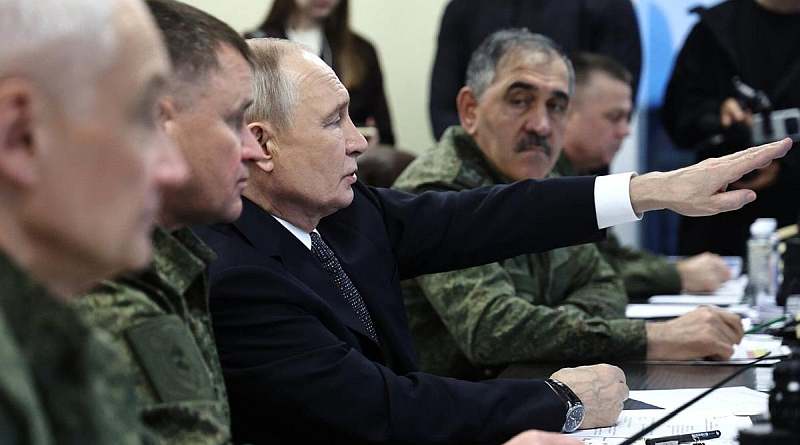
In the image: Putin at the military exercises “Center-2026,” held from September 28 to October 3 in the Chelyabinsk region of the Russian Federation. An invasion of a foreign country and the creation of a buffer zone on its territory was simulated. Photo: Occupiers’ media
