
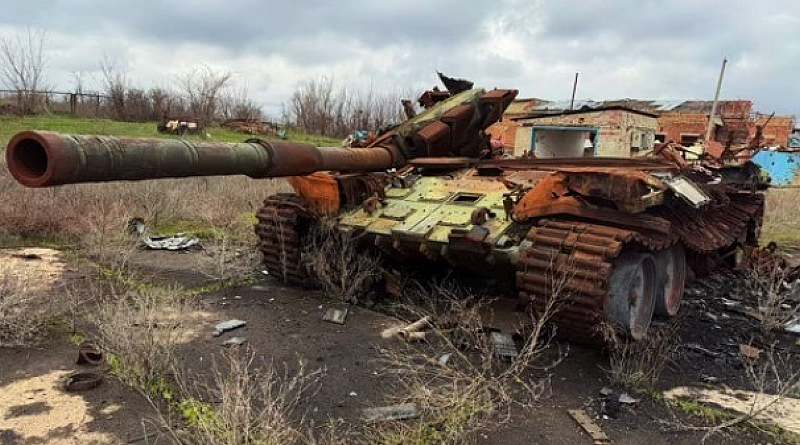
Oleksandr Kovalenko / Obozrevatel
The losses of the Russian occupation forces in March 2026 were largely a result of the start of the spring-summer offensive campaign, which immediately collapsed. This led not only to an increase in enemy losses but also to a number of other negative factors for them.
For more details, see the joint project by OBOZ.UA and the group “Information Resistance”.
Personnel Losses
In March, Russian occupation forces suffered the highest personnel losses since the beginning of 2026 – 31,960 people.
This is quite high even for the average indicator of the previous year and in the proportion of losses to territory capture.
Last month, the Russian occupation forces captured 155 km² of Ukrainian territory, which is one of the lowest indicators for the first half of 2025. It is important to remember that during last year’s summer offensive, the average weekly capture of Ukrainian territories by the Russian army was 130-150 km². In other words, the pace has decreased almost fourfold.
The most negative area of the front in terms of captured territories remains the eastern flank of the Slovyansk-Kramatorsk bridgehead (formerly the Sievierodonetsk direction) – over 70 km² of lost territories in a month.
At the same time, the proportion of Russian occupation forces losses to captured territories in March was a record 206 bodies per 1 km².
I would like to remind you that during the spring-summer offensive campaign of 2025, the similar proportion for the Russian occupation forces was:
April – 36,260 people for 186 km² or 194 bodies/1 km²;
May – 35,370 people for 440 km² or 80 bodies/1 km²;
June – 32,420 people for 497 km² or 65 bodies/1 km²;
July – 33,220 people for 537 km² or 61 bodies/1 km²;
August – 27,940 people for 467 km² or 59 bodies/1 km².
I also note that in the monthly statistics of enemy losses, the category of killed – “200s” – remains consistently high. This figure has steadily remained since late 2025 at the level of 60-65%.
Considering the monthly increase in enemy losses, including consistently large numbers in the “200s” category, as well as the low level of mobilization in Russia (the average voluntary level remains at 20-22 thousand per month), it is possible to say that if current trends continue, the Russian occupation forces will soon face a serious human resource shortage. And the Putin regime can solve this problem only by conducting a general mobilization.
Separately, it should also be mentioned that according to statements by the Commander-in-Chief of the Armed Forces of Ukraine, Oleksandr Syrskyi, since January 29, 2026, thanks to systematic counterattacks, the Armed Forces of Ukraine succeeded in liberating 480 km² of Ukraine’s territory. Based on the data he provided, it can be concluded that about 80 km² was liberated in March. Subtracting this area from the results of territorial gains by Russian occupiers, it turns out that, in March, the Russian occupying forces captured less than 75 km² with a loss ratio of 426 bodies/1 km². This is an absolute anti-record for the entire time of the full-scale invasion of Ukraine.
Tank Losses
In March 2026, Russian occupiers lost a fairly moderate number of tanks (slightly above the average of the previous year) – 119 units.
Even the offensive campaign by the Russian occupying forces, which started on March 17, did not lead to a sharp increase in losses in this category, although mechanized assaults on the front did indeed become more frequent.
Shortages, strict economization, and impassable kill zones without radical decisions on protecting main battle tanks led to the near disappearance of this type of equipment on the battlefield.
Armored Fighting Vehicle Losses
Losses of armored fighting vehicles among the Russian occupying forces in March doubled compared to January and February and became the highest since June 2025 – 219. However, they did not become record-breaking or among the largest throughout the invasion of Ukraine. In overall statistics, they are quite moderate.
The reasons are almost entirely analogous to the situation with the depletion of tank stocks and potential, and the increase in losses was provoked by the offensive campaign and the attempt to expand the range of control zones through mechanized assaults. However, no particular scale in these attempts was observed.
Artillery Losses
In March 2026, Russian occupiers lost 1,448 units of artillery, just slightly missing the third-highest result – the so-called bronze position.
It is worth noting that the level of losses is also a consequence of the activation of occupying forces on the front. Despite the dominance of tactical drones in the air, the need to use artillery during offensives and defenses has not disappeared. Meanwhile, the Russian occupying forces have outdated, towed artillery systems from the Soviet era, which leads to a sharp increase in losses as their use is intensified.
MLRS Losses
During March, the Russian occupying forces lost 50 units of multiple launch rocket systems, the highest figure in this category since November 2023!
It is important to note that the increase in MLRS losses among Russian occupiers is due not only to the failed start of the offensive campaign but also to the deliveries of rocket systems from North Korea. This, in turn, allowed the enemy to use this component more frequently.
Air Defense Losses
In March, Russian army air defense losses amounted to 30 units. This is the highest figure since March 2025.
There is evident intensification of hunting down enemy air defense complexes since January 2026. While in the second half of 2025 the average air defense losses for the Russian occupying forces stood at up to 15 units per month, now it can be stated that losses have doubled.
This fully aligns with the objectives of the Ukrainian Defense Forces to bleed Russian air defense dry and turn Russian airspace into a thoroughfare.
Vehicle Losses
In March, Russian forces lost a record number of light vehicles for the entire time of the full-scale invasion of Ukraine – 6,068 units!
I think the reasons for this record are quite clear, considering the intensification of offensive actions, improved weather conditions, and at the same time, the worsening tactical situation on the front for the Russians.
Special Equipment Losses
In this category, since March 2025, there have traditionally been no major changes – 32 units.
The acute crisis and deficit that arose in 2024 continue to affect the Russian engineering troops.
Conclusions
March 2026 was supposed to be the month of the start of the spring-summer offensive campaign of the Russian forces, which can be characterized as a “va-bank” move. This is the enemy’s last chance to achieve operational-tactical success in the war, in which, since the second half of 2022, the Russian command has failed to execute operations above the tactical level.
In turn, this start became a real false start: with high losses and catastrophic anti-records in some categories, minimal territorial expansions, and the most negative ratio of manpower losses per 1 km². And all this against the backdrop of ongoing tactical level counterattacks by the Ukrainian Defense Forces – which began in late January and were not paused for a single day.
While in February and March, Russian forces cumulatively occupied about 293 km² of Ukrainian territory, the Ukrainian Defense Forces liberated 480 km². The disproportion is more than evident and clearly indicates, if not a turning point in the prolonged positional confrontation of the two armies, then at least clear problems faced by the occupiers in terms of capabilities, forces, and means of conducting combined arms offensive operations.
And whoever cannot fully advance will eventually not be able to fully defend either. And March showed this like litmus paper.
The demilitarization and denazification of the Russian army are proceeding strictly according to plan!
