
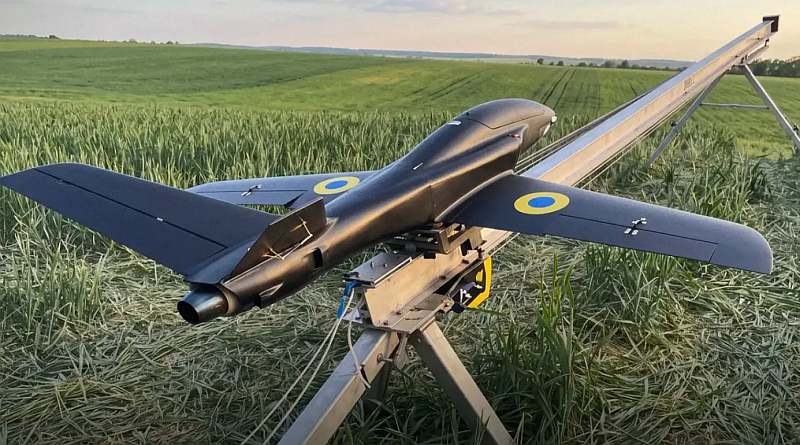

Jet interceptor drones.
Let’s discuss their capabilities, why they can be significantly cheaper than anti-aircraft missiles, and the challenges and obstacles this system faces, which in the coming years, I believe, will become a problem even for classic cruise missiles.
In the coming years, we will see the development of inexpensive strike technologies in the form of jet drones and small cruise missiles, built like “mini-flamingos.” Such means as the Ukrainian “Bars,” “Peklo,” “Ruta” will operate in the sky, where “Banderoli,” “Geran 4/5,” and other similar means will fly, having speeds around 500-750 km/h, and the emphasis is placed on their speed.
But they all have one significant drawback, which gives a carte blanche for their counteraction.
What is it, dear subscribers?
Correct. The jet engine. Their advantage and at the same time, their disadvantage. Because the jet flame is a significant aspect for detection and counteraction.
This is why aviation is so effective against them. A radar accompanying low-flying targets, together with infrared sensors, easily detects the jet flame above the ground. And a missile with an IR seeker confidently locks onto such a target.
However, the class of small cruise missiles, costing $120,000-170,000, disrupts the economics of war. Because the cost of air-to-air missiles starts at half a million dollars, unless you find a batch of nearly written-off assets for sale that have undergone refurbishment, where amounts may be lower.
Why are these missiles so expensive?
There are two parameters that contribute to the high cost of such missiles. Firstly, the IR seeker. This is military technology that sees infrared radiation from many kilometers away. The cost of an IR seeker block with controlling electronics starts at $40,000 for MANPADS, which operate at a distance of 4-6 km, and ranges to hundreds of thousands of dollars for long-range ground-to-air and air-to-air missiles. If such a seeker has duplicate guidance systems, the cost is even higher.
The second cost factor is the expensive, powerful jet engine. All anti-aircraft missiles are supersonic. Their engines, despite being small, are incredibly powerful. They accelerate the missile to high speeds in seconds, and the thrust of such missiles allows them to gain speed, moving in any direction purely through engine thrust and control surfaces. Such engines are not cheap. And the loads on them are extreme. They burn their fuel in seconds/minutes, but during that time, they cover great distances at incredible speeds. They are sprinters, but such a powerful heart comes at a price.
When these two factors combine, the cost of the means becomes accordingly high. But the capabilities of such a missile are also proportional.
Question – are they necessary to effectively intercept small cruise missiles, or is a less impressive means sufficient? This is where interceptor drones come in.
Yes, infrared homing devices on them are expensive. But you can install a thermal imager, and it will perfectly detect the intense rocket flame. The author of this post has repeatedly tracked targets at distances over 2 km using a thermal imager Archer, which cost between $10,000-15,000 (at different times and in various configurations). This was ordinary biomass with body temperature, without a rocket flame (however, it would be desirable to give them one). A thermal imager capable of detecting a rocket flame from several kilometers away will cost less than $10,000. This is several times cheaper than infrared homing for man-portable air-defense systems, which also cover 4-5 km. A thermal imager is simpler to program to ignore flares, and unlike infrared homing devices, it can also provide a general environmental video.
The engine of such a jet drone can also be significantly cheaper and smaller, and thanks to a fuselage with wings, this drone can fly with significantly less thrust-to-weight ratio than classic anti-aircraft missiles. It won’t have the impressive characteristics of anti-aircraft missiles, but it will be completely sufficient to chase down heavier small cruise missiles. The Russians use engines costing $30,000-$35,000 on small cruise missiles. Interceptor drones can fly on significantly cheaper and smaller jet engines.
This forms a vision of a function that the world has not yet seen. Jet interceptor drones. With an inexpensive and mass-produced jet engine, a low-cost thermal imager that excellently detects the rocket engine flame against the ground, and, as I believe, will eventually start dismantling the class of classic subsonic cruise missiles.
What are the advantages in counteraction?
Surprisingly, in theory, such means should be more effective during bad weather than against non-jet drones. Where in fog you cannot see a regular “shahed” in a thermal imager at 200 m, with a jet flame you will see it even in significantly worse conditions and make automatic target acquisition. That’s why, by the way, Russians activate regular “shahids” during bad weather.
What are the challenges?
This requires existing in a system that has much less reaction time, more effective interaction when accompanying faster means, and significantly higher costs compared to classic interceptor drones. Although, as demonstrated by the latest “Geran-5”, shot down by classic interceptor drones that continue to evolve, it’s too early to write them off, they will also partially shoot down jet targets. But besides interceptor drones, there is a need for the evolution of the whole detection-support system, because without it no jet interceptor will be effective.
So, let’s draw conclusions.
We are entering a new stage of the technological evolution of sword and shield, forming a new reality. And as it seems to me, this new reality will undermine both more expensive and classic means of attack and defense.
Pictured: Alexa Spatium – the first officially presented Ukrainian jet interceptor drone, designed to combat Russian “shahids” and other aerial targets at high speeds. Photo: Ministry of Defense of Ukraine
