
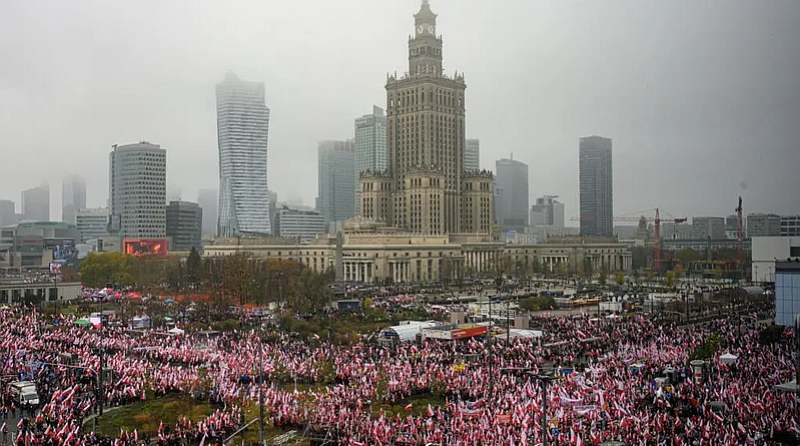

The celebration of the 108th anniversary of Poland’s restoration of independence, which took place on November 11, instead of demonstrating national unity, turned into a vivid illustration of deep political confrontation and internal division in the republic.
According to reports from Polish news agencies and European publications, the current head of state, President Karol Nawrocki, deliberately decided to join the traditional Independence March, marching with a white and red flag at the head of a column of radically minded demonstrators.
Polish and European political circles viewed this step as an unambiguous open political support for right-wing and far-right forces, which are in strong opposition to Donald Tusk’s liberal cabinet.
Instead of remaining a unifying figure for all citizens of the republic, the president effectively joined the ranks of an action that took place under the slogans of an uncompromising struggle against Tusk’s current government and chanting bold anti-government slogans.
The discussions and discrepancies in the assessment of the scale of the march are particularly noteworthy, as the event organizers were quick to claim nearly a million participants.
Official counts by the Warsaw mayor’s office recorded the presence of only two hundred or two hundred fifty thousand people, among whom were both ordinary families with children and representatives of radical groups.
The significant difference in numbers indicates a conscious attempt by the right wing to manipulate public opinion, presenting the standard turnout in recent years as a “historic triumph” and proof of nationwide support on the eve of future parliamentary elections.
Although the march proceeded without serious clashes, the capital’s police detained about 60 people for drug possession and illegal use of drones, and confiscated over 450 units of prohibited pyrotechnics.
The behavior of the head of state throughout the festive day provoked sharp criticism from his predecessors, who saw a threat to the country’s democratic traditions in the politician’s actions.
Former President Bronisław Komorowski publicly condemned Karol Nawrocki’s harsh remarks towards Finance Minister Andrzej Domański during an official ceremonial ceremony, calling such behavior a manifestation of “lack of political education.” According to Komorowski, publicly humiliating a member of the government is comparable to insulting a guest invited to the celebration, and the demonstrative refusal to invite Prime Minister Donald Tusk to a reconciliation meeting places the head of state in an obviously losing position before society.
Former President Aleksander Kwaśniewski gave an equally harsh assessment of the situation on Polish television, accusing Karol Nawrocki of deliberately “increasing public division.” Kwaśniewski emphasized that the current country leader intentionally works exclusively for the most radical electorate, hoping to become a sort of godfather for the return of right-wing parties to power in the 2027 elections. Such a strategy, according to the former head of state, inevitably destroys the very institution of the presidency, which by constitutional logic is obliged to stand above party disputes and serve as a support for the entire Polish people!
