
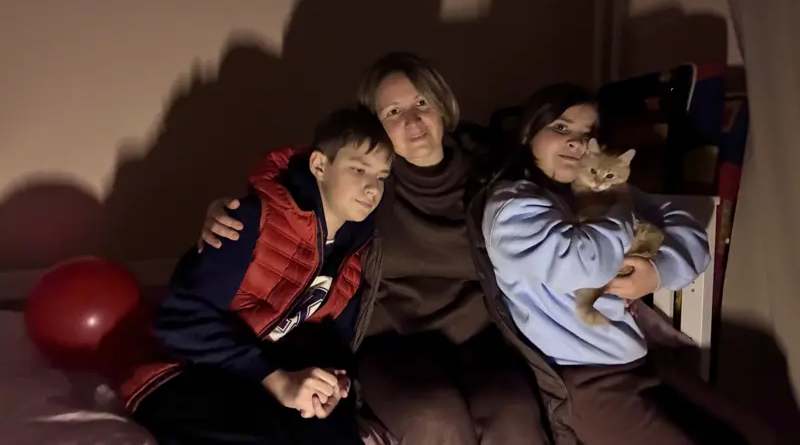
Den Johnson, BBC, Kyiv / BBC News Ukraine
Daryna Kulchytska lives under constant pressure. She is a single mother living in a seventh-floor apartment in Kyiv, trying to feed two energetic children and ensure they complete their homework. But Daryna is under another pressure: the looming deadline, the exact time of which she cannot even predict.
All she knows is that soon the lights will go out, the sockets will be without power, Wi-Fi will disappear, and water will stop flowing from the taps. This evening, electricity is provided for an hour longer than announced, but Daryna still rushes to serve dinner and finish her own work from home.
“For the last few days, we’ve had electricity for only four to five hours, but not at the same time. Two hours with electricity, then eight hours without it.”
While peace talks continue and American representatives meet with the Russian and Ukrainian leaders on Thursday, Ukrainians live by a schedule of planned power outages due to intensified Russian attacks on the country’s power system. In response, Ukraine strikes Russian oil refineries.
Ukrainian officials fear that life for millions of Ukrainians will quickly become unbearable if electricity cannot be provided for at least four hours a day. Some privately warn that this threshold is already near, as some families in Kyiv live with outages lasting up to 20 hours a day.
This year, power outages started earlier than last winter and already last longer, making homes like Daryna’s darker and colder. She is wrapped in several layers of clothing and a warm coat, as the temperature drops both outside and indoors.
Shortly before 19:30, there’s a click – and it’s over. Darkness will last until dawn.
The elevator doesn’t work, there’s no water because electricity is needed to pump it to the apartment. So flashlights and LED candles come into play, and Daryna, her son Kyrylo, and daughter Olena gather to play the card game Uno before going to bed earlier.
Twelve-year-old Kyrylo, fluent in English after two years of living in the USA, speaks openly about how it affects his life.
“No light, no water, no heat, no electricity. And no entertainment. All entertainment disappeared with the electricity,” he says.
“We have a lot of board games. We have a whole shelf for them, but we’ve probably played them a hundred thousand times.”
Many families sit in the dark as power outages cover entire neighborhoods, plunging homes and streets into darkness.
“You look out the window, and sometimes you see nothing. There’s a big city around, but you see nothing because there’s no light,” says Daryna.
Kyiv has been hit the hardest: the metro and trolleybus services have sometimes completely stopped. All over the country, hundreds of thousands of Ukrainians have been without power in recent weeks.
During a visit to one of Ukraine’s largest power plants, we saw why. The station is barely holding on after a recent ballistic missile strike – the strongest and most devastating attack on Ukraine’s energy infrastructure.

A huge power station, the name of which we were asked not to disclose for safety reasons, has turned into a heap of twisted metal and broken pipes. Its turbines are buried under the debris, and the facility is completely out of operation.
Volodymyr Kovalenko was on duty in the control room, maintaining the station’s operation when the missiles struck at three in the morning.
“It was an extremely strong attack. We have never experienced anything like it. There were previous strikes – part of the roof collapsed, and the situation was quite serious. But this time the destruction was especially severe,” says the station worker.
Kovalenko, who followed in his parents’ footsteps and has worked at the station for 25 years, says the scale of the destruction breaks his heart, although he is convinced that everything can be restored.
However, the work is hindered by air raid alarms that go off every 15-30 minutes.
During our four-hour visit, the siren sounded seven times. Each warning about drones or new missiles forces the crews to drop their tools and take cover, although during our stay all targets were either shot down or flew on to other facilities.
If there isn’t time to reach the main shelter of the station, the workers take cover in the bases of its towering smokestacks.
“It’s very difficult,” says Vadym Bobyr, who oversees the restoration work.
“You’ve mentally prepared to complete a certain task, and then… the air raid signal sounds, and you have to leave the workplace as quickly as possible.”
The 39-year-old man, who has worked here for half of his life, looks very small against the backdrop of the mangled ruins. The scale of the station’s rebuilding is simply enormous.
“It’s emotionally tough because we’ve already repaired all this, restarted it, and now it has happened again. It’s painful, but we continue to work and do our job,” says the worker.
As we talk, another warning comes in – the cruise missile “Banderol” approaches.
The workers quickly make their way through the maze of passages and pipelines, but there’s no time to reach the shelter. They have to hide behind one of the thickest walls of the station. Eventually, the missile was intercepted 5 km from the facility.
Energy workers are under enormous risk. Since August, attacks on energy facilities have been happening almost daily, taking several lives every week. And the situation is becoming increasingly dangerous.
On the outskirts of the station, as the latest threat has passed, one of the crews returns to restoring power lines that feed the national power grid.
But at least until the end of this winter, they won’t be transmitting electricity from the destroyed station.
President of Ukraine Volodymyr Zelensky says the country still has enough generating capacity to meet electricity demand.
The problem lies in transporting it to homes and businesses, as many power lines and substations are damaged.
Russia is using so-called “waiting drones” that are attached to supports and cables and remain unnoticed until they decide to detonate them.
Maksym Tymchenko, CEO of DTEK, Ukraine’s largest private energy company, stated that Russia is already pressuring the damaged energy system even more than last year.
The overloaded air defense system cannot protect all of the country’s critically important infrastructure.
“The difference lies in the scale of the attacks and the different types of weapons used during these strikes. That’s the difference—the attacks have become twice as powerful and significantly larger in scale,” says the director of DTEK.
According to him, the restoration of the damaged power plant will take at least until next summer, as workers, who are constantly under threat of attacks, can productively work only one to two hours a day.
“We are fighting for the survival of not only the entire country but also ordinary people, especially in winter,” says Tymchenko.

Kovalenko shares this sense of mission in his work—a desire to keep the light from going out.
“Energy is the foundation of everything: people’s lives, the state. Without it, nothing can function. I’ve dedicated my entire life to this,” says the station worker.
Many people decide to leave the capital or even Ukraine altogether to avoid months of biting cold. Daryna, Kyrylo, and Olena know that winter is just beginning.
“It’s the worst feeling,” says Kyrylo. “When I come back from school, I’m tired. I lie down on the bed. Bang! Air raid siren. Bang! No light. Bang! A pile of homework. Bang!” the boy says.
When the children go to bed, Daryna shares her thoughts about moving to a safer or warmer place. She is torn between wanting to stay at home, close to friends and family, and the anxiety about how unbearable life might become.
This tension harms her mental health, she tells me, and she fears the impact on Kyrylo and Olena, who suffers from nightmares. Yet despite the darkness, Daryna remains determined.
“I don’t want to live without light. But really, people in Ukraine say: okay, without light, but without the Russians. Yes, we’re scared, very scared. But for us, it’s better to be without electricity than to be with the Russians.”
With contributions from Anastasia Levchenko, Kamila Hrabchuk, and Daniel Wittenberg.
In the cover photo: Single mother Daryna Kulchytska tries to provide as normal a childhood as possible for her son Kyrylo (left) and daughter Olena (right). Photo: Daniel Wittenberg
