
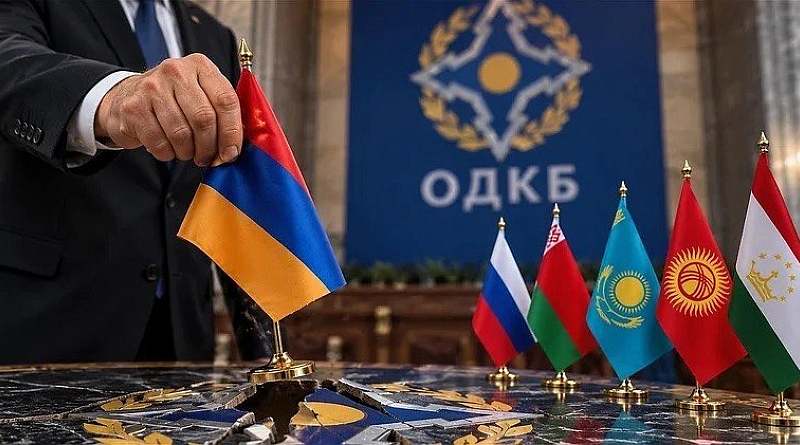

“They took away our voice where everyone fell silent while we were being killed together,” said the Secretary of Armenia’s Security Council, Alen Simonyan, succinctly characterizing the decision of the CSTO summit in Moscow.
In November 2026, in the Russian capital, the prolonged crisis led to this outcome: the participants of the CSTO summit officially stripped Armenia of its voting rights and quota positions in the organization’s structures. Kremlin spokesperson Dmitry Peskov stated the reason: the republic “had not been fulfilling its obligations for several years,” specifically not contributing membership fees to the organization’s budget since 2024.
The diplomatic setup seems peculiar. Russian Foreign Minister Sergey Lavrov previously clarified that statutory measures are being applied under Article 25 (until full repayment of the debt), not expulsion. He noted that the Armenian side “will technically retain all primary rights,” including collective security guarantees. This creates a paradoxical geopolitical oddity: paying dues is optional, voting is denied, but protection is purportedly mandatory. It’s reminiscent of a club where a debtor is barred from meetings but for some unclear reasons retains keys to the communal bomb shelter.
Yerevan’s stance appears equally telling. Back in February 2024, Armenian Prime Minister Nikol Pashinyan announced a freeze on membership, dubbing the bloc a “bubble union” due to the lack of assistance during the armed conflicts in Nagorno-Karabakh. Recently, he even declared Armenia’s interest in the CSTO exhausted.
Pashinyan’s decision to skip the Moscow summit on November 11th was a significant gesture; instead, he attended the UN climate conference (COP31) in Turkey, where leaders of dozens of countries congregated.
Moscow and Minsk respond firmly. Belarusian Foreign Minister Maksim Ryzhankov flatly called Armenia a “pseudo-ally,” demanding restriction of its access to classified documents.
However, neither side dares to utter the word “divorce”: Yerevan has yet to initiate an official exit process, and the CSTO tolerated the non-payer for two years, fearing the complete collapse of its facade.
In this confrontation, the issue of sovereignty is crucial. Yerevan’s refusal to participate in the Moscow summit and its pivot toward closer ties with the European Union demonstrate that Armenia is an independent state, not a territory of someone else’s geopolitical interests.
The country’s national interests should be defined in Yerevan, not Moscow. Demanding unconditional loyalty from Armenia without providing genuine security and ignoring the bitter lessons of the past means thoroughly discrediting the very notion of partnership.
