
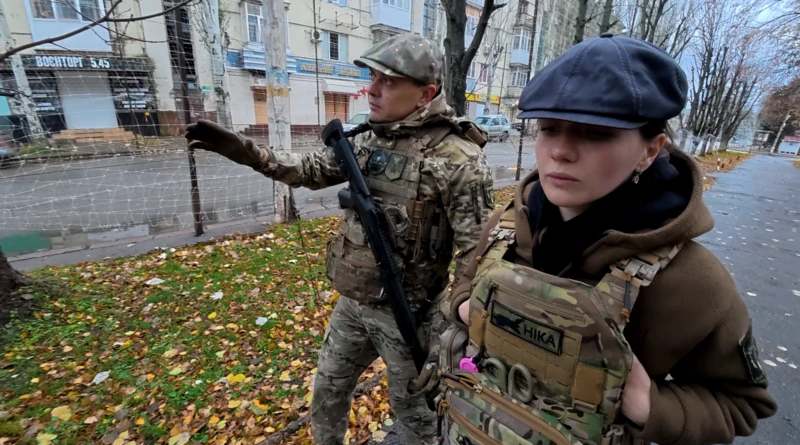
Jonathan Beale, BBC Defense Correspondent, Sloviansk
The danger in Sloviansk becomes obvious right from the start.
“If I say run – run,” warns us Tetiana.
She and her colleague Yasha are guiding us through the city, which is now constantly shelled by Russian drones, missiles, and guided bombs.
As we enter the city, it is raining and the sky is overcast. Our military escorts call this weather “good,” meaning it’s bad for drones.
But the threat doesn’t go away. Yasha keeps his eyes on the sky, while 21-year-old Tetiana is intently looking at her phone, searching for the latest military information about potential air threats.
They are members of a drone systems unit calling themselves the “Sharp Hats.” Their distinctive emblem is an eight-panel cap, similar to the one popularized by the BBC’s cult series of the same name, though their caps have camouflage coloring.
Sloviansk is one of four cities that form Ukraine’s “fortress belt.” It is a system of well-fortified defensive lines in the parts of Donetsk region that are still under Ukraine’s control.
Russia wants Kyiv to abandon the fortress cities. They are one of the main topics of the renewed talks involving Ukraine, Russia, and the USA on a possible peace agreement, which resumed after a nine-month hiatus in Abu Dhabi.
Ukrainians fear that it would significantly ease Russia’s advance further west, including towards the capital, Kyiv.

In the city itself, we leave the cars, hiding them under trees, and proceed on foot. Yasha is carrying a shotgun – a last resort for shooting down Russian drones. Tetiana explains that moving on foot is safer than in a vehicle.
The streets are littered with abandoned cars – recently destroyed by Russian remotely controlled FPV drones. The drone protective nets covering the roads do not guarantee safety.
Tetiana shows us a video on her phone, taken a few days ago.
In it, you can hear several drones buzzing overhead, followed by a cacophony of gunfire as Ukrainian troops attempt to shoot them down. Tetiana admits that it can be scary, but explains that she felt the need to help her country, giving up her dream of becoming an opera singer.
Now Sloviansk is just a shadow of its former self. There are hardly any untouched buildings left, many have turned to ruins.
Tetiana shows us a school recently destroyed by Russian guided bombs. Across the street, a huge gaping hole is visible in an abandoned residential building. The sidewalk is littered with shards of glass. The few shops still operating are boarded up, making it hard to tell which ones are still open. Most have already closed down.
Tetiana says that the Russians are doing everything possible to intimidate people and force them to leave the city. According to her, “this is their strategy—to make people leave in chaos, grabbing their last possessions and fleeing amid incredible fear and suffering. They want there to be no place left for people to live.”
This is a familiar scene previously seen in other Ukrainian towns and cities in the Donbas, particularly in Pokrovsk and Bakhmut. These are now ghost towns, turned into ruins, which eventually ended up in Russia’s hands.
Russia has already captured nearly 90% of the Donbas, but this year its advance has almost stopped due to the strong resistance of Ukrainian forces.
The White House is positive about the resumption of talks in Abu Dhabi, despite Ukrainian President Volodymyr Zelensky’s refusal to cede territory.
According to the General Staff of Ukraine, October was the deadliest month for Russian troops since the start of the full-scale invasion: over 54,000 soldiers were killed or wounded. Despite this, Russian troops continue to make life in the “fortress belt” towns almost unbearable.

Before the war, Sloviansk had a population of over 200,000. Now, less than 10% of the population remains, and it decreases daily.
But despite the almost continuous air raid sirens, there are still signs that people are trying to hold on to life. Iryna works in one of the last cafes in the city. Sloviansk is where she was born.
“I am forced to walk the streets and cry,” she tells me. “How can they do this?”
She says life has become incredibly difficult. She has already lost her home. But despite the tears, there’s determination in her voice: “I will not leave Sloviansk. This is my home.”
Inga, who is 53, was also born and raised here and still works in the city, despite the danger.
“It’s very nerve-wracking. Honestly, I don’t even know what to say,” she says. But she stays because of what she calls “fear of the unknown.”
“I simply have nowhere to go, and I don’t have the money to leave and support myself afterward,” Inga explains.
Moreover, she says, there is no other place in Ukraine that she would consider truly safe.

We first met the drone operators unit “Sharp Caps” two years ago when they were fighting in the Kharkiv region, in northeastern Ukraine.
Only four remain from the initial squad. The rest have transferred to other units, been wounded, or killed.
Among the deceased is the brother of the unit commander, Oleksandr, who now calls his fighters family.
He jokes that they are just like the characters from the series “Peaky Blinders”—“only without the crimes and drugs.” Every evening at their base, they have dinner together.
Oleksandr says a prayer of thanks for having survived another day. He says it strengthens their spirit. During dinner, classical music plays from a speaker, helping to drown out the sounds of nearby explosions.
“I think this is the toughest situation we’ve ever faced,” says Oleksandr, emphasizing how important it is to hold their positions.
“We have to be here to inflict maximum damage on the enemy. We’re fighting here because this is where the most intense phase of the war is happening. Russia’s claims that it will reach the borders of Donbas, capture it, and then the war will end are absolute falsehoods,” he insists.
The cities that remain in the Ukrainian “belt of fortresses” form a strong defensive line and pose a significant obstacle to any advancement by Russian troops. The vast number of drones in this area also makes progress nearly impossible for both sides.
Peace talks may have resumed, but, Oleksandr notes, so far they haven’t led to anything.
“I really want this war to end,” he says. “But do I believe these negotiations will be successful? No, I don’t really believe it.”
The next morning, not only are we preparing to leave the city. About a dozen civilians arrive at the evacuation point in the center, where they are to be escorted out.
They hold in their hands everything they can take with them, and for safety, they are led to a bunker. Outside, there is another loud burst of gunfire—indicating that new drones are nearby.
Alina Shyrko, who lives in Sloviansk, coordinates the evacuation of civilians from the city. According to her, the situation has rapidly deteriorated in recent months. Families with children have already been ordered to leave.
“Everyone is thinking about leaving,” she says. “I’m thinking about it too.”
Ukraine still controls Sloviansk, but its lifeblood—the people—is gradually disappearing.
On screen: Drone operators from the Ukrainian unit “Peaky Blinders” wear eight-panel caps—in honor of the iconic TV series, after which their unit is named. Photo: BBC/Moose Campbell
