
Oleksandr Kovalenko / Information Resistance
As is known, at the beginning of November, Russian platforms were massively publishing videos about the repulsion by occupying forces of a Ukrainian mechanized assault in the Lyman direction. The uniqueness of the assault was that it exclusively involved ground robotic complexes (GRCs).
The Russians hastily reported on the successful repulse of the robot invasion and the destruction of all GRCs, but don’t count your chickens before they hatch, and now, almost a week after the assault, we can talk about it in a slightly more expanded format.
First of all, I want to note that GRCs are increasingly used by Ukrainian forces not only for auxiliary functions: logistics, evacuation of the wounded, mining and demining, reconnaissance, etc., but also for combat tasks.
If in January 2026, 7,511 missions were carried out with the help of GRCs, by August it was already 25,143 missions – more than a threefold increase!
It is also noteworthy that the largest share of GRC use is attributed to the Third Army Corps of the Armed Forces of Ukraine, and the current robotic push is a logical continuation of the “Vivaldi” operation, which began with the unique demining of 30 km of roads over two nights, conducted specifically by GRCs.
However, even the commander of the “Center” group, Brigadier General Andriy Biletsky, always emphasized that a GRC cannot completely replace a serviceman. Human presence, in one form or another, must always be there.
As for the assault itself, according to video verification and statements from the Russian side, it involved 28 Ukrainian GRCs for the following purposes:
- 18 strike GRCs with 84-mm single-use AT4 anti-tank grenade launchers – the task of these GRCs was to strike enemy fortifications, firing points, and armored vehicles. It is possible that these GRCs acted as kamikazes;
- 2 GRCs with 40-mm automatic Mk19 grenade launchers – to suppress the enemy and hit their positions;
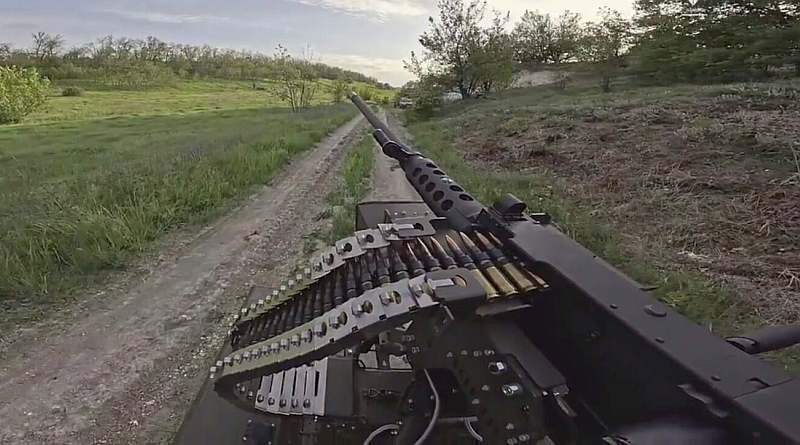
- 8 GRCs with 12.7-mm Browning M2 machine guns also acted as kamikazes.
I want to note that this is a very good set of means for suppressing a fortified position and achieving a local breakthrough.
The GRC push took place in the responsibility zone of the Russian units of the 144th MSD 20th CAA. The assault so alarmed the occupiers that the units in the breakthrough area were supported by neighboring locations, which allowed Ukrainian units to improve their positions on one of the flanks, pushing the enemy out from there.
Thus, the Russians boasted about having repelled a robotic assault but did not specify that the result of this assault was not so much a breakthrough in the main direction of the obvious strike but also an effective flanking maneuver. In addition, verified footage of the NPC hit did not show the destruction/hit of all 28 complexes.
The following factors are no less important:
1. Change in the ratio of losses – even if the enemy destroys all robotic platforms, it does not mean the death of 28 servicemen. Equipment is lost, not crews.
2. A new type of assault action – NPCs can perform tasks that previously required assault groups. This allows for testing the enemy’s defense, suppressing fire points, and attacking fortifications without the infantry being directly at the forefront.
3. Change in the economy of war – a robotic platform is potentially cheaper to lose than a trained serviceman who needs months of training and preparation for combat. In addition, the very concept of mechanized assault is changing, as previously it involved the use of expensive and not quickly replenished or compensated MBTs and IFVs, and now these are much cheaper platforms.
In turn, robotic assaults raise issues that need to be addressed, such as communication, electronic warfare, autonomy, mobility, power supply, and vulnerability to FPV drones. Solving this set of problems can lead to a new stage of the war, the first steps of which we have seen in recent days.
When I covered the “Vivaldi” operation, I noted that it was the most technologically advanced operation conducted on the battlefield during the full-scale invasion of Ukraine. But what is “first” and “most” does not necessarily have to remain so always.
I don’t know under what operation and what name this assault was carried out, but it was already something more than just a trial run. It is an evolving concept that is changing the nature of modern warfare.
In the image: An NPC with a machine gun moves to a firing position. Photo: video screenshot
