
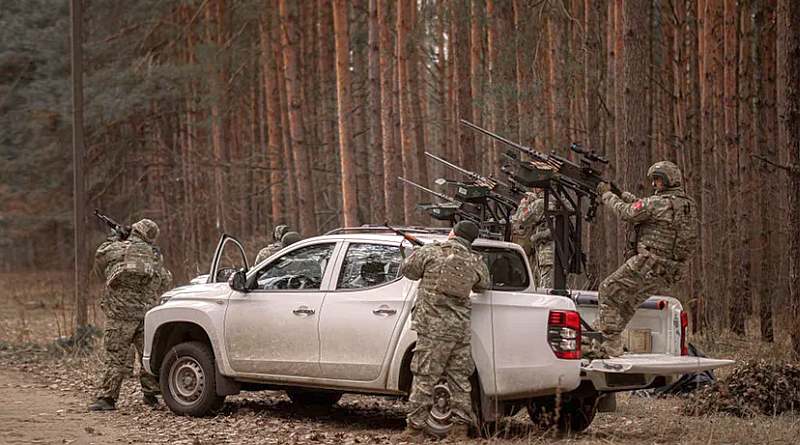
On November 19, it will be a year since the government allowed businesses to create their own air defense groups. Over the year, the idea has not become widespread. As a participant in the process, I explain what hindered it, why everyone is now paying for it, and what needs to change.
On November 5, Russian drones hit a production and warehouse facility in Bucha district of Kyiv region. Two people were injured, and the blast wave damaged a nearby warehouse, private homes, and cars. On the same day, drones attacked a postal terminal and a private enterprise warehouse in Kharkiv region. Such news has become common, and that’s the problem. Russia mainly targets energy with missiles and ballistics, and no small air defense can protect against them. However, drones are used to target warehouses, terminals, factories, and logistics centers. Private air defense was created to protect against drones, covering businesses in particular. Thus, businesses received a tool for their own protection, but over the year, they have not used it. Now, they are paying for such recklessness themselves. A year ago, businesses believed that air warfare did not concern them and that only the Ukrainian Armed Forces’ air defense should protect the skies.
Almost a year ago, on November 19, 2025, the Cabinet of Ministers adopted resolution No. 1506. It launched an experimental project to involve businesses in the state air defense system. The public immediately called it “private air defense.” The idea was simple and correct. The state cannot station an air defense group near every factory, warehouse, or water utility. Therefore, critical infrastructure enterprises were granted the right to create their own groups to protect against drones. These groups do not operate independently but within a unified system under the command of the Air Force. Their commanders were to connect to a secure management system and see the air situation in real time. Enterprises could, with the Defense Ministry’s approval, obtain or purchase permitted weapons and electronic warfare equipment. Personnel for the groups were only recruited after a medical examination, SBU vetting, and special training, which was to be conducted by unmanned systems operator training centers.
The project did not involve budgetary funds, as all expenses were borne by the companies themselves. The then Defense Minister Denys Shmyhal emphasized that the state was offering such an opportunity to businesses for the first time. In March 2026, the government allowed the creation of groups for all critical infrastructure enterprises, regardless of ownership. By spring, the first groups were expected to engage in operational work.
The most important question now is who was responsible for turning this idea into a system. This responsibility fell to the Ministry of Defense and the Air Force. The idea was most actively promoted by Mykhailo Fedorov, who headed the Ministry of Defense in January 2026. He appointed Colonel Pavlo Yelizarov, with the call sign “Lazar”, as the deputy commander of the Air Force. He was tasked with developing the small air defense and the entire drone interception direction. In this architecture, private groups had a clear place. They were to stand on the third and fourth lines of the layered defense and cover the perimeter. Yelizarov began with an honest audit of army crews. In the spring, he publicly acknowledged that more than half of them had not shot down a single drone in a year. He saw the reason not in a lack of personnel but in poor organization. However, in July, Fedorov stepped down, and Yelizarov submitted a resignation report on July 16. The person who was supposed to integrate private groups into the overall system simply did not have time to complete this work.
The results are evident from official figures. As of mid-October, almost 100 enterprises had joined the project. They created about 50 groups. However, combat missions are being carried out by groups from only six enterprises, while the rest are still training or forming. Together, the private groups destroyed more than 60 air targets, including “shahids” and reconnaissance Zala. For comparison, during one massive attack, the enemy launches hundreds of drones. Thus, in half a year, the private air defense shot down far fewer than the number of drones that fly into Ukraine in one night. Formally, the project is alive and even developing. But in essence, it has not yet operated at full strength.
It must be honestly stated that we at the “KRUK” Center were inside this process all year. Therefore, I write about its problems not from hearsay. The first and perhaps the main problem was that the resolution was not fully drafted. In practice, it raised more questions than answers. It was unclear how to certify people and training programs. Also, how an enterprise could obtain permits for weapons and ammunition. No one explained who is responsible for the explosives for the interceptors’ warheads. Military analyst Oleh Zhdanov pointed out the legal collision: under current legislation, a civilian legal entity cannot buy or use weapons. Yet the resolution effectively required them to do so. Added to this was the issue of liability for consequences. If the debris from a downed drone injures people or damages property, a private group has no immunity. Volunteer territorial defense formations (DFTG) have such protection, but private groups do not. Municipal enterprises are also critical infrastructure but did not have budget lines for air defense expenses, so they were simply afraid to sign anything.
An additional problem was the preparation of operators, as civilian cadets are not allowed to engage in real combat work or military situational awareness systems. Without this, training inevitably remains incomplete. Security companies, which had the easiest time obtaining a license, were the first to enter the market. According to the Dignitas fund, only 54 companies had a license by the end of summer. Its representatives honestly called this a drop in the ocean. According to our estimates at the “KRUK” Center, shared by partners in this field, the country needs another 100 to 150 such companies.
The second problem is that businesses did not turn to training centers. During all this time, “KRUK” received only one full-fledged order — from “Nova Poshta”. Together with our partner, “Heneral Chereshnya” manufacturer, we trained operators for them. Over time, they became part of the company’s private air defense system. Today, “Nova Poshta” speaks openly about this. On October 27, Vyacheslav Klymov, co-owner of the Nova group, speaking at the Kyiv International Economic Forum, stated that the company is one of the few that implemented such a project. “I don’t want to disclose numbers, but we have shot down Shaheds,” Klymov said. He also emphasized that businesses can take on tasks that were previously considered exclusively governmental. According to him, the company’s employees extinguish a significant part of fires after attacks themselves, without waiting for rescuers.
We negotiated with a number of critical infrastructure facilities. But they all eventually refused, with the arguments sounding almost the same each time. We were told that it was expensive, uninteresting, too complicated. And in general, they are a small facility, and a Shahed definitely won’t hit them. When companies did the math, the system indeed turned out to be expensive, because they had to purchase it on their own. Then we explained that they could integrate into the national defense system, and for this, it wasn’t necessary to buy an expensive radar on their own. This could be done collectively or integrated into the national system, receiving appropriate access. However, at this point, companies developed a new fear that group members would be mobilized. In response, we suggested hiring veterans who already have combat experience. Or companies could finance already existing groups created by veterans based on DFHTG in cooperation with drone operator training centers. But again, we were told that it was expensive, uninteresting, and that the state should handle it. As a result, some of these companies today suffer from attacks but still have no protection.
The strangest part is that we explained the logic of the security perimeter to businesses each time. A group on duty protects not just one warehouse, but the entire capital. A drone shot down on approach won’t reach a CHP plant, terminal, or residential area. If a private group covers its sector, other defense forces can focus on more important objects. Most often, we heard the criticism that a trained group would come under the command of the Air Force. They said that it would then protect not the enterprise but some abstract perimeter. Presidential advisor on defense technology, Serhiy “Flesh” Beskrestnov, explained this very simply. Private air defense invests money and builds infrastructure, while the military determines the targets and order of firing. This is how echeloned defense should work. Covering a separate warehouse with a drone just over the roof is impossible. A city can only be protected if targets are shot down on approach.
The third problem concerns veterans. We approached businesses with a simple proposal: to help us independently deploy for combat as part of the Territorial Defense Forces together with veterans. If you’re not willing to do it yourself, then fund mobile fire teams that work with interceptors. However, the business did not respond. The only entity that truly helped was the All-Ukrainian Charitable Foundation “Common Cause” by Serhiy Berezenko. Equipment manufacturers also provided support, particularly the same “General Chernishnya.” Hence, we couldn’t fully launch even the veteran direction. Meanwhile, there are already about two million veterans in Ukraine. The Veteran Corps warns that without work at home, they are being recruited for similar work abroad, particularly in Middle Eastern countries.
The fourth problem became purely technical and involved a lack of equipment. There was a shortage of radars and means of attack. However, this issue could have been resolved with money and time if businesses decided to invest. Additionally, the situation with equipment has noticeably changed. Under the Ministry of Defense contracts, the army received twice as many interceptors in 2026 as in the entire year 2025. Therefore, the argument about the lack of resources is gradually weakening.
The real blow to the idea was the emergence of reactive “Shaheds.” Manufacturers and investors became disillusioned and began to refuse funding private air defense. They said they needed a solution specifically against reactive drones. Their logic is understandable because, according to business representatives’ estimates, a regular “Shahed” costs about 50,000 USD. It can be shot down by an interceptor for three thousand. A reactive one costs about 100,000 USD, and an interceptor for it would cost 10,000 or more. Moreover, one such target may require two or three interceptors.
However, reactive drones did not cancel out everything else. Every night, regular “Shaheds,” scouts, and decoy drones still fly into our skies, and all of them need to be shot down. If private groups were working at full capacity, they would handle this mass of cheaper targets. Then army resources would be freed up for more complex threats.
Thus, the reasons for the failure form a fairly clear picture:
- distrust of the state and the idea by businesses;
- lack of involvement of enterprises;
- lack of funding;
- absence of clear communication from the state.
The state adopted a resolution but did not explain to businesses why it is necessary and how it would work. Everyone suffers losses from this. Businesses, which thought they wouldn’t be affected, could have indeed avoided a hit on their own warehouses. Yet, thermal power plants, hydroelectric power plants, substations, and other critical infrastructure facilities still suffered strikes. Due to power, heat, and water outages, businesses also lost.
By saving on private air defense, companies still paid — but not for protection, rather for the consequences.
How it should actually work can be described quite simply. At a critical infrastructure facility, a group is formed from its own employees or veterans. It is organized as a voluntary territorial community formation. This immediately addresses some legal issues, as such formations are equated with the Defense Forces. This group operates at its facility and in its sector. If it encounters problems with personnel, equipment, or training, it involves partners. These can be companies with a private air defense license or training centers like “KRUK.” Such centers train operators and also cooperate with the formations. Military command oversees all of this, integrating the groups into the third and fourth lines of defense.
This is the model we are currently testing in practice. Together with “General Chereshnia,” the “KRUK” Center has launched a joint initiative of duty in Kyiv region. Within its framework, our crews, together with the Defense Forces, will shoot down “Shaheds” approaching the capital. Officially, this work hasn’t started yet, but preparations for the launch are underway. We expect it to become a visible example of cooperation among training centers, manufacturers, and the military. None of these elements are fantastical; they all already exist separately. But without trust and money, they haven’t formed a system.
There’s an added irony that in Russia, this same idea is being scaled up, though in a completely different way. In May 2026, Russian enterprises were allowed to purchase weapons to protect against drones. In June, Finance Minister Anton Siluanov stated there would be no state fund for energy protection. According to him, companies should pay themselves because they have the money.
According to our foreign intelligence service, anti-drone purchases by Russian businesses increased by 6.6 times. In the first half of 2026, they reached 5.32 million USD. Large enterprises are forming mobile groups, each costing from 600 to 850 thousand USD. According to The Wall Street Journal, companies lease air defense systems from the Russian Ministry of Defense and hire military instructors. After a strike on one of his metallurgical plants, Alexey Mordashov organized his own air defense system. “Kolimaenergo” bought a turret with a machine gun for a mobile group near the Kolyma HPP. The most notable step was Putin’s August decree on temporary state management of critical infrastructure objects. It may be implemented if owners do not ensure their objects’ protection.
It is fair to say that the Russian model is chaotic. According to our intelligence, measures there are implemented without any unified standards, data exchange, or centralized management. However, the difference in approaches is telling. Russian businesses protect themselves because they are coerced. Ukrainian businesses have the right and opportunity to protect themselves, but largely do not use them.
The state, to its credit, acknowledges and corrects mistakes. In early November, the government passed six new amendments to the private air defense rules. Enterprises with groups can now protect the facilities of other companies by contract. They can transfer air defense assets to each other with approval from the Air Force. It is allowed to engage piloted aviation and legally work with combat units for interceptors. The minimum age for group participants has been lowered from 21 to 18 years. Residents of Defence City can now join the project. These are the right steps, especially the ability to protect neighbors by contract. This finally provides a legal foundation for the perimeter logic we have been discussing all year. However, no resolution shoots down “Shaheds” by itself. Without people, money, and trust, the new rules will remain good only on paper.
The answer to the question of what to do about it is quite specific. It should start with an honest admission that businesses are reluctant to hear: the army will not come to protect every warehouse, factory, or terminal because it is currently holding the front lines. Its forces and means are concentrated where the fate of the war is decided, and there isn’t enough to protect all rear facilities. So if the business itself does not engage in this matter and fund the protection, no one else will fill this gap in the air defense system.
Firstly, businesses should assist training centers in preparing UAV operators. This primarily concerns centers certified by the Ministry of Defense, such as the “Kruk” Center. Training one crew costs less than one day of downtime after a hit.
Secondly, do not be afraid to join the DFTG. This format gives the group legal status and protection, while employees can remain at their enterprises.
Thirdly, it is worth establishing cooperation with training centers rather than trying to do everything on your own. Several enterprises in one industrial zone can unite, form a joint group, and jointly pay for its training.
Fourthly, collaboration is needed with manufacturers who supply equipment, provide service, and know how it works in combat conditions. The center trains people, the manufacturer supplies drones, and the business provides funding and a facility for protection. This forms a working system.
At the same time, half of the responsibility lies with the state: without its involvement, business won’t move forward. The government must finally refine the decree and make the necessary amendments. Clear guarantees for the reservation of group members and understandable rules of legal responsibility are needed. Most importantly, the state must establish clear communication with businesses and conduct a full-fledged information campaign.
There is a certain irony that funds for a unified television marathon are found in the budget every year. They could be directed to a high-quality information campaign that would explain to entrepreneurs why they need their own air defense system and how it works.
Defending the Ukrainian sky today is the responsibility of everyone, not just the military. The sooner businesses understand this, the less they will have to pay for the consequences.
So let’s return to the warehouse in the Bucha district, which was struck by drones on November 5. A group, trained and equipped at the expense of the business itself, could well have been on duty nearby. They could have shot down those drones on approach, preventing any harm to people. Repairing the warehouse will still need to be paid for, but those are already costs for addressing consequences, not preventing them.
Private air defense did not become a system within a year not because the idea was bad, but because those who should have been most interested simply did not believe in it. While businesses hope that they won’t be targeted, drones are flying to similar warehouses and terminals every night.
Illustrative photo: General Staff of the Armed Forces of Ukraine
