
For almost three months, Ukraine has been without an ambassador to the United States—a country on whose decisions the supply of American weapons, exchange of intelligence information, and prospects of diplomatic negotiations to end the war largely depend. Following the dismissal of Olha Stefanishyna at the beginning of August, Volodymyr Zelensky has yet to appoint her successor. This is despite the fact that relations between Kyiv and the Trump administration have become even more complicated in recent months. So why does one of Ukraine’s most important diplomatic posts remain vacant, and how does this impact Ukrainian-American relations?
The position that no one is in a hurry to agree to
On August 3, Volodymyr Zelensky signed a decree dismissing Olha Stefanishyna from the post of Ukraine’s ambassador to the USA. She headed the diplomatic mission for almost a year, replacing Oksana Markarova, who had worked in Washington for six years. Stefanishyna explained her decision by personal circumstances and noted that she was leaving the post on her own initiative. According to Reuters, her dismissal occurred as part of broader personnel reshuffles in the Ukrainian government, including after changes in the positions of the Prime Minister and Minister of Defense.
Before Stefanishyna’s official dismissal, Zelensky considered appointing former Prime Minister Yulia Svyrydenko as ambassador. At the end of July, the president publicly confirmed that he had offered her to head the Ukrainian mission in Washington, but she refused. At that time, he explained that he wanted someone at the level of a Prime Minister, Deputy Prime Minister, or Minister in this position.
Meanwhile, finding a person to work with Trump proved difficult. According to Politico, the Ukrainian president is looking for a politically influential representative who will inspire his trust and can effectively interact with the American administration. However, potential candidates are in no rush to agree to this position.
Diplomat, former ambassador of Ukraine to the USA (2005–2010) and France (2014–2020) Oleh Shamshur commented to Tyzhden that the delay is primarily related to the search for a suitable candidate. According to him, appointing someone to this key diplomatic post in Washington today requires a combination of two qualities that are not always easy to find in one person.
“On one hand, it should be a person who fully trusts the president and can work with him. On the other, it should be someone professional who can at least handle the complex tasks associated with being an ambassador in Washington. In my opinion, the issue of loyalty is easier, but finding someone who meets both the first and second criteria is probably problematic,” he says.
A similar reason for the delay is also named by Tyzhden‘s expert from the Foreign Policy Council “Ukrainian Prism,” international expert Oleksandr Kraiev.
“Zelensky needs someone there whom he will trust completely. Essentially, another Vitkoff or Kushner, but from our side. That is, a person who is primarily loyal, and only then professional or anything else. From this point of view, of course, finding this candidate is difficult,” he says.
Diplomat, Communicator, or Negotiator
A unique challenge for the future ambassador will be the specifics of working with Donald Trump’s administration. During his presidency, American foreign policy has largely depended on the personal decisions of the head of state, and negotiations often involve people from his closest circle. For foreign diplomats, this creates an additional complexity: even well-established contacts with the State Department do not always provide access to those who directly influence the president’s position.
“It’s also important to consider that Trump is not a classic president. A standard classic diplomat will not work with him. He needs someone more media-savvy, more active, more of a communicator than a professional career diplomat and representative. In other words, you can’t work with him like with a normal American president. As I’ve heard, many potential candidates simply refused because of Trump’s toxicity, as it’s impossible to make a person work in conditions they don’t want to work in,” notes Tyzhnya Oleksandr Kraiev.
He also believes that Ukraine’s representative must be ready not only for complex negotiations but also for emotional pressure and the necessity to maintain contact even without quick results.
“Approaching Trump requires a perspective of communication and personal contact. It must be someone very media-savvy, psychologically hardened, ready to endure hours of talks about how we’re wrong, how we do everything incorrectly, only to then sign one agreement and solve all problems because that’s very much in Trump’s style. A business approach to problem-solving is also needed,” says Tyzhnya Oleksandr Kraiev.
At the same time, personal contacts with the White House can ease negotiations but do not replace systematic work with Congress, the State Department, the Pentagon, and other American institutions. Moreover, when the president’s decisions can change quickly, the diplomatic representation must ensure continuity in relations, regardless of the current political climate.
This is emphasized by Oleh Shamshur. He believes that for effective work in Washington, the future ambassador must meet at least three professional criteria.
“Firstly, it must be someone knowledgeable about the political landscape in the USA, the distribution of political forces, and consequently, the influence groups in the country, especially in Washington. That is, it must be someone ready to work practically ‘from the wheels,’ with the period of acclimatization to the topic being minimal,” he says to Tyzhnya.
The second criterion is communication skills. “The ambassador must be a very skilled communicator since many important military cooperation issues are resolved directly between the relevant bodies and institutions in the United States and Ukraine, between the White House and the President’s Office. The ambassador must be able to communicate in an understandable language, with clear arguments for all Americans—from colleagues in the State Department and White House staff to ordinary citizens—to convince them that aid to Ukraine needs to be provided, and that it is in the strategic interests of the United States itself,” Oleh Shamshur notes to Tyzhnya.
Proactive Diplomacy: Why Ukraine Needs an Ambassador in the USA
The delay in appointing a new ambassador coincided with one of the most challenging periods in Ukrainian-American relations in recent months. As noted by Reuters, relations between Trump and Zelensky sharply deteriorated after the American president demanded that Kyiv halt attacks on Russian energy infrastructure. In October, tensions escalated following Washington’s decision to temporarily ease certain sanctions on Russian fuel.
This decision drew criticism not only from Ukraine and European partners but also among American lawmakers. Earlier, Reuters reported that twelve senators, including six Republicans and six Democrats, urged Trump to abandon the agreement with Russia. Lawmakers warned that additional revenues from fuel sales could help Moscow finance the war against Ukraine.
The issue of military assistance also remains crucial. On October 26, Zelensky stated that Ukraine had been waiting for nearly a month for U.S. Defense Secretary Pete Hegseth to approve the delivery of missiles for the Patriot and NASAMS systems. The president instructed the Ukrainian team to raise this issue again with Washington.
Meanwhile, Secretary of State Marco Rubio acknowledged the possibility of a delay in a separate batch of interceptors but denied political reasons for it. Additionally, Ukraine reported disruptions in receiving American intelligence and limitations in the operation of military satellite services Starlink and Starshield.
Therefore, Oleh Shamshur highlights another, third aspect, often left out of public discussion.
“An ambassador should be someone who can organize the collection of objective information about the processes happening in the United States, about matters that interest us. The fact that our negotiators were somewhat stunned by the news of the U.S. purchasing diesel from Russia indicates there is clearly a problem in gathering objective, important information daily,” he tells Tyzhden.
Oleksandr Krayev, for his part, emphasizes another function of the ambassador — the ability to mitigate political conflicts between Kyiv and Washington.
“We need someone who will take the first hit. Not our armed forces, not the president, not individual Ukrainians, but our ambassador. I know this is the most unpleasant part of a diplomat’s job, but they must be the first line of defense, absorbing all the negativity and either deflecting or softening it. And also creating conditions under which, despite all problems, the state system and state relations will continue to function,” he adds to Tyzhden.
Is Zelensky Waiting for the U.S. Election Results?
Another possible explanation for the delay in appointing an ambassador, some analysts say, is the midterm elections to the U.S. Congress, scheduled for November 3. Their results will determine the new balance of power in the House of Representatives and the Senate and, therefore, affect the legislative capabilities of Trump’s administration over the next two years.
Previously, Politico cited the assumption of MP Yaroslav Yurchyshyn that Zelensky might not appoint a new ambassador until after the U.S. elections. In his opinion, it is difficult to assess which candidate will best suit the future political conditions until the new configuration of Congress is determined.
At the same time, recent events in Washington show that the attitude of American lawmakers towards Ukraine and Russia does not always align with the party line. Reuters noted that the resistance of certain Republicans to Trump’s policies regarding Russia may complicate his interaction with Congress after the elections.
Oleh Shamshur does not rule out that the appointment of the ambassador might be delayed until the American elections, although it’s hard to predict; however, in his opinion, waiting for their results is not a sufficiently convincing explanation for the staffing pause.
“Such assumptions have a right to exist, but I do not see how the election results could influence the selection of the ambassador. If indeed a professional person is sought, they will be ready to work under any conditions. Whether the ambassador has better relations with the Democrats or worse with the Republicans, nothing changes because they will need to work with both,” he tells Tyzhen.
The former Ukrainian ambassador to the USA also adds that the key role in shaping US foreign policy will remain with the president and his administration.
“If the Democrats gain a majority, even in both chambers, the primary person shaping foreign policy will still be the president and his team. I do not see how this could radically change. It may affect the level of policies or statements, but practically, to be honest, I don’t think so,” Oleh Shamshur emphasizes.
Therefore, given that Washington’s decisions directly affect Ukraine’s defense capability, and the foreign policy of the Trump administration increasingly depends on personal agreements and internal political calculations, Kyiv needs not only a representative with direct access to the president but also a diplomat capable of building long-term relationships with American institutions. After all, regardless of who controls Congress after the November elections, Ukraine will have to work with the Trump administration for over two years. And the longer Washington remains without a Ukrainian ambassador, the longer Kyiv postpones the formation of a full-fledged diplomatic mechanism, which should work not only during crises but also proactively.
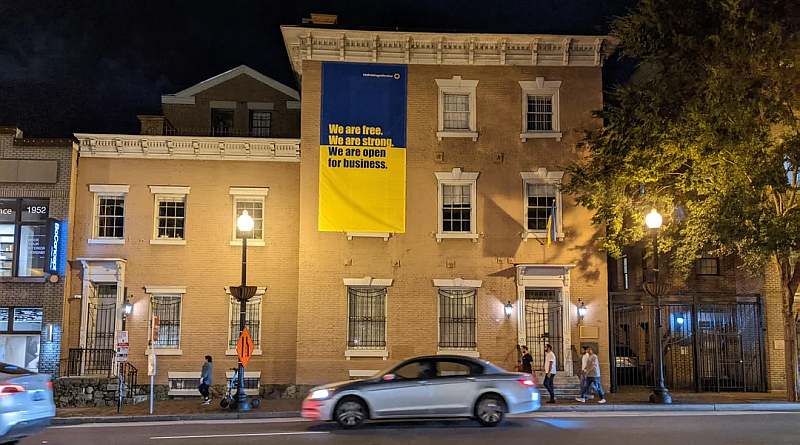
In the cover photo: Embassy of Ukraine in Washington, USA. Photo from open sources
